The original 7Hz Timeless helped turn planar-magnetic IEMs into mainstream recommendations. Its successor cannot win merely by being fast, detailed and affordable; a crowded field now does that too. It must solve the original model’s weaknesses without losing what made it matter.
The production Timeless II is more than a cosmetic refresh. Its 14.5mm dual-sided planar driver, revised magnetic structure, interchangeable nozzles, two-pin cable sockets and modular cable amount to a substantial redesign. The result is more physical through the bass, weightier through the middle and cleaner at the top than the original. It is also unusually configurable for a single-driver IEM.
The catch is anatomical, not electrical. The large circular shells still fit some ears beautifully and others awkwardly, while nozzle and tip selection can shift the balance from rich and expansive to sharp or spatially unnatural. At $229 USD, this is a highly capable planar IEM for listeners willing to spend ten minutes finding the right setup—not a universal blind buy.
Scorecard
Fast transients, strong separation and excellent treble extension; tuning varies materially by nozzle and fit
Light machined-metal shells, excellent modular cable and generous accessories; shell geometry remains divisive
Competitive performance and an unusually complete package at $229, though cheaper planars are formidable
Four nozzle pairs, 3.5mm/4.4mm plugs and broad genre compatibility; benefits from a capable dongle
Who it is for: listeners who want planar speed without anaemic bass; buyers who value tuning options; owners of a clean dongle or portable DAC/amp.
Who should skip it: small-ear buyers unable to audition; listeners sensitive to upper-mid or treble energy; anyone wanting warm dynamic-driver decay with zero setup fuss.
Verified specifications
| Specification | Published value |
|---|---|
| Driver | 14.5mm planar magnetic, dual-sided coated diaphragm |
| Impedance | 15.2Ω |
| Sensitivity | 108dB/V at 1kHz, approximately 90.4dB/mW |
| Claimed frequency range | 5Hz–40kHz |
| Connector | Flush 0.78mm two-pin |
| Cable termination | Modular 3.5mm single-ended and 4.4mm balanced |
| Weight | 5g per earpiece |
The sensitivity notation matters. 108dB/V is not 108dB/mW. Converted against the 15.2-ohm load, the Timeless II is closer to 90.4dB/mW. A decent phone dongle can drive it, but additional clean voltage and current headroom are more useful here than the headline number suggests.
Design and build: premium hardware, familiar geometry
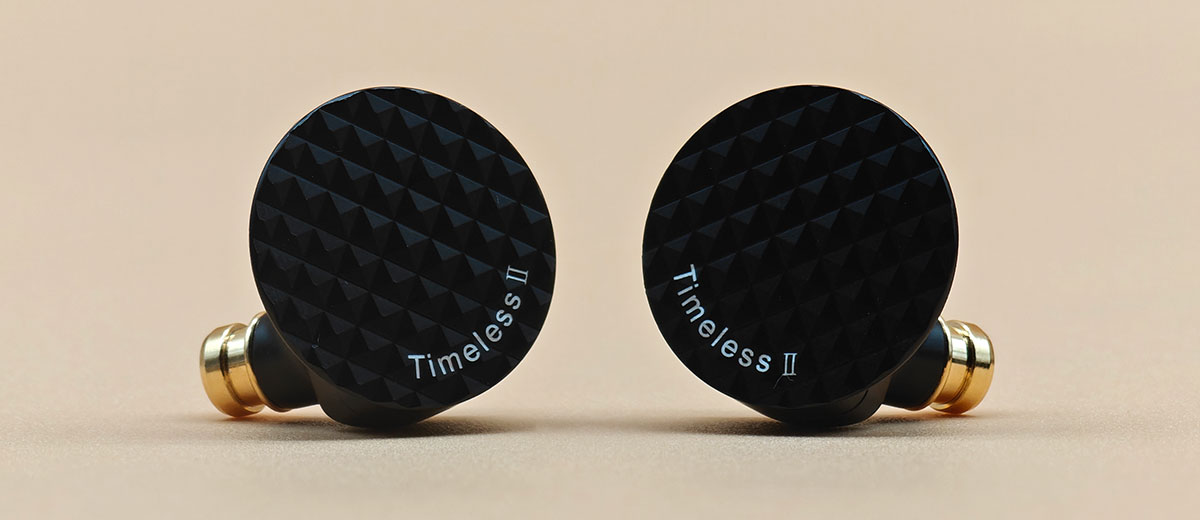
At five grams per earpiece, the Timeless II is lighter than its broad black discs suggest. The shell combines cast and CNC-machined aluminum, with clean finishing and a geometric faceplate that separates the second generation from the original’s concentric pattern. Four vents manage pressure around the large driver, though occasional diaphragm flex has still been reported when inserting the IEM too aggressively.
The connector change is welcome. Standard 0.78mm two-pin sockets replace the original Timeless’s MMCX arrangement, expanding aftermarket cable choice. The four-core copper cable ends in a modular system with 3.5mm and 4.4mm plugs. Four nozzle pairs, numerous silicone tips and a heavy aluminum case complete an unusually generous package.
The circular faceplate remains the deciding ergonomic variable. Larger ears may find the smooth inner shell comfortable for hours, while smaller conchas and narrow canals can struggle with the broad disc and chunky nozzle. Isolation is typical for a vented IEM rather than class-leading. Buy from a retailer with a sensible return policy if the original Timeless never sat properly in your ears.
Technical performance: speed with actual weight
Independent frequency-response measurements confirm that the nozzles alter more than the extreme treble. The standard or “flower” options change upper-mid output and the slope from sub-bass into the midrange, while the phase-plug-style dome nozzles show different upper-treble behaviour. That means published impressions that appear contradictory may both be accurate: seal, ear geometry and nozzle selection can produce meaningfully different balances.
Across those variations, the stable strengths are transient speed, separation and low-level resolution. Bass notes start and stop quickly without becoming sterile, and the Timeless II adds enough midbass punch to avoid the flat quality associated with weaker planar implementations. Dense arrangements remain orderly, with kick drum, bass guitar and synthesizer lines occupying distinct spaces.
Imaging is similarly strong, but “huge soundstage” is too simple. Some evaluations describe generous width; others hear moderate width with impressive depth and vertical layering. The safer conclusion is that the Timeless II organizes complex mixes exceptionally well for $229. Its stage is convincing because images are separated and stacked coherently, not because every recording expands beyond the head.
Sound character: four nozzles, one clear personality
The Timeless II’s basic character is energetic, clean and slightly analytical, supported by a more physical low end than the original. Sub-bass reaches deep, midbass has useful impact, and decay remains quicker than a typical dynamic driver. On electronic material such as Massive Attack’s Teardrop, that combination favours bass texture and rhythmic definition over lingering bloom. Bass-heavy listeners can push quantity further with the warmer nozzle options, though the result may become disproportionate on already elevated masters.
The midrange carries more body than the first Timeless, which helps male vocals, guitars and piano avoid sounding skeletal. Vocal placement is generally centred and clear. The principal disagreement concerns the upper mids: some patterns describe natural clarity, while others find female vocals and hard-edged recordings occasionally sharp. Tip depth and nozzle choice deserve attention before blaming the driver.
Treble extension is one of the Timeless II’s strongest traits. Cymbal decays and room cues remain present without the blunt roll-off found in darker rivals. The trade-off is honesty: sibilance already in a recording may be emphasized, and the most energetic combinations are not ideal for treble-sensitive listeners. Fleetwood Mac’s Dreams and well-recorded jazz reward the air and separation; aggressively mastered pop can expose the less forgiving side of the tuning.
The conventional flower-style nozzles are the safest starting point. The dome nozzles can increase apparent separation and alter tonal weight, but some assessments hear that effect as disjointed rather than spacious. Treat all four as tools, not upgrades: the best option is the one that produces a stable centre image and balanced vocals in your ears.
Comparisons and value
Against the LETSHUOER S12 2024 Edition, the Timeless II offers punchier midbass, stronger treble extension and better layering. The S12 counters with deeper sub-bass and a smoother top end. Choose 7Hz for clarity; choose LETSHUOER for rumble and relaxed treble.
The larger Hidizs MP145 is warmer and more relaxed. The Timeless II sounds quicker and more focused; the Hidizs suits listeners seeking easygoing weight.
The original 7Hz Timeless remains relevant when heavily discounted. The sequel brings cleaner extension, weightier mids, improved dynamics, two-pin sockets and tuning flexibility, but retains the same fit philosophy. Upgrade for refinement and accessories, not because the first generation is obsolete.
At the verified $223–$229 street range as of July 11, 2026, the Timeless II earns an 84 for value. Cheaper planars approach its resolution, but few combine it with four tuning options and such a complete cable package.
Pairing and everyday use
A competent USB-C dongle such as the FiiO KA13, iFi GO Link or Qudelix-5K provides enough power. The 4.4mm plug is useful when a source offers more balanced-output headroom, but balanced wiring is not inherently better. Warm or neutral sources are safer than aggressively bright pairings.
Isolation is adequate once sealed but not exceptional. For gaming and dense orchestral music, precise layering matters more than exaggerated width. Start with the conventional nozzle, select tips for comfort and seal, then change one variable at a time.
Verdict
The 7Hz Timeless II succeeds because it treats the original as a foundation rather than a relic. Bass has gained conviction, the midrange has gained weight, treble reaches cleanly upward, and the accessory package finally matches the ambition of the driver. Its 86/100 composite reflects a product that is technically accomplished, thoughtfully equipped and unusually adaptable.
It is not the effortless recommendation the original once was, partly because the competition is better and partly because the shell still asks your ears to cooperate. But when the fit works and the right nozzle is installed, the Timeless II delivers the speed people buy planars for without asking them to surrender bass impact. The sequel has learned new tricks; it just kept the same dress code.
MyHiFi weights Technical Performance at 30%, Value at 30%, Build Quality at 25% and Versatility at 15%. The resulting weighted composite is 86/100, in the Highly Recommended band.
Methodology
This assessment synthesizes seven sources across four evidence tiers: one independent frequency-response measurement set, five professional editorial assessments, low-weight reader sentiment exceeding 250 combined votes, and manufacturer specifications. Confidence level: Moderate-to-High because frequency-response and editorial coverage are strong, while standardized distortion testing and verified-owner long-term reliability evidence remain limited. MyHiFi did not perform hands-on testing of the 7Hz Timeless II.
Affiliate disclosure: MyHiFi may earn a commission from purchases made through affiliate links, at no additional cost to you. This does not influence our editorial decisions, scores or source selection.