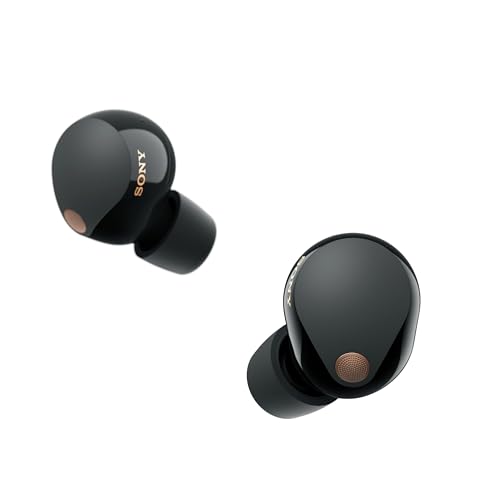
The Sony WF-1000XM5 is the premium true-wireless earbud to research first when the priority list includes effective noise cancellation, a compact case, useful app controls and support across multiple device brands. It does not dominate every specialist category. Instead, its evidence pattern is unusually complete: strong isolation and adaptive processing, LDAC for compatible Android sources, multipoint, adjustable sound, and hardware substantially smaller than Sony’s preceding flagship.
That breadth is the thesis. Galaxy owners can obtain tighter phone integration elsewhere, while sound-first buyers may prefer Sennheiser’s emphasis. Sony is the safer mixed-device choice because most of its value survives a phone change. The important qualification is fit. Its foam-style tips can support isolation but require more care than ordinary silicone, and a poor seal weakens bass, ANC and comfort at once.
Scorecard
• Technical Performance — 92/100: sophisticated ANC, capable microphones and DSP, adjustable tuning, LDAC and a strong overall acoustic system. • Value — 84/100: broad daily utility supports the flagship price, though wired IEMs offer more pure sound per dollar and discounts matter. • Build Quality — 86/100: compact, well-finished buds and case with IPX4 resistance; tip maintenance and touch controls temper the result. • Versatility — 90/100: multipoint, broad phone compatibility, ambient mode and extensive software make this an unusually adaptable daily earbud.
Who it is for—and who it is not for
The WF-1000XM5 is for commuters, frequent travelers, office listeners and mixed-device households seeking one premium earbud that can cover music, calls and concentration. It is especially relevant to Android users who can use LDAC, but AAC support keeps it practical with Apple devices. Buyers who value adjustable EQ and automation without committing to a single handset brand are central to its appeal.
It is not the obvious choice for listeners whose ears reject foam tips, runners requiring a stronger water-resistance rating, or iPhone owners seeking Apple-specific switching and spatial features. Call-heavy users in windy places should compare stem-based alternatives. Anyone listening primarily at home should also consider whether a wired IEM or over-ear headphone would provide better performance for the same money.
Verified specifications
Sony identifies an 8.4mm Dynamic Driver X in each earbud. Wireless support includes SBC, AAC and LDAC, with Bluetooth LE Audio support also listed. LDAC availability depends on the source device and settings; its presence should not be interpreted as automatic audible superiority. Connection stability, mastering, fit and tuning often matter more than codec branding.
The retained product page states up to eight hours of earbud playback with ANC enabled using AAC and a typical total of up to 24 hours with the charging case. Real duration varies with volume, codec, calls, processing and battery age. The buds carry an IPX4 splash-resistance rating, appropriate for sweat and light splashes but not immersion. Sony provides adaptive noise cancellation, an ambient mode and app-based control. These are verified product characteristics, not numerical claims about subjective ANC or sound quality.
The retained page lists a $299 MSRP. Its retailer button points to Sony’s product page rather than a product-specific Amazon listing, so the canonical affiliate field is marked for manual search rather than preserving an unverified marketplace destination.
Design, fit and everyday ownership
The XM5 generation reduces the bulk that made some earlier Sony flagship earbuds difficult for smaller ears. Smaller shells and a pocketable case materially improve daily ownership: an earbud that travels without requiring a bag is more likely to deliver value than one left at home. The smooth shell looks refined, although it offers less grip during removal than a textured body or stem.
Fit remains the decisive design variable. Sony’s foam-style tips compress before insertion and expand to form a seal. A stable seal supports passive attenuation, gives the ANC system a more predictable acoustic load and prevents bass leakage. The consequences are practical rather than mystical: a loose fit can make the same product seem thinner, noisier and less secure. Foam also collects wear, changes with age and may need replacement more frequently than silicone. Buyers should treat tip condition as routine maintenance.
Touch controls avoid moving parts and keep the shell clean, but they are less tactile than buttons or stem squeezes. Gloves, wet fingers and fit adjustments can produce friction. IPX4 is adequate for ordinary commuting and exercise caution, yet it trails products with stronger certified protection. Build quality is therefore good and appropriately premium without making the buds unusually rugged.
Features and connectivity
Sony’s companion software is a major part of the proposition. It provides equalization, ambient-sound adjustment, adaptive behavior and access to convenience features. Multipoint is valuable for users moving between a phone and laptop because it reduces manual repair cycles. Speak-to-Chat and location-aware automation can be useful, but automatic behaviors are only valuable when they match the owner’s routine; unwanted triggers can be disabled.
LDAC gives compatible Android users a higher-bitrate option than AAC or SBC, while iPhones remain on AAC. That asymmetry does not make the XM5 unsuitable for Apple hardware, but it removes one headline advantage. The more platform-neutral strengths—ANC, fit-dependent isolation, multipoint, EQ and compactness—remain available. This is why the Sony retains a broader audience than earbuds whose defining features require one phone family.
Microphone processing and call quality are serviceable for daily use, but the retained review identifies wind performance as a weakness relative to the best stem designs. A stem places microphones closer to the mouth and can provide a more favorable physical layout. DSP can mitigate environmental noise, not repeal microphone geometry or severe wind.
Technical and perceptual consequences
The XM5 works as an acoustic system rather than a driver operating alone. Tip seal determines leakage; microphones estimate external and internal conditions; ANC counters predictable low-frequency noise; DSP shapes the driver response; and the app lets the listener alter the result. That systems approach explains why driver diameter is a poor shortcut for performance.
ANC is most consequential on steady transit and HVAC noise. Reducing that mask allows listening at a lower level and makes quiet details easier to perceive without turning the earbud into a reference monitor. Ambient mode reverses the priority by admitting outside information for announcements and conversations. Neither mode can guarantee identical behavior across ears, environments or frequencies.
The small enclosure and active processing also impose limits. Battery state and firmware become part of ownership, microphones can be challenged by wind, and the product cannot operate like a simple passive wired IEM after its batteries expire. The score rewards the quality and breadth of Sony’s implementation while recognizing those category-wide dependencies.
Sound pattern
Published and retained descriptions converge on a full, smooth and adjustable presentation. Bass has enough weight to remain audible in transit without making the midrange disappear. Vocals are centered and intelligible, while treble avoids using a sharp peak as a substitute for detail. The result favors sustained daily listening over a spectacular first impression.
That pattern is not a numerical score for bass, treble or “soundstage.” Seal and ear geometry can substantially change perceived balance, and Sony’s EQ means the default curve is not permanent. LDAC may preserve more data under suitable conditions, but a secure seal and sensible EQ produce larger practical consequences for many listeners. Buyers wanting strict passive neutrality should consider wired alternatives; buyers wanting a forgiving, configurable travel tuning are better aligned with the XM5.
Rivals and comparison links
The Sony WF-1000XM5 vs Samsung Galaxy Buds3 Pro comparison frames the central platform decision. Samsung offers stronger Galaxy integration and an IP57 rating, while Sony carries its principal benefits more consistently across Android, iPhone and computers.
The Sony WF-1000XM5 vs Sennheiser Momentum True Wireless 4 comparison is about daily balance versus sound-first emphasis. Sennheiser provides deeper personalization and a more enthusiast-oriented identity; Sony is smaller and easier to recommend for commuting and mixed priorities.
AirPods Pro remain the natural ecosystem rival for iPhone owners because device switching and Apple-specific functions may outweigh codec flexibility. Wired IEMs are the disruptive alternative: they sacrifice ANC and wireless convenience but avoid battery aging and can deliver stronger sound value.
Value in July 2026
At its retained $299 MSRP, the XM5 is expensive but coherent. Its value comes from replacing several devices or use cases: commute isolation, office focus, casual calls and portable music. A listener using those functions daily can justify the premium more readily than someone who needs earbuds only occasionally. Because the model is mature by July 2026, live price, authorized-retailer status and warranty should be checked; this refresh does not assert a current street price.
Discounts strengthen the case, but replacement tips and eventual battery degradation belong in the ownership calculation. Sony’s platform neutrality also protects value when a user changes phone brands. Conversely, buyers committed to Galaxy or Apple may obtain more frictionless ecosystem behavior from the matching product.
Verdict
The Sony WF-1000XM5 earns its position through balance. Its compact hardware, effective acoustic system, broad software control, multipoint and platform reach create fewer caveats than most premium true-wireless rivals. Foam-tip maintenance, modest splash protection and merely competitive windy-call behavior prevent a universal recommendation, but the core proposition remains unusually resilient.
Composite Score: 88/100 (Highly Recommended)
• Technical Performance: 92/100 • Build Quality: 86/100 • Value: 84/100 • Versatility: 90/100
MyHiFi weights Technical Performance at 30%, Value at 30%, and Versatility at 15%, with Build Quality at 25%. The weighted result is 87.8, rounded to 88/100, within the Highly Recommended band.
Methodology
This assessment draws on verified manufacturer specifications and recurring evidence patterns in the retained published review. Confidence: high for design, connectivity and broad use-case positioning; moderate for fit-dependent performance, call behavior and long-term ownership. MyHiFi did not perform hands-on testing of the Sony WF-1000XM5. The historical source archive was not reconstructed.
MyHiFi may earn a commission from purchases made through affiliate links. This does not influence our editorial decisions or source selection.