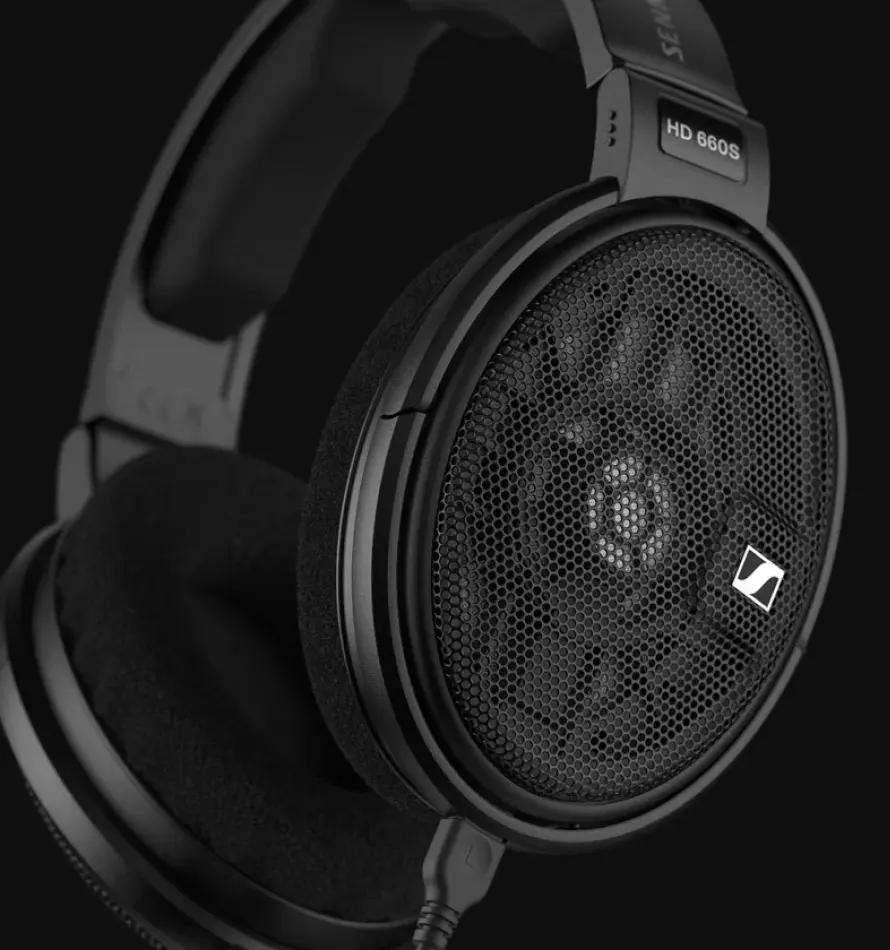
The original Sennheiser HD 660S is a 2017 open-back headphone that adapted the long-running HD 600-series formula for a lower 150-ohm impedance and a somewhat more immediate presentation. It has since been succeeded by the HD 660S2, making this review as much an availability and value assessment as a pure performance review. The product remains relevant for its natural midrange, low weight, replaceable wear parts and straightforward wired design, but it is not a modern all-purpose headphone.
The evidence supports a very good home-listening headphone with clear limits in sub-bass, spatial width, isolation and current retail certainty. Its strongest case is natural vocal presence and low physical weight, not spectacle or feature density.
Construction, fit and included connections
The HD 660S follows the familiar elliptical HD 600-family shape. Most visible structural parts are polymer, with metal mesh over the open ear cups and reinforcement in the headband. That material choice can feel modest beside metal-heavy planar headphones, but it keeps weight to about 260g and supports a design with a long record of serviceable parts. Pads, cables and headband cushioning can be replaced. Long-term ownership therefore depends less on cosmetic luxury and more on the continuing supply and price of those parts.
The velour pads are breathable and distribute contact around the ear. Clamp force is commonly reported as firm when new, especially for larger heads, while the lightweight chassis reduces pressure on the crown. Fit is personal and should be checked without assuming that bending the headband is risk-free. Pad wear also matters: compressed pads can change comfort, ear-to-driver distance and measured response, so an older or used pair may not represent factory tuning.
Sennheiser supplied detachable cables terminating in the company’s two-pin ear-cup connectors. Original packages included a 6.35mm cable, a 4.4mm balanced cable and an adapter, though bundles can differ by market and date. Buyers in 2026 should verify package contents rather than treating an old listing as definitive. A balanced cable does not inherently improve fidelity; it is useful when a source offers its suitable output only through 4.4mm or provides more voltage there.
Verified operating characteristics
The HD 660S uses a dynamic transducer in an open-back circumaural enclosure. Sennheiser specifies 150-ohm impedance, 104dB sound-pressure level at 1V and a 10Hz–41kHz frequency range under its stated convention. That broad frequency claim is not evidence of flat response to either limit. Independent response patterns are more informative: bass rolls away toward the lowest frequencies, the midrange is prominent and generally smooth, and upper-treble output is restrained compared with airier planar alternatives.
The 150-ohm load is easier to accommodate than the 300-ohm HD 600 and HD 650 in the sense that it requires less voltage for a comparable level. It still benefits from a source with adequate voltage swing and low noise. Many modern audio interfaces, dongles and desktop DAC/amps can drive it cleanly, but device capability should be checked rather than inferred from connector type. A powerful balanced amplifier is not mandatory.
Open construction means almost no acoustic isolation. Environmental sound reaches the listener, and music leaks into the room. This is a deliberate acoustic design, not a defect, but it confines the best use case to quiet private spaces. There is no microphone, wireless radio, active noise cancellation or onboard processing.
Sound evidence pattern
The HD 660S is most consistently praised for midrange timbre and vocal intelligibility. Published evaluations describe voices, guitars, piano and strings as present and well organized without the strongly scooped middle found in many consumer headphones. Compared with the warmer HD 650, the HD 660S pattern is slightly leaner and more immediate, with clearer leading edges. It is still recognizably part of the same family rather than a radical technical departure.
Bass has good pitch definition through the mid-bass, but measured roll-off limits deep sub-bass weight. Kick drums and bass guitar fundamentals remain legible; synthesized lows, organ and cinematic effects lack the physical foundation available from headphones with stronger extension. Equalization can add some low-frequency energy at sensible levels, but it cannot create unlimited excursion or transform the driver into a bass-focused design.
Treble is detailed enough to expose recording texture without adopting an overtly brilliant balance. Reports vary around the lower-treble region because fit, pad condition and individual hearing matter, but the common picture is livelier than the HD 650 while still smoother and less airy than some planar competitors. Buyers who equate elevated top-octave energy with resolution may find it subdued; treble-sensitive listeners may appreciate the restraint.
Spatial presentation is intimate. Imaging between left, center and right is orderly, and separation within small ensembles is a strength, but the perceived stage does not extend especially far beyond the head. That limits its appeal for listeners seeking a grand orchestral scale or maximally wide competitive-gaming cues. The same intimacy can benefit vocal and small-group recordings by keeping the central image stable and close.
Dynamics are competent rather than spectacular. The HD 660S communicates smaller changes in vocal phrasing well, while large impacts and deep-bass transients do not have the force of some planar or closed-back designs. This balance helps explain its durability as a recommendation: it prioritizes tonal continuity and long-session usability over a spectacular first impression.
Amplification and practical ownership
A quiet desktop DAC/amp with a sensible volume range is the straightforward partner. Output power specified only into 32 ohms is not enough information; voltage into 150 ohms is relevant here. Excess power offers no benefit once clean listening level and headroom are available. Tube amplifiers with high output impedance may alter frequency response and damping, so any tonal change should be understood as an electrical interaction rather than proof that the headphone “scales” universally with price.
The proprietary two-pin cable interface is secure but less convenient than a standard 3.5mm socket. Replacement availability partially offsets that limitation. The open mesh also leaves the driver less isolated from dust and moisture than a sealed portable design. Routine indoor use is appropriate; travel bags, rain and shared offices are not.
Rivals, availability and value
Launch MSRP was approximately $499. This review was refreshed in July 2026, after the HD 660S2 had become the current successor in many markets. No current new-stock price or authorized-retailer availability was independently verified. Remaining inventory and used examples should be judged against pad condition, included cables, warranty and the price of newer alternatives.
The Sennheiser HD 650/Drop HD 6XX remains the closest value rival. It offers a warmer, more relaxed balance and 300-ohm impedance, often at a lower price depending on region. It is an alternative flavor, not an automatically inferior predecessor. The Sennheiser HD 660S2 adds stronger low-frequency extension and a fuller balance, but may cost considerably more. The HiFiMAN Sundara offers a wider, airier planar presentation and stronger perceived extension; its fit, heavier structure and ownership considerations differ from the Sennheiser.
At a deep, warranty-backed discount, the HD 660S remains attractive. Near its original MSRP, the value case is weaker because the successor and strong planar competitors broaden the choice. Used pricing can be sensible only after budgeting for fresh genuine pads, since worn pads affect both comfort and tuning.
Who it is for—and who it is not for
The HD 660S is for listeners in a quiet room who prioritize natural vocals, midrange clarity, low weight and repairable wired hardware. It particularly suits acoustic, folk, jazz, classic rock and other material centered on voices and instruments rather than sub-bass effects.
It is not for commuting, shared offices, bass-heavy listening without EQ, wireless convenience or buyers seeking a very wide soundstage. It is also a questionable purchase at an inflated discontinued-product price. Owners already satisfied with an HD 600 or HD 650 should treat it as a tuning alternative, not a compulsory upgrade.
Verdict
The HD 660S is a mature variation on a proven platform. Its excellent midrange organization, manageable load, light chassis and replaceable parts remain meaningful. Limited sub-bass, narrow staging and open-back impracticality are structural compromises, while discontinued-market pricing determines whether it is still a smart buy.
Composite Score: 81/100 (Highly Recommended)
• Technical Performance: 86/100 • Build Quality: 84/100 • Value: 78/100 • Versatility: 72/100
MyHiFi weights Technical Performance at 30%, Value at 30%, Build Quality at 25% and Versatility at 15%. The weighted result is 81.0/100, within the Highly Recommended band.
Methodology
This assessment draws on verified manufacturer specifications, published measurements and recurring patterns in professional evaluations. Confidence: High for design, impedance and tonal tendencies; moderate for discontinued-market value and long-term ownership. MyHiFi did not perform hands-on testing of the Sennheiser HD 660S. The historical source archive was not reconstructed.
MyHiFi may earn a commission from purchases made through affiliate links. This does not influence our editorial decisions or source selection.