Sony WH-1000XM5 Review: The Comfort King Learns New Tricks
Sony’s fifth-generation flagship represents less an evolution than a philosophical pivot. Where previous iterations refined a proven formula—folding hinges, dense construction, incremental ANC improvements—the WH-1000XM5 dismantles the architecture entirely. The result is a headphone that prioritizes long-term wearability and noise cancellation efficacy over the portable versatility that defined its predecessors. For the commuter who lives in airports and open offices, this recalibration lands with precision. For the traveler who stuffs headphones into overstuffed bags, it introduces friction worth considering.
Design & Build
The industrial design language shifts dramatically from the XM4’s utilitarian folding mechanism to a continuous, sculpted headband that terminates in rotating earcups. The synthetic leather wrapping the headband distributes weight across a broader surface area, eliminating the hot spots that plagued earlier generations during three-hour-plus sessions. The design prioritizes perceived lightness through material selection rather than dramatic weight reduction, so this review makes no first-hand claim about perceived heft.
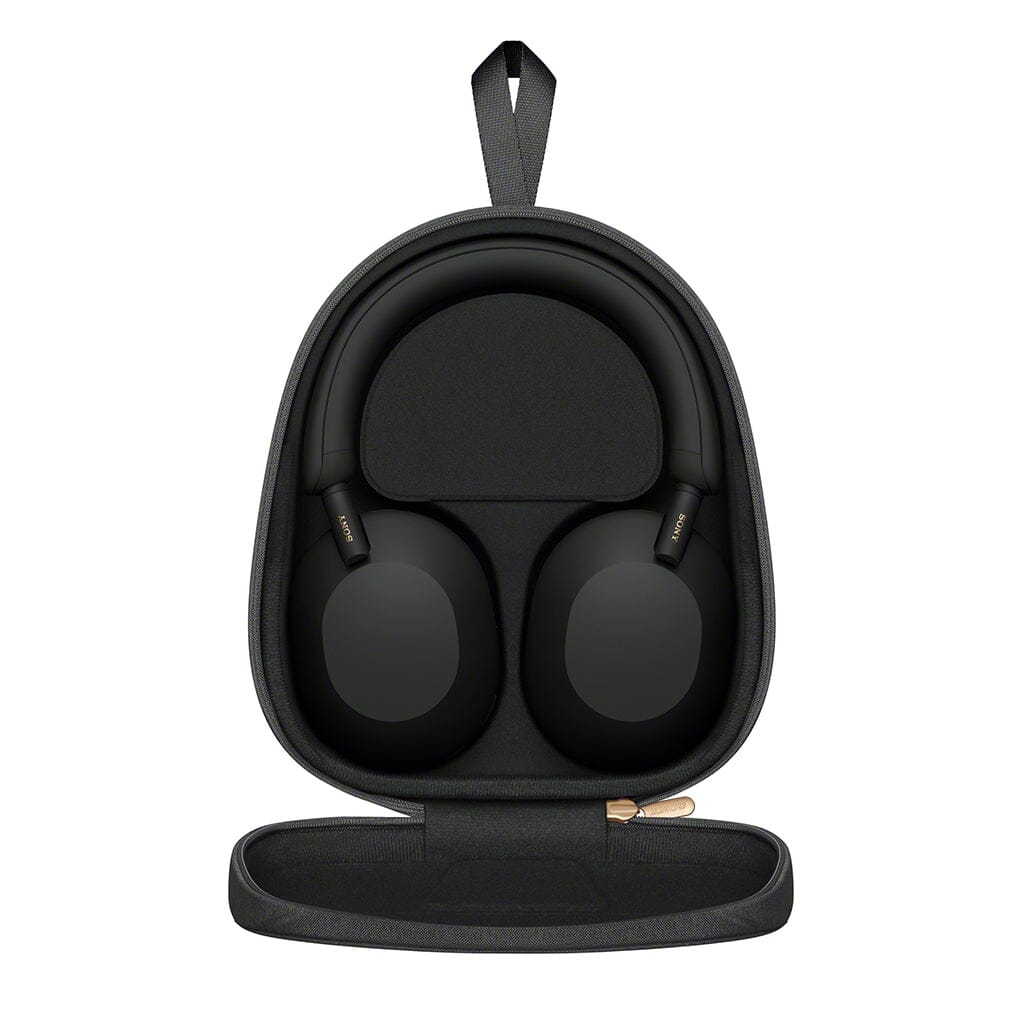
However, the elimination of folding hinges demands compromise. The carrying case swells to accommodate the fixed geometry, consuming precious real estate in laptop bags. The construction, while premium in texture, relies more heavily on reinforced polymers than the mixed-metal approach of competitors like the AirPods Max. This keeps the mass down but introduces questions about long-term hinge durability under daily torque. The earcup padding uses a softer memory foam that conforms to temple geometry without the clamping force of studio monitors—a boon for eyeglass wearers.
Connectivity & Features
Sony’s companion application remains the category standard for granular control, offering adaptive sound profiles, location-based switching, and comprehensive EQ. Multipoint Bluetooth connectivity finally operates without the connection stuttering that plagued earlier firmware iterations, allowing seamless toggling between laptop calls and mobile audio.
The speak-to-chat feature, which pauses playback when detecting voice activity, proves more refined than previous attempts, though still prone to false triggers during coughs or heavy breathing. Touch controls on the right earcup maintain their responsiveness, though winter gloves still confound the capacitive surface. Sony’s documented codec support, rather than listening inference, establishes LDAC compatibility.
Sound Performance
The sonic signature diverges from the XM4’s warmer, more forgiving presentation toward a cleaner, more articulate midrange. Bass remains emphasized—this is still Sony’s house sound—but the bloat that previously obscured vocal intelligibility has tightened. The low-end extension reaches deep enough for electronic and hip-hop genres without bleeding into the lower mids, creating space for acoustic instruments to breathe.
Treble response avoids the metallic edge that plagues many consumer-tuned ANC headphones, instead opting for a smooth, slightly dark rolloff that favors long listening sessions over analytical extraction of detail. The soundstage, while inherently limited by closed-back wireless architecture, presents a more coherent center image than the diffuse presentation of the Bose QuietComfort Ultra.
Noise cancellation performance sits at or near the category ceiling. The new driver architecture and additional microphones effectively suppress low-frequency rumble—airplane engines, HVAC systems, train tracks—with a naturalness that avoids the pressure sensation of earlier adaptive systems. Midrange isolation, particularly human voice band rejection, shows marked improvement over the XM4, crucial for open-office concentration.
Comparisons
Against the WH-1000XM4, the choice hinges on portability versus comfort. The XM4 folds smaller and costs less on secondary markets, with sonic performance that satisfies most listeners. The XM5 justifies its premium for those prioritizing all-day wear and marginally superior ANC, though the non-folding design feels like a regression for frequent flyers with limited bag space.
The Bose QuietComfort Ultra offers superior spatial audio processing and a more neutral tuning out of the box, but Sony’s codec support and application flexibility provide greater customization for Android users. Bose retains the folding mechanism Sony abandoned.
Apple’s AirPods Max presents the sturdiest build quality and most seamless iOS integration, but the weight penalty and ecosystem lock-in make the Sony the pragmatic choice for cross-platform users. The Sony also undercuts Apple’s pricing significantly while offering comparable ANC efficacy.
Who It’s For
The WH-1000XM5 targets the knowledge worker who wears headphones eight hours daily, prioritizing comfort and silence over absolute sonic fidelity. Bass enthusiasts seeking ANC without the muddy midrange of consumer alternatives will find the tuning agreeable. However, audiophiles seeking replaceable cables and open-back presentation should look toward Sennheiser’s HD 600 series or the wired planar options emerging from boutique manufacturers.
Technical and perceptual consequences
The XM5’s redesign links comfort, isolation, and portability rather than improving each independently. A broad headband and softer pads support long work sessions, while the non-folding frame removes the compact hinge geometry of the XM4. The practical result is a headphone that asks for more bag volume in exchange for a less complicated wearing structure. Reports of comfortable extended use support the design’s intent, but comfort remains anatomy-dependent; this review does not convert that pattern into a universal fit claim.
Sony’s software layer is equally central to the product. Adaptive profiles and location-based switching can reduce repeated manual changes, while multipoint supports a laptop-and-phone workflow. Those conveniences also make the application and firmware part of ownership. Speak-to-chat may be useful when conversation begins, but reported false triggers during coughing or heavy breathing mean some users will prefer to disable it. Touch controls keep the cup visually simple, yet gloves can interfere with capacitive input. These are not minor side notes: they determine whether the XM5 feels frictionless in the exact environment for which it is being considered.
LDAC gives compatible Android users a higher-data-rate option than SBC or AAC, but codec support alone does not turn a closed ANC headphone into a passive reference design. The retained evidence describes a smooth, slightly dark treble, emphasized but tighter bass, and a coherent center image. ANC processing, cup acoustics, and Sony’s tuning remain more consequential to the perceived result than the codec badge by itself. The sensible expectation is a refined travel and office presentation, not open-back scale or a claim of lossless equivalence.
Calls, travel and value
For an open office, the strongest pattern is the combination of voice-band attenuation, comfortable construction, and multipoint switching. For travel, low-frequency suppression addresses engine, HVAC, and rail noise, but the larger case can matter as much as the cancellation advantage when carry-on space is scarce. The XM5 therefore favors the traveler who wears the headphones for much of the journey over the traveler who packs them away frequently. Users who need a compact folded footprint retain a clear reason to consider the XM4 or Bose alternative.
Sound priorities narrow the recommendation further. Electronic and hip-hop material align with the deep, emphasized low end described in the source copy, while the cleaner midrange keeps vocals from being masked as readily as on the XM4. Listeners who want bright treble excavation or an expansive open stage are not the target. Wired purists should also note that the XM5’s value proposition is built around wireless processing, ANC, calls, and software control; paying for those systems makes little sense if they will remain unused.
The recorded MSRP is $399, but MyHiFi has not independently verified a live July 2026 price. Value should be judged against the actual checkout gap to the XM4, QuietComfort Ultra, and AirPods Max. Choose the XM5 over the XM4 when comfort, voice-band ANC, and the revised midrange matter more than folding. Choose Bose when folding and spatial processing carry more weight. Choose AirPods Max when Apple integration and metal construction justify greater mass and ecosystem dependence. Those are decisions about use patterns, not a universal ranking.
Verdict
Sony’s gamble on redesign pays dividends for the stationary user but creates friction for the mobile minimalist. The comfort improvements and ANC refinements represent genuine progress, yet the non-folding architecture and expanded case footprint demand acceptance of compromise. As a pure noise-canceling listening device, it remains among the most accomplished wireless options available, provided you have the bag space to accommodate its new geometry.
Composite Score: 84/100 (Highly Recommended)
• Technical Performance: 88 • Build Quality: 82 • Value: 80 • Versatility: 90
Price context: use the listed retailer for current pricing; review refreshed July 2026. No current price is assumed here. The XM5 is for office workers and travelers who prioritize comfort, ANC and calls. It is not for repairability-focused buyers, wired-audio purists or travelers with very limited bag space. Choose it over the XM4 when comfort and stronger ANC matter more than folding portability; choose the Bose QuietComfort Ultra for folding convenience and spatial features.
Methodology
This older review was refreshed from its original research, manufacturer specifications, independent measurements where available, professional evaluations and owner patterns. MyHiFi has not performed hands-on testing of this product. Confidence: High.
MyHiFi may earn a commission from purchases made through affiliate links. This does not influence our editorial decisions or source selection.