
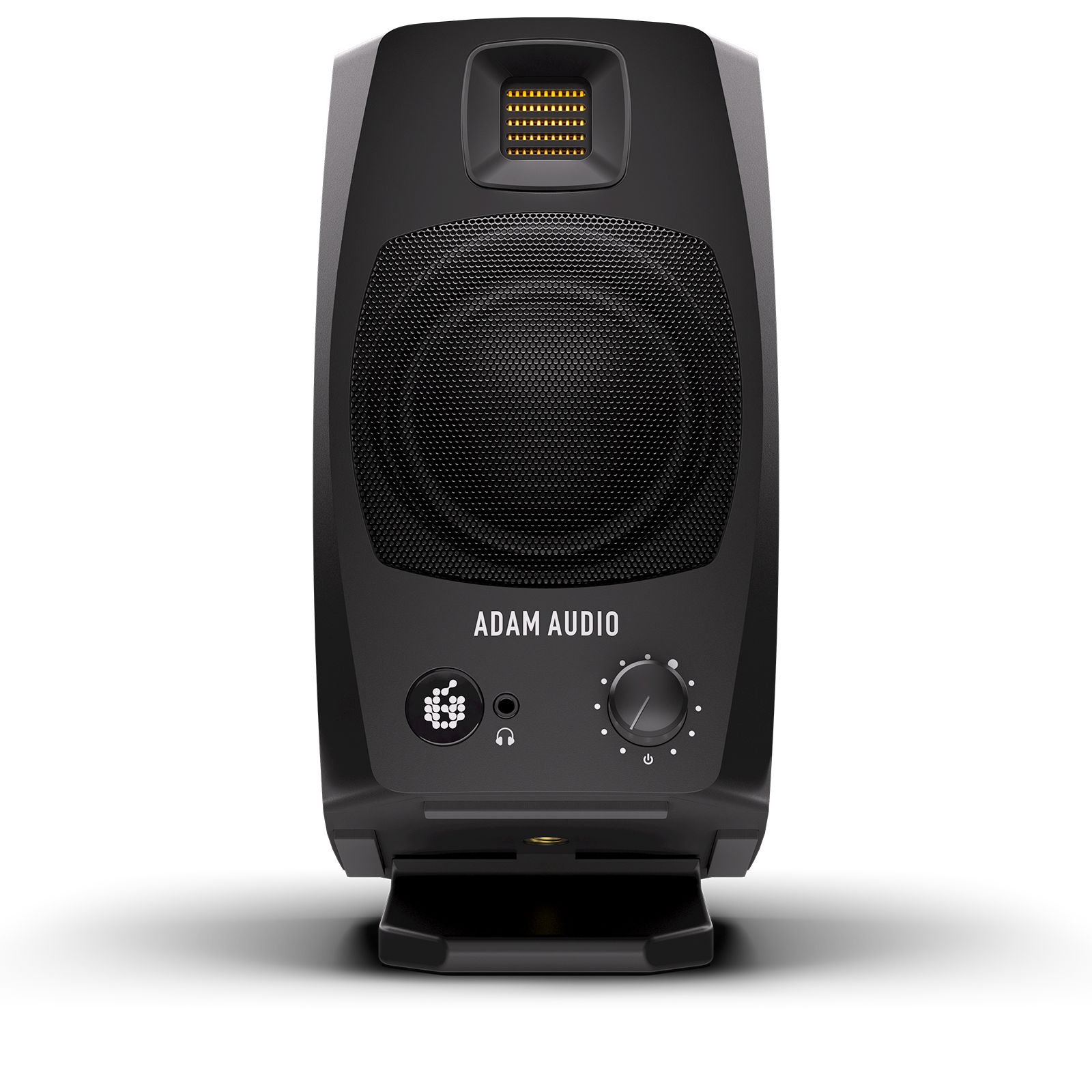
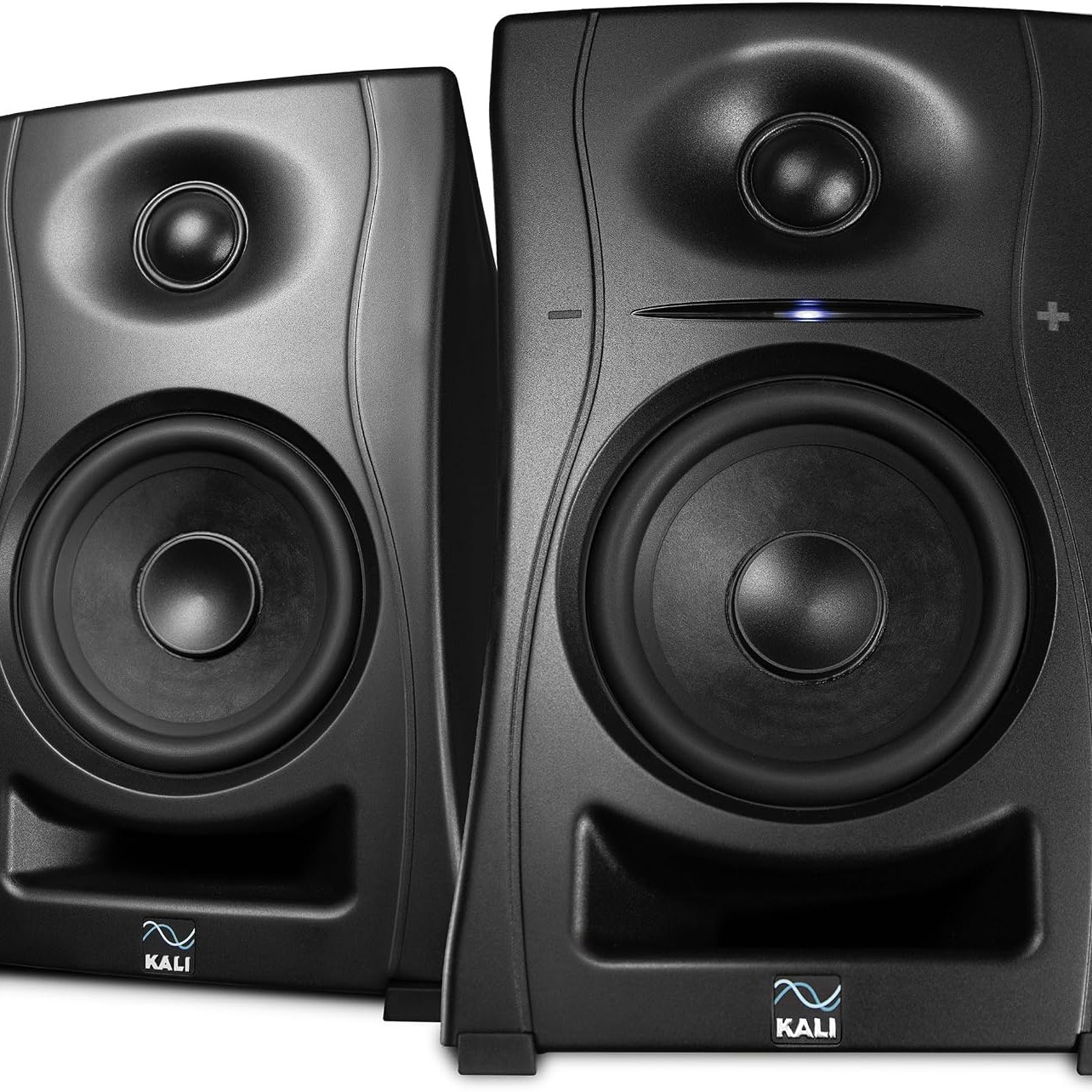
One-line verdict: choose D3V when the monitor must disappear beside a laptop without sacrificing tonal accuracy or physical control; choose LP-UNF when slightly larger cabinets are acceptable in exchange for more bass, output, inputs and value.
The shared score hides two different priorities
ADAM Audio D3V and Kali Audio LP-UNF both earn 87/100 and a Highly Recommended rating. That tie is useful because it stops a simplistic ranking from deciding the purchase. D3V scores higher for technical performance and build/usability. LP-UNF scores higher for value and versatility. The weighted totals converge even though the products make different compromises.
D3V is the more concentrated design. Its 3.5-inch aluminum woofers, side passive radiators, folded-ribbon tweeters, balanced inputs and USB connection fit into cabinets only 200 mm tall before the stands. LP-UNF moves to a 4.5-inch woofer, textile-dome tweeter and front port in a 254 mm cabinet. That extra volume buys useful low-frequency and output advantages while leaving room in the budget for Bluetooth and RCA.
Neither is a room-filling monitor. Both are active DSP-based pairs designed around an approximately 0.8–1.0 metre listening distance. The right question is not which one replaces a six-inch monitor across a living room. It is which set of desktop boundaries creates fewer compromises in front of one listener.
Measurements: D3V wins linearity, LP-UNF wins physical headroom
D3V's measured response stays within roughly ±2 dB and remains clean through the midrange, with useful extension to around 50 Hz before a steep roll-off. Horizontal dispersion is controlled and stereo localization is precise when the tweeters are aligned correctly. A mild presence rise above 4 kHz can become more apparent as room contribution increases, but ordinary nearfield behavior is notably disciplined.
LP-UNF also measures well on-axis, with controlled directivity from its waveguide. Its narrow dip near 200 Hz is an intentional cabinet-resonance mitigation filter, not evidence of a broken sample. The trade is slightly less midrange linearity than D3V, offset by a larger woofer and cabinet that sustain more energy at the edges of the operating range.
A direct exact-model comparison found LP-UNF roughly 2 dB louder and 2–3 dB deeper. That is more useful than comparing marketing wattage: D3V publishes 200 W summed RMS for the pair, while LP-UNF uses 40 W for each high- and low-frequency section, 160 W total. Amplifier totals do not predict maximum clean output across different drivers, protection strategies and measurement conditions.
Bass: compare usable shape, not incompatible frequency numbers
LP-UNF publishes 39 Hz at −10 dB and 54 Hz within ±3 dB. D3V publishes 48 Hz at −3 dB and 45 Hz at −6 dB. Those headline figures use different tolerances, so placing 39 beside 48 and declaring an easy winner would be misleading. The more comparable evidence is the measured response shape and direct comparison.
D3V remains flat to roughly 50 Hz, then protects itself with a steep roll-off. Its passive radiators provide impressive size-relative bass, but deep electronic notes and film effects disappear rather than remaining with reduced authority. LP-UNF carries more usable weight into the low bass and maintains more headroom, which makes it sound less miniature at the same desk distance.
Neither product provides a subwoofer output or built-in high-pass filter. Adding a sub therefore requires external routing, an interface with bass management or a subwoofer that can accept and pass through the signal. Buyers already planning a properly integrated sub can choose D3V for its smaller footprint and linearity. Buyers who want the strongest standalone low end should choose LP-UNF.
Output and distance: Kali has the advantage, but both stay nearfield
D3V remains clean at ordinary nearfield levels, then compression and distortion rise above approximately 89–90 dB at one metre. High-demand sweeps recorded 6–7 dB of compression. The published 94 dB RMS and 97 dB peak figures use short bursts and do not describe continuous full-range music at couch distance.
LP-UNF measured around 91 dB at one metre in a test that exceeded its intended 0.8 metre geometry. It has enough transient headroom for focused desktop listening and the direct comparison confirms a modest output lead. That lead matters for bass-heavy work or listeners who occasionally turn up the desk, but it does not convert LP-UNF into a monitor for a room full of people.
At the intended distance, both can support editing, production and attentive listening. Move much farther away and both surrender headroom to larger models. A buyer deciding between these and a six-inch monitor should first decide whether the desk or the room is the actual listening environment.
Desk fit and listening window
D3V is substantially easier to place. Each cabinet is 115 mm wide and 150 mm deep, compared with LP-UNF at 164 mm wide and 186 mm deep. D3V includes padded 15-degree stands and adhesive pads, plus a 3/8-inch mounting point. The stands raise total height to about 240 mm but reduce the need to buy separate isolation or tilt hardware.
The catch is vertical directivity. D3V's folded-ribbon tweeter has a narrow vertical listening window, so ear height matters. If the supplied angle misses the listener, adjustable stands may still be necessary. Horizontal behavior is much more forgiving.
LP-UNF's waveguide gives it the more forgiving horizontal and vertical pattern in direct comparison, but its best stereo image still assumes a roughly 0.8 metre equilateral triangle. It is more tolerant than D3V of small vertical movement, not a wide-area party speaker. Its front port also makes wall-adjacent placement easier to manage, while the larger cabinet demands more physical desk area.
Placement DSP: useful controls, not room correction
D3V provides three-position Position, Desk and Room switches. They adjust bass for stand, wall or corner placement, reduce low-mid desk interaction and trim treble for reflective rooms. These are fixed filters. They do not measure the room, correct narrow resonances or replace careful positioning.
LP-UNF provides seven published boundary configurations plus separate ±2 dB low- and high-frequency trim. Its settings cover common stand, desk, wall and console placements, and measurements confirm the switches change response as intended. The separate trims make broad tonal adjustment straightforward.
Kali wins for the number and clarity of placement combinations. ADAM counters with included tilt hardware and a more compact physical problem to solve. On either product, start with geometry and tweeter height, then use the switches for broad boundary effects rather than trying to fix every room issue.
USB, analog, Bluetooth and headphone use
Both accept USB-C audio directly from a computer, phone or tablet, but the published paths differ. D3V currently lists 16-bit USB input with 48 kHz internal processing. LP-UNF accepts 24-bit/48 kHz USB. Those bit-depth differences are unlikely to decide audibility at the noise and output limits of compact speakers, but LP-UNF has the more conventional modern specification.
D3V adds two balanced 6.35 mm analog inputs and accepts unbalanced TS. Its physical front encoder switches USB and analog sources, controls volume, mutes, enters standby and swaps the primary speaker's left/right assignment. USB and analog can remain attached but cannot be mixed.
LP-UNF accepts balanced TRS, unbalanced RCA, USB-C and Bluetooth 5.1. That breadth makes it easier to combine an interface, computer, consumer source and phone without adapters. Its front capacitive controls cover volume, mute and Bluetooth pairing. Recurring reports include occasional touch-control inconsistency, while D3V's physical encoder is the stronger everyday interface.
D3V alone includes a front 3.5 mm headphone socket, which automatically mutes the speakers. Its published 32-ohm output impedance and unspecified power mean it should be treated as convenience rather than a proven replacement for a dedicated headphone amplifier. LP-UNF has no headphone output at all.
Construction, cabling and ownership details
D3V uses dense PC-ABS cabinets rather than traditional MDF. LP-UNF uses MDF with a matte finish. Neither material choice creates an automatic sound-quality verdict because both products rely on DSP, active crossovers and cabinet-specific engineering.
Both centralize electronics in one primary speaker and tether the secondary speaker with a supplied cable. D3V's two-metre link reduces clutter but prevents independent operation. LP-UNF's four-conductor cable carries signal and power; recurring reports criticize its thin feel and lack of a positive locking click.
D3V provides black or white finishes, threaded mounting, the included stands and a two-year warranty extendable to five years after registration. LP-UNF offers black, white, Mojave Red and Pacific Blue. Its larger color range and MDF finish suit buyers who want the speakers to be visible; D3V is easier to make physically disappear.
Value and Canadian context — July 2026
D3V was available for US$349.99 and approximately C$419–429.99 per pair in mid-July 2026. The price includes amplification, USB playback, balanced inputs, tilt stands, mounting points, a front encoder and the convenience headphone path. It costs more because compact packaging and the D-ART tweeter are part of the proposition, not because it plays louder.
LP-UNF was US$274–299 per pair in the same period. At that price it includes bi-amplification, USB-C, Bluetooth, balanced TRS, RCA, multiple boundary presets and stronger standalone bass. That combination earns its 93/100 value score and makes it the default recommendation when desk space is available.
The price gap is not enormous, so do not buy solely by saving US$50–75. D3V can avoid the cost of separate tilt stands and provides better physical control. LP-UNF can avoid an RCA adapter or Bluetooth receiver and is less likely to prompt an immediate desire for more bass. Count the accessories and sources the actual desk requires.
ADAM Audio D3V
- The smallest footprint is a hard requirement.
- Midrange linearity and precise on-axis work lead the purchase.
- A physical encoder is preferable to touch controls.
- Included tilt stands, mounting and headphone convenience matter.
Kali Audio LP-UNF
- Standalone bass and modest extra output matter most.
- Bluetooth, RCA and balanced analog must coexist.
- Your ear height or position varies more at the desk.
- You want the strongest capability per dollar.
Final buying advice
Buy ADAM Audio D3V for a tightly constrained production desk where each speaker must fit beside a display or laptop and the listener stays in a precise arm's-reach position. Its strong measured linearity, focused imaging, included stands, physical front control and headphone convenience form a coherent compact tool. Accept that it gives up deep bass, maximum output, Bluetooth, RCA and vertical tolerance.
Buy Kali Audio LP-UNF for the more flexible all-purpose desktop. It occupies more space and its touch controls and interconnect are less convincing, but it reaches deeper, plays somewhat louder, accepts more sources and costs less. It is the better default for music listening and mixed-source desks; D3V is the more specialized answer when compact precision is the priority.
For the full evidence behind each product, read the ADAM Audio D3V review and Kali Audio LP-UNF review.
MyHiFi may earn a commission from purchases made through affiliate links. This does not influence our editorial decisions or source selection.