Small studio monitors usually force a choice between computer-speaker convenience and professional accuracy. The ADAM Audio D3V tries to combine both.
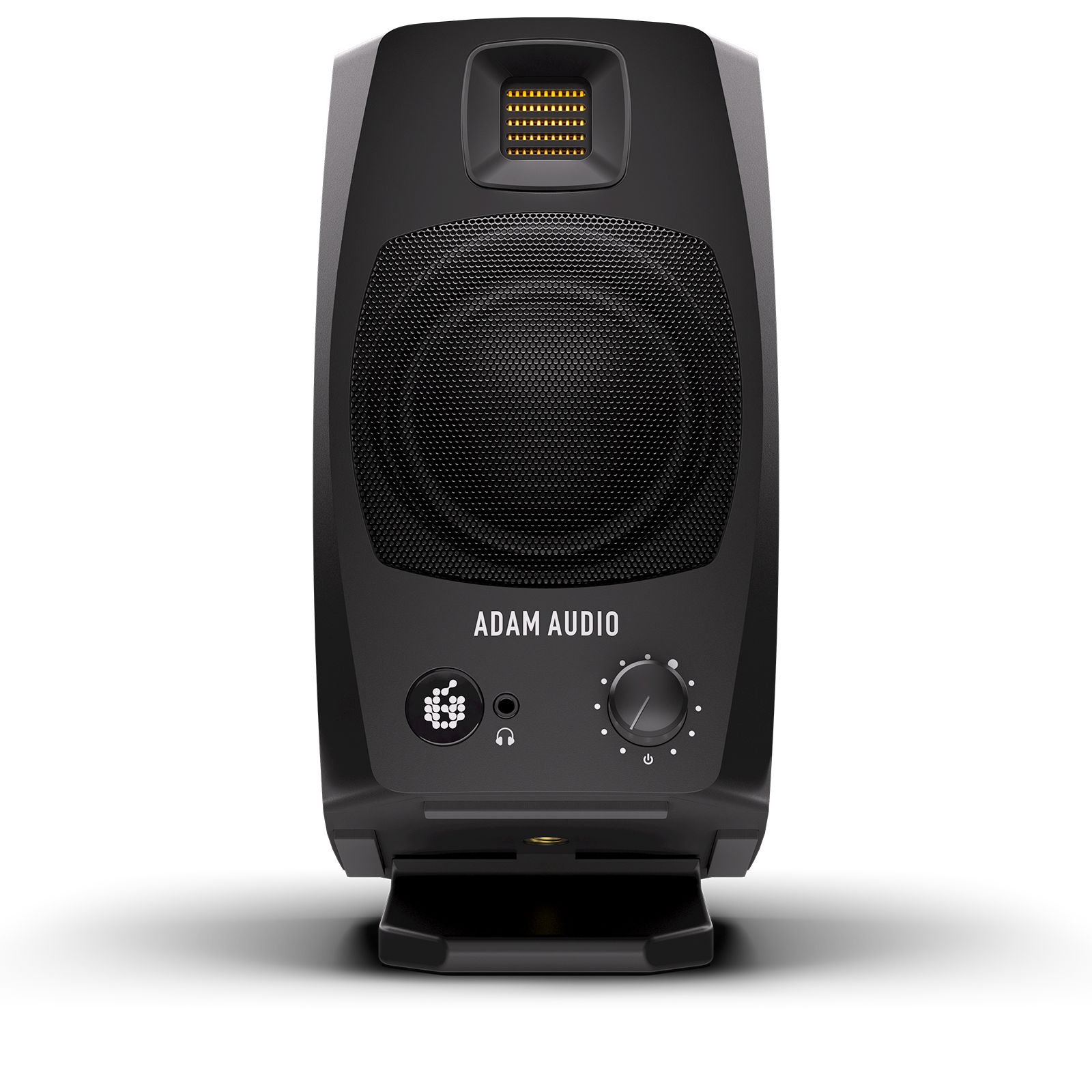
For US$349.99 per pair, it provides 3.5-inch aluminum woofers, four passive radiators, folded-ribbon tweeters, 200 W of summed RMS amplification, USB-C, balanced analog inputs, a headphone socket and placement filters. Supplied 15-degree stands help aim the tweeters without extra hardware.
Independent measurements support the monitor claim: response remains within roughly ±2 dB and reaches about 50 Hz before rolling off sharply. Horizontal dispersion and midrange linearity are strong. Physics returns at higher levels, where compression rises above approximately 89–90 dB at one metre; the vertical listening window is also narrow.
Scorecard
Approximately ±2 dB response, useful 50Hz extension and controlled horizontal dispersion; narrow vertical window and limited full-range output
Solid compact cabinets, included stands, front control and flexible mounting; plastic construction and one-primary-speaker topology
Measured monitor accuracy, USB playback and amplification for US$349.99 per pair
USB-C, balanced analog, headphone output and placement DSP; no Bluetooth, sub output, RCA input or automatic correction
Who it is for: musicians, editors and listeners working within roughly one metre; small desks where an interface and separate stands add unwanted clutter; buyers prioritizing tonal accuracy and stereo focus over party-level output; creators who need USB and analog sources connected simultaneously.
Who should skip it: anyone filling a larger room, monitoring bass-heavy work without a subwoofer, requiring Bluetooth or HDMI, or expecting the headphone output to replace a measured dedicated amplifier. Listeners who move vertically or share the desk with another person should also consider a speaker with wider vertical tolerance.
Verified specifications
| Specification | Published or independently measured value |
|---|---|
| Architecture | Fully active DSP-based two-way stereo pair |
| Drivers per speaker | 3.5-inch aluminum woofer, two 3.5-inch passive radiators, D-ART AMT tweeter |
| Amplification | 200 W summed RMS / 240 W summed peak for the pair |
| Crossover | 4 kHz DSP crossover |
| Official frequency response | 48 Hz–22.6 kHz −3 dB; 45 Hz–23.2 kHz −6 dB |
| Measured response | Approximately ±2 dB; flat to roughly 50 Hz before steep roll-off |
| Analog inputs | Two balanced 6.35mm TRS; unbalanced TS accepted |
| USB | USB-C Audio Class 1.1, published 16-bit input, 48kHz internal rate |
| Headphone output | Front 3.5mm; published 32Ω output impedance; power not specified |
| Placement controls | Three-position Position, Desk and Room DSP switches |
| Dimensions | 200 × 115 × 150mm per cabinet; 240mm high on stand |
| Weight | 3.58kg for the pair, excluding feet |
| Warranty | Two years plus three additional years after registration |
Design and setup: compact by intent, not by accident
Each cabinet is 200mm tall before adding the stand. A 3.5-inch woofer sits below the D-ART tweeter, with passive radiators on both sides. Those radiators extend bass without a rear port but need at least 10cm of clearance.
The PC-ABS enclosures feel dense and well assembled, if less traditional than MDF studio monitors. Black and white versions are identical technically. Each has a 3/8-inch mount; the padded supports angle upward by 15 degrees, while six adhesive pads allow flat placement.
The primary cabinet receives power, USB-C and both analog channels, then feeds the second through a supplied two-metre cable. A triple press swaps channels, allowing the primary speaker on either side. This reduces clutter but prevents independent operation.
The front encoder handles volume, source selection, mute, standby and channel swap. A headphone plug mutes the speakers. Automatic standby begins after roughly 20 minutes and can be disabled on firmware 1.7 or later.
USB, analog and headphone use
USB-C lets a laptop, tablet or phone feed the D3V without an interface. The supplied cable and USB-A adapter cover common computers, but USB carries audio only; the external power brick remains mandatory.
The current specification lists 16-bit USB input and 48kHz internal processing. That is adequate for this speaker's practical dynamic range, if modest by modern interface standards. Balanced 6.35mm inputs pass through a 24-bit analog-to-digital stage so DSP remains active. Unbalanced TS works; RCA needs adapters.
USB and analog sources can stay connected and be selected from the front, but cannot be mixed. Bluetooth, streaming, HDMI ARC and a subwoofer output are absent.
The 3.5mm headphone socket is convenient but uncharacterized. Its published 32-ohm output impedance may alter some low-impedance headphones, while power and supported loads are unspecified. With no independent electrical data or useful owner consensus, treat it as a convenience output rather than a dedicated amplifier replacement.
Placement controls: useful shelves, not room correction
Three rear switches address Position, Desk and Room, each with three presets. Position shelves bass for stand, wall or corner placement; Desk reduces low-mid energy for small or large surfaces; Room attenuates treble in reflective spaces.
These are fixed filters, not automated correction. Different reviewers preferred different desk settings, and the strongest cut removed too much vocal body in one setup. Treat the labels as starting points.
Vertical alignment matters more. Directivity data shows a narrow window around the tweeter, so adjustable stands may be necessary when the supplied supports miss ear height. Horizontally, usable response extends approximately 60 degrees either side.
What the measurements mean
At ordinary nearfield levels, response stays within roughly ±2 dB, with clean midrange and useful bass to around 50 Hz. A mild rise above 4 kHz adds presence; farther away, room reflections can make 4–6kHz sound brighter.
The radiators improve extension without making the enclosure full-range. Output falls steeply below 50 Hz and low-frequency headroom declines below roughly 120 Hz. Deep electronic bass and film effects need a subwoofer or headphones, yet adding a sub requires external routing because there is no sub output or high-pass filter.
Distortion remains low around 76–86 dB at one metre, then rises as protection compresses peaks. Demanding tests recorded 6–7 dB of compression. The published 94 dB RMS/97 dB peak figures use very short sine bursts averaged from 100 Hz to 6 kHz at 3% distortion, so they do not contradict the lower full-range ceiling.
At the intended distance near 0.8m, output is sufficient for editing, mixing and focused listening. It is not designed for couch-distance playback or a room full of people.
Sound character: clear nearfield balance with two boundaries
Clarity is the strongest consensus. Voices, guitars and percussion separate cleanly, while the folded-ribbon tweeter resolves transients without the coarse edge common to inexpensive desktop speakers. Stereo localization is precise on-axis; depth is less consistently impressive than width.
Bass is fast and substantial for the cabinet volume, but the lowest notes disappear rather than merely losing authority. Size-relative praise is not sub-bass capability.
Treble is disputed. Several nearfield evaluations found it detailed and non-fatiguing; standardized data found extra 4–6kHz energy, especially with more room contribution. Another treated-room comparison heard softer transients than larger monitors. Distance, vertical alignment, room and reference speaker explain much of the disagreement.
Early owners reported treble loss at very quiet signal levels. Firmware 1.7 explicitly improved low-level tweeter behavior and added control over automatic standby. Buyers should verify firmware before judging quiet playback or wake behavior.
Comparisons: D3V, LP-UNF and connected speakers
The Kali Audio LP-UNF is the closest existing MyHiFi reference. It plays roughly 2 dB louder, reaches 2–3 dB deeper in independent comparison and offers wider horizontal and more forgiving vertical dispersion. It also includes Bluetooth and RCA. The D3V is smaller, shows better midrange linearity and provides a front headphone output. Choose Kali for output, connectivity and a broader listening window; choose ADAM for compactness and nearfield precision.
The ELAC Debut ConneX DCB41 is the living-space alternative. It adds HDMI ARC, Bluetooth, phono input and subwoofer connectivity. The D3V is the better production tool because its measured response, desk filters and balanced inputs prioritize monitoring over entertainment integration.
The KEF LSX II LT is a wireless-network system at a much higher price. It offers streaming, app control and room-filling convenience that the D3V intentionally omits. Choose KEF for a connected room; choose ADAM for a focused desk where USB and honest nearfield behavior matter more than ecosystem features.
Value and verdict
The D3V was available for US$349.99 and C$419–429.99 per pair on July 14, 2026. Major retailer pools were substantial, and 17 of 20 inspected firsthand owners were positive about sound, clarity or value. The young corpus contains isolated channel defects and launch-firmware problems rather than an established reliability pattern.
At this price, few monitor pairs combine standardized acoustic performance, direct USB playback, balanced analog inputs, included tilt stands, threaded mounting, a five-year registered warranty and a usable front control. The missing sub output, Bluetooth and proper headphone specifications matter, but they are boundaries around a focused product rather than evidence of confused design.
The ADAM Audio D3V earns 87/100 and a Highly Recommended rating. It is a precise, compact nearfield system whose limitations arrive predictably: below 50 Hz, above roughly 90 dB at one metre, and outside the tweeter's vertical window. The D3V measures like a serious monitor until volume asks it to stop being small.
MyHiFi weights Technical Performance at 30%, Value at 30%, Build Quality at 25% and Versatility at 15%. The weighted composite is 87.2, rounded to 87/100, in the Highly Recommended band.
Methodology
This assessment uses one independent full acoustic measurement suite, six professional evaluations, 20 inspected firsthand owner reports, multiple retailer-rating pools, manufacturer documentation and live July 2026 pricing. The measured pair was manufacturer-loaned; sample provenance was undisclosed for most subjective reviews. Confidence is High for frequency response, directivity, price and connectivity; Moderate for tonal consensus, output interpretation and firmware behavior; Low for headphone performance and long-term reliability. MyHiFi did not perform hands-on testing.
Affiliate disclosure: MyHiFi may earn a commission from purchases made through affiliate links. This does not influence our editorial decisions or source selection.