

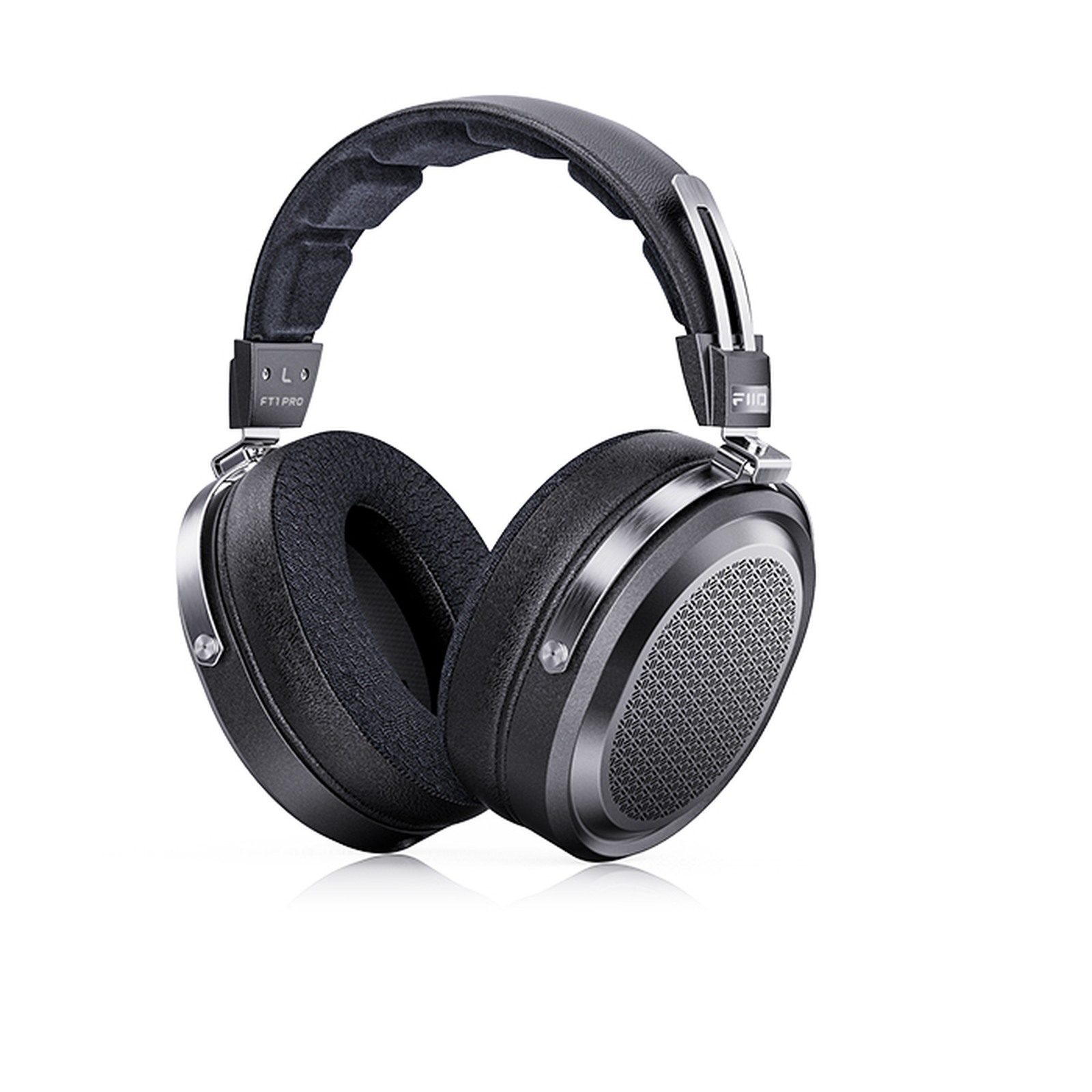
One-line verdict: The closed FT1 is the better default and better value; the FT1 Pro is the more specialized home headphone, not a universal upgrade.
Why the names are misleading
FiiO reused the FT1 chassis language but changed the acoustic system. The standard FT1 uses a 60mm dynamic driver behind solid wood closed cups. FT1 Pro uses a 95 × 86mm double-sided-magnet planar driver behind open metal grilles. The standard model is nominally 32Ω and weighs 340g; the Pro is nominally 20Ω and weighs approximately 374g.
Those differences overwhelm the word “Pro.” Closed versus open determines where the headphone works. Dynamic versus planar helps shape its bass, distortion and presentation. Buying by suffix alone can leave someone with a headphone that leaks into a microphone, annoys a nearby person or removes the bass weight they enjoyed in the less expensive model.
Sound: warmth and impact versus openness and control
FT1 is the warmer headphone. Measurements place its bass roughly 4dB above a neutral reference in one program, and recurring reports describe substantial sub-bass and midbass with better texture than its price suggests. Lower mids inherit that warmth, while upper mids are relaxed. It is the more forgiving choice for aggressive recordings and the more immediately satisfying choice for bass-led music.
FT1 Pro still extends low for an open headphone, remaining broadly level into the bottom octave on measured samples. Extension is not impact: its bass is less elevated and physical than FT1. The reward is lower masking, cleaner separation and a more neutral-leaning presentation. Complex arrangements are easier to parse, but some listeners hear the 1–2kHz recession as vocal distance or dryness.
Treble on both models varies with fixture, fit and anatomy. FT1 shows notable 5–6kHz behavior that can sound smooth to one listener and slightly sharp to another. FT1 Pro has sample- and channel-dependent fine structure around 4kHz plus variable upper treble. Neither is guaranteed fatigue-free; seller returns and personal fit remain more useful than declaring a universal treble winner.
Stage and imaging
FT1 Pro is more reliably open. Its grilles remove the sealed boundary and its planar presentation supports stronger separation. That does not prove a huge holographic stage: reports range from broad to merely average in width and depth. “More open than FT1” is defensible; “enormous” is not.
FT1 organizes layers unusually well for a closed headphone, but still presents them within a bounded space. Its imaging can be stronger than the absolute stage size. Choose it when privacy matters more than maximum openness; do not buy it expecting the room-like presentation of an open design.
Isolation changes the decision
FT1 provides useful passive isolation and low leakage when its pads seal correctly. That makes it practical beside another person, during office work, for casual recording and for moderate travel. It is not active noise cancellation, and glasses can reduce seal and bass, but it preserves options the Pro cannot.
FT1 Pro is fully open. Outside sound enters freely and music escapes freely. It is a poor choice near a sleeping partner, in a shared office or beside a live microphone. In a quiet private room, that same openness is its reason to exist. This environmental question should be answered before comparing driver technology or scores.
Comfort, construction and accessories
The common visual language includes metal yokes, broad hybrid pads, articulated cups and fitted cases. FT1 weighs about 34g less and uses real walnut or beech cup material. Both include separate 3.5mm and 4.4mm cables, though their cup-side connector details differ. Neither folds, and both cases occupy meaningful bag space.
Comfort is head-dependent. FT1 has moderate clamp and large cups, but small heads can reach the end of adjustment and some owners report crown heat or shallow-feeling openings. FT1 Pro has lower measured clamp but greater weight, modest crown padding and a pad opening that can feel short to large ears.
Build confidence favors FT1. Its owner record is broader and more mature. Early FT1 Pro reports include loose hinge fasteners, detached cups, channel imbalance and low-bass buzz or rattle. Later intact units exist and no formal defect rate is available, but the correct buying advice is simple: use a seller with easy exchanges and inspect a new Pro promptly.
Do you need a stronger amplifier for FT1 Pro?
No. Planar does not automatically mean difficult. FT1 Pro measures around 18–21Ω with sensitivity close to its published 95dB/mW and 112dB/V figures. A competent two-volt dongle provides useful headroom for normal listening. FT1 is similarly easy to drive and can reach ordinary levels from a basic dongle.
The included 4.4mm cables are convenient when a source already provides that socket. They do not make a balanced connection inherently better, and neither headphone justifies purchasing a large desktop amplifier solely for volume. Spend first on the headphone that fits the room and tonal preference.
Value and current pricing — July 2026
FT1 currently sits around US$159.99 for walnut, compared with its US$149.99 launch price. It includes two cables, a fitted case, real-wood cups and measured performance that remains difficult to match near US$160. Its 90/100 score reflects that complete package, not a claim that its warm tuning is more accurate than the Pro.
FT1 Pro launched at US$199 and has appeared around US$199.99–219.99, but current US availability has been inconsistent; Canadian listings were around C$299.99 with limited stock when reviewed. At a US$40 gap from FT1, the Pro remains excellent value when the open planar format is specifically wanted. Paying more without wanting openness is not an upgrade.
FiiO FT1
- You share the room or need practical isolation.
- You prefer warm bass weight and forgiving mids.
- You want the stronger default value and build record.
- You need one wired headphone for mixed use.
FiiO FT1 Pro
- You listen privately and leakage is irrelevant.
- You prefer separation, openness and moderate bass.
- You want an affordable planar without demanding amplification.
- You can inspect the unit during an easy return window.
Final buying advice
Buy the FiiO FT1 if there is any uncertainty. It costs less, works in more places, delivers the more physical bass presentation and carries the stronger current ownership case. Its Exceptional 90/100 rating comes from breadth and value, not universal sonic superiority.
Buy FT1 Pro only when its differences are the point. In a quiet room, its open architecture, planar separation and restrained bass can be more rewarding. It is a companion to FT1, not its replacement. The buyer who wants both closed practicality and open planar contrast could reasonably own both without duplicating the same role.
For the complete evidence behind each verdict, read the FiiO FT1 full review and FiiO FT1 Pro full review.
MyHiFi may earn a commission from purchases made through affiliate links. This does not influence our editorial decisions or source selection.