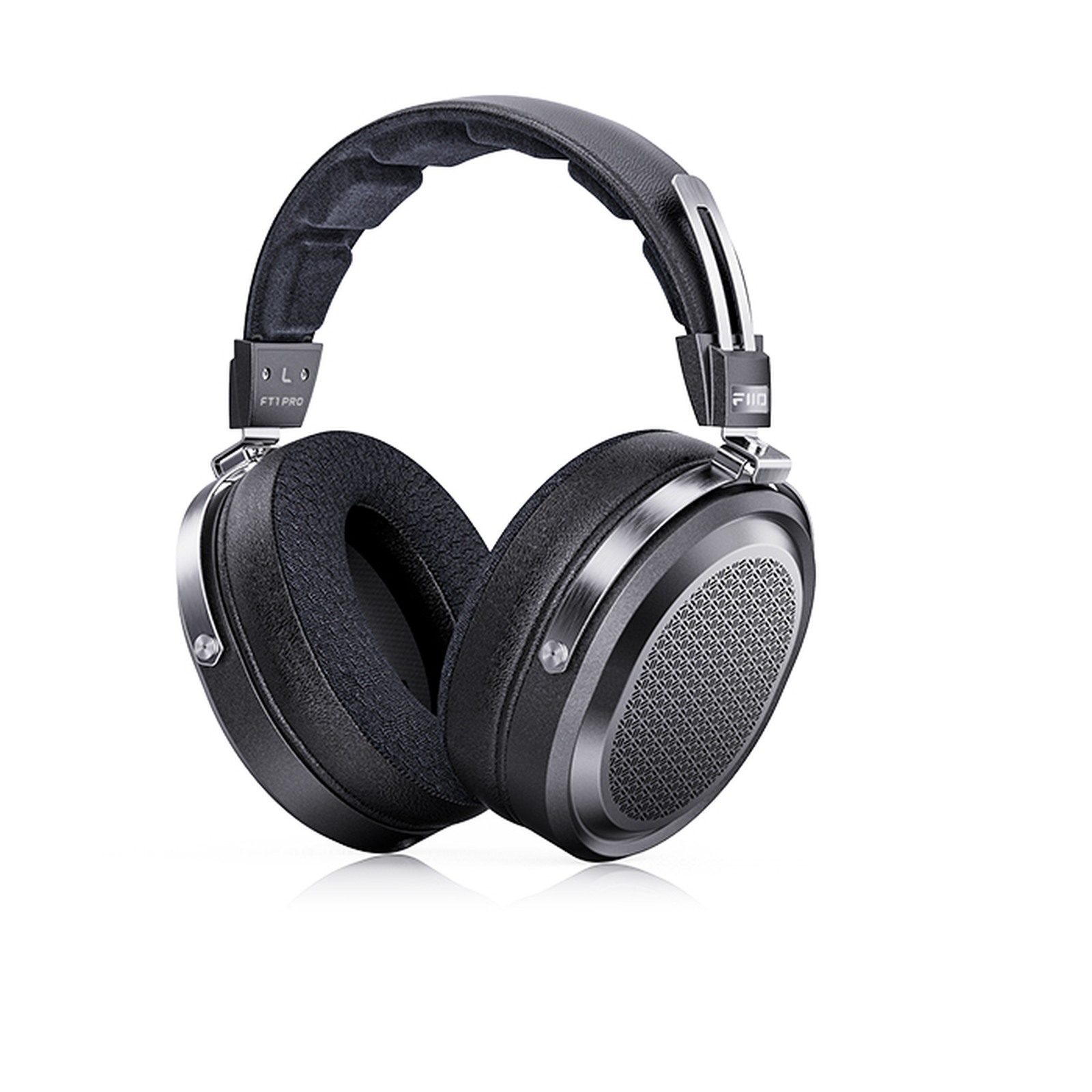
The FiiO FT1 Pro is not a better-equipped version of the closed-back FiiO FT1. It is a different acoustic proposition wearing a familiar chassis. The FT1 uses a dynamic driver and closed wood cups; the FT1 Pro substitutes a large double-sided-magnet planar driver and open metal grilles. One prioritizes isolation, warmth and bass weight. The other prioritizes openness, speed and a more neutral balance.
At its US$199 launch price, the Pro's hardware list is aggressive: a 95 × 86mm planar assembly, 1µm diaphragm, metal structural parts, a fitted case and separate 3.5mm and 4.4mm cables. Independent measurements support strong bass extension, low ordinary-level distortion and stable behavior across amplifier output impedances. The less flattering evidence is equally important. Fine response around 4kHz varies by sample, bass headroom tightens at extreme levels, and early owners reported loose hinge hardware, imbalance and driver buzz often enough to deserve a genuine caution.
That combination makes the FT1 Pro technically impressive and easy to recommend—but not something to buy from a seller with a difficult exchange policy.
Scorecard
Deep open-back extension, low normal-level distortion and clear separation; restrained impact, sample-dependent 4kHz structure and high-level bass limits remain
Substantial metal frame, removable cables and generally comfortable pads; early fastener, balance and buzz reports reduce confidence
Planar performance, two proper cables and a fitted case remain exceptional near US$199, though stock and current pricing are inconsistent
Easy enough to drive and unusually leak-tolerant, but fully open operation, 374g weight and no portable isolation narrow its role
Who it is for: home listeners seeking a neutral-leaning open planar around US$200; buyers who value bass extension and separation more than boosted punch; people who want both single-ended and balanced cables without buying accessories; FT1 owners looking for a genuinely different open-back companion.
Who should skip it: commuters, shared-room listeners and recording situations requiring isolation; bass-first buyers; people sensitive to crown weight or upper-treble variation; anyone buying from a seller without straightforward returns.
Verified specifications
| Specification | Published or independently verified value |
|---|---|
| Type | Open-back circumaural planar-magnetic headphone |
| Driver | 95 × 86mm double-sided-magnet planar assembly |
| Diaphragm | 1µm PET with aluminum and sapphire coatings |
| Impedance | 20Ω nominal; approximately 18–21Ω independently measured |
| Sensitivity | 112dB/V and 95dB/mW official; 114dB/V and 97dB/mW in one independent test |
| Claimed bandwidth | 7Hz–40kHz, without a published tolerance |
| Weight | Approximately 374g without cable |
| Cup connectors | Dual recessed 3.5mm TS |
| Included cables | Separate 1.5m 3.5mm and 4.4mm cables |
| Other accessories | 3.5-to-6.35mm adapter and fitted case |
Design and comfort
The FT1 Pro uses steel slides, metal yokes and open metal grilles around largely polymer cup structures. Twelve adjustment positions and multi-axis cup articulation provide a broad fit range. The hybrid pads place breathable textile against the skin and protein leather around the sidewall. Independent inspection found soft angled foam, an opening near 56 × 42mm and low clamp around 1.5–2N.
Most professional and owner reports describe the headphone as comfortable for long sessions. The caveat is geometry. At 374g it is not especially light, the crown padding is modest, and the pad opening may be short for large ears. Some owners report no pressure over hours; others develop crown discomfort after roughly an hour. Neither experience should be treated as universal.
The accessory package is unusually complete. Instead of one cable with an interchangeable plug, FiiO supplies separate 3.5mm single-ended and 4.4mm balanced cables, plus a 6.35mm adapter and fitted case. Cable handling reports conflict: some find them pliable and quiet, while others find them springy and mildly microphonic. Their 1.5m length suits a desk better than a listening chair across the room.
Service documentation is less polished. Pads are removable, but FiiO does not publish an exact replacement SKU, dimensions or stocked parts page. Documents circulating online as FT1 Pro manuals are internally labelled FT1 and illustrate the other model's cable system; they should not be used as exact-model documentation.
Measured response
Multiple independent programs agree on the broad response even though their fixtures and compensations cannot be numerically averaged. Bass reaches unusually low for an open design, remaining broadly level until roughly 25–30Hz on measured samples. A shallow recession around 1–2kHz places some vocal presence slightly behind the bass and upper-mid regions. Treble above roughly 4–8kHz changes more with sample, fixture, head and seating.
That explains why the listening descriptions overlap without becoming identical. The safe description is neutral-leaning, open and lightly lively—not uniformly bright, dark or bass-light. Bass is controlled and extended rather than elevated. Mids are clear, but the presence recession can add distance or dryness. Treble can sound crisp and airy, with occasional edge depending on ear geometry and recording.
The 4kHz region deserves special care. Two early samples showed a narrow one-channel feature around 3.8–4.5kHz, and one retained it when measured without pads. Other samples showed a dip or resonance without the same channel mismatch. That is evidence of sample-dependent fine structure, not proof that every FT1 Pro is imbalanced or defective.
Distortion, bass headroom and amplification
At ordinary levels, measured distortion is low through most of the audible range. The planar driver becomes less comfortable when deep bass, heavy EQ and extreme playback level arrive together. In one multi-level test, low-bass second harmonic rose sharply by a 104dB test and the driver reached excursion limiting at 110dB. Another test found roughly 1dB of low-bass compression around 100dB. Different samples and methods prevent a universal maximum-SPL claim.
For normal listening, the practical message is simple: the FT1 Pro handles clean, extended bass well, but it is not an unlimited sub-bass equalization platform. Buyers seeking club-level bass impact should choose a different tuning rather than forcing it electronically.
The electrical load is friendly. Independent results span roughly 18–21Ω with little frequency variation, while measured sensitivity lands close to the official figures. Ordinary dongles and portable players can reach useful levels, and a two-volt source provides ample margin for most listening. A large desktop amplifier is not required for volume. Reports of amplifier-dependent focus or treble behavior were not controlled or level-matched, so they do not justify an expensive source requirement.
Sound character from the evidence
Bass extension and bass impact are separate. The FT1 Pro measures deep, but its level is moderate and its midbass punch is not exaggerated. That produces clear bass lines and low masking, while listeners accustomed to the closed FT1 or consumer bass shelves may hear less physical drive than expected.
The midrange favors intelligibility and separation. Complex arrangements remain easy to parse, and vocals generally retain enough body to avoid a stereotypically thin planar presentation. The 1–2kHz recession can place singers a step back, while strings and acoustic material sometimes expose a dry edge.
The open chassis reliably creates more space than the closed sibling, but evidence differs on scale. Some listeners hear a very broad envelope; others hear average width and depth with merely solid imaging. Open and spacious is defensible; huge and pinpoint is not. Separation and detail are strong for the price, while low-level microdetail, image depth and macrodynamic impact do not consistently challenge more expensive planars.
FT1 Pro versus FT1
The closed-back FT1 remains the more versatile everyday headphone. It isolates, leaks less, has fuller bass and delivers more immediate weight. Its dynamic driver presentation is thicker, smoother and more forgiving.
The FT1 Pro is the home-listening alternative. It sounds tighter, crisper and more open, with stronger separation and less bass bloom. It does not replace the FT1; it removes the closed model's main practical advantages to pursue a different tonal and spatial goal. Owning both is less redundant than their names suggest.
Against the Sennheiser HD 600, the FiiO offers deeper measured bass reach, a larger planar diaphragm and a far richer cable/case package at a lower price. The HD 600 retains the more mature service ecosystem and a long-established midrange reference. Only one inspected source made an exact comparison, so broad superiority claims would exceed the evidence.
The lighter Sennheiser HD 550 is the more conventional dynamic-driver choice for buyers prioritizing low weight and a widely open presentation. No substantial controlled professional head-to-head with the FT1 Pro was found; the comparison should remain about architecture, fit and use case rather than invented sonic ranking.
Reliability and buying advice
More than 20 firsthand exact-model owner/demo accounts and 13 visible verified-purchase reports were inspected. Praise for detail, extension, layering, comfort and value recurs. So do several early-unit problems: loose hinge fasteners, detached cups, channel imbalance and low-bass buzz or rattle. Some later owners describe revised fittings and intact hardware, but there is no formal change notice or sample large enough to quantify an improvement.
The pooled black-and-blue retailer aggregate was 4.2/5 from 228 ratings. That is useful context, not a substitute for inspected reports. Long-term evidence remains limited, with both intact multi-month units and isolated covering/headband failures represented.
Launch pricing was US$199. As of July 16, 2026, one US dealer listed US$199.99 as unavailable/preorder and another listed US$219.99 unavailable. Canadian black and blue listings were C$299.99 with limited stock. Availability is therefore less impressive than the product's underlying value.
Buy from a seller with an uncomplicated exchange window. On arrival, inspect both hinge fasteners, sweep low bass at moderate—not abusive—level, verify channel balance with a centered mono signal, and check that both cables seat securely. Those are proportionate checks grounded in the owner corpus, not an assumption that every unit will fail.
Verdict
The FiiO FT1 Pro earns its suffix by changing the engineering, not by adding cosmetic trim. Its measured bass extension, low ordinary-level distortion, open presentation and complete cable package are outstanding near US$200. It is easier to drive than planar stereotypes suggest and different enough from the closed FT1 to justify a separate place in the catalog.
The reservation is confidence rather than capability. Early mechanical and driver reports, sample-dependent 4kHz behavior and thin service documentation prevent an Exceptional score. With a good return policy and a clean sample, the FT1 Pro is one of the strongest open planar values in its class.
Methodology
This assessment combines exact-model official specifications, multiple independent measurement programs, six fully inspected professional evaluations, more than 20 firsthand owner/demo accounts and 13 visible verified-purchase reports. Measurements from standardized head fixtures and a custom flatbed system were interpreted within their own methods rather than averaged. MyHiFi has not performed hands-on testing of this product. Outside source names and quotations are retained only in the private research dossier.
MyHiFi may earn a commission from purchases made through affiliate links. This does not influence our editorial decisions or source selection.