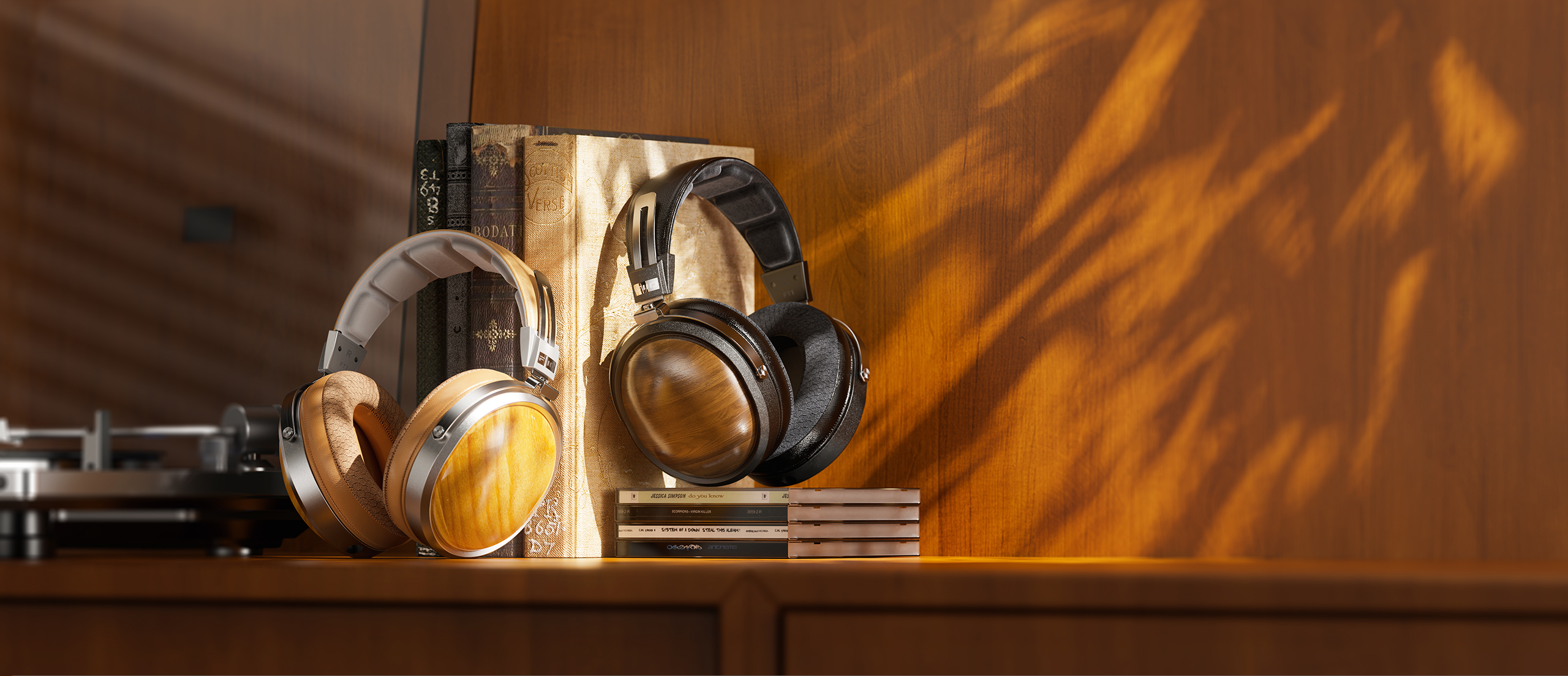
Affordable closed-back headphones have been coasting. The familiar choices are durable, easy to drive and available everywhere, but too many ask buyers to choose between studio-tool austerity and consumer bass with little technical finesse. Then the FiiO FT1 arrived with real wood cups, a 60mm driver, two proper cables and a fitted case for roughly the price of an Audio-Technica ATH-M50x.
That package would be impressive even if the sound were merely competent. It is better than that. Independent measurements and recurring listening patterns describe a warm, bass-elevated headphone with low distortion, orderly mids, articulate treble and unusually strong spatial organization for a sealed design. The FT1 is not neutral in the strict sense, and its stage does not sound equally expansive to every head. Yet it gets the fundamentals right while making many $150–$200 rivals look under-equipped.
At a verified July 2026 street price of $159.99 for walnut and $164.99 for beech on Amazon US, the FT1 is no longer exactly the $149.99 launch bargain. It remains the closed-back headphone to beat near $160—provided you want warmth and bass weight rather than a lean studio microscope.
Scorecard
Who it is for: listeners wanting a comfortable wired closed-back with deep bass, forgiving tonality and strong detail; office or shared-room users; buyers who value standard connectors and complete accessories.
Who should skip it: strict bass-neutrality seekers; small-headed users sensitive to large cups; anyone needing Bluetooth, ANC or folding travel portability; listeners who want aggressive upper-mid presence.
Verified specifications
| Specification | Published value |
|---|---|
| Type | Closed-back, over-ear dynamic headphone |
| Driver | 60mm nanowood-fiber composite dynamic |
| Impedance | 32Ω nominal; 28.9Ω independently measured average |
| Sensitivity | 98dB/mW or 113dB/V at 1kHz |
| Claimed frequency range | 10Hz–40kHz |
| Weight | 340g without cable |
| Cup material | Solid American black walnut or beech |
| Connectors | Dual 3.5mm TRS at the cups |
| Included cables | 1.5m 3.5mm and 4.4mm silver-plated OFC |
FiiO claims up to 26dB of passive noise reduction, but no accessible independent full-frequency curve confirms that maximum. Treat it as a best-case manufacturer figure, not an ANC-equivalent promise.
Design and comfort: more expensive than it looks
The FT1’s wooden cups are not vinyl wrap over plastic. Walnut and beech versions use solid wood, each with natural grain variation, attached to metal yokes and a steel-reinforced adjustable headband. At 340g, the headphone is not featherweight, but broad hybrid pads and moderate 4.5N-rated clamp distribute the load effectively for most users.
Comfort is still head-dependent. Larger ear openings and generous swivel help, while the fabric contact surface reduces the clammy feel of full pleather. Most owner reports describe multi-hour comfort, but heat, a crown hotspot and shallow-feeling openings recur for a minority. Small heads may also reach the minimum adjustment before achieving an ideal fit. This is a comfortable design, not a universal one.
Dual 3.5mm cup sockets avoid proprietary cables, and the pads use a conventional mounting lip. The cups articulate but do not fold, so the fitted case is closer to luggage than a commuter pouch. The soft-detent sliders work but feel less precise than the rest of the construction.
What the measurements mean
Independent tests place the FT1’s average impedance around 28.9Ω and sensitivity around 101.4dB/mW—slightly easier to drive than FiiO’s conservative 32Ω and 98dB/mW ratings imply. Roughly 0.13Vrms is sufficient for 90dB SPL with 9dB of musical headroom under one published calculation. In plain English: a decent phone dongle has enough power, and a large desktop amplifier is optional.
Frequency-response testing consistently shows a warm foundation. One laboratory characterizes bass as roughly 4dB above target, with relatively even mids and treble. Multi-fixture measurements reveal an important complication near 5–6kHz: a pronounced feature around 5kHz on one ear simulator becomes smaller and shifts toward 6kHz on another. That explains why some listeners hear restrained, smooth treble while others notice extra bite. Ear shape, seal and pad position matter.
Harmonic distortion stayed mostly below 2% even during tests reaching unrealistic listening levels. That does not make the FT1 magically transparent, but it means the driver is not adding obvious fuzz under ordinary use. Good left/right matching further supports stable centre imaging.
Sound character: warm, lively and more disciplined than expected
Bass is the headline. The FT1 reaches convincingly into the sub-bass, then carries enough midbass weight to give kick drums and bass guitars physical substance. The important distinction is control: recurring reports describe texture and definition rather than one-note bloom. On material like Massive Attack’s Angel, the appeal is the combination of low-frequency pressure and audible layering. Already bass-heavy masters can become too full, and a small EQ reduction below 150Hz is reasonable for neutral-minded listeners.
The lower midrange inherits warmth from that shelf. Male vocals, cello and distorted guitars sound substantial rather than papery. Upper mids are more relaxed, which keeps aggressive mixes civilized but can move lead vocals and snare attack slightly behind the bass. That is why the FT1 can be described both as smooth and as mildly V-shaped: the centre is not absent, but its presence is less forceful than the frequency extremes.
Treble has enough energy to preserve cymbal texture and room cues without adopting the Beyerdynamic school of permanent spotlight. Fleetwood Mac’s Dreams suits this balance: percussion remains intelligible while vocals avoid excessive glare. The 5–6kHz variability means no universal fatigue verdict is honest. Most owners find the top end benign; a minority hears a dry edge or uneven peak. Pad changes can alter that region substantially.
Soundstage is the largest disagreement. Assessments range from exceptional width and depth to narrow and congested. The middle position is most defensible: the FT1 organizes layers well inside a bounded space. Imaging and separation are stronger than absolute stage size, though complex passages can crowd the edges.
Comparisons: which closed-back should you buy?
Against the Audio-Technica ATH-M50x, the FT1 offers deeper bass, a less pinched stage, smoother treble and richer materials. The M50x folds and remains a proven tracking tool. Choose Audio-Technica for studio portability; choose FiiO for music and value.
The Beyerdynamic DT 770 Pro X Limited Edition is brighter, isolates well and has established studio ergonomics. The FT1 sounds warmer, fuller and less fatiguing. Pick Beyerdynamic for forensic clarity; pick FiiO for bass texture and relaxed listening.
The folding AKG K371 aims closer to a reference target, with tidier bass and more forward mids. The FT1 trades strict balance for greater low-end drama, better materials and a stronger accessory bundle.
The Meze 99 Classics remains the style-first wooden rival. Meze is lighter and more overtly lush, but its upper-bass coloration and treble unevenness are harder to ignore at its higher price. FiiO supplies the stronger technical and value case unless Meze’s comfort or design wins personally.
Pairing and everyday use
A basic Apple USB-C dongle can reach useful levels, while a FiiO KA13, Qudelix-5K or FiiO K11 R2R adds volume control and comfortable headroom. The included 4.4mm cable is convenient for balanced portable outputs, but balanced wiring is not inherently superior; there is no need to buy a new amplifier merely to use it.
Passive isolation is useful for offices, homes and moderate travel, with low leakage reported when the pads seal correctly. It does not replace ANC on aircraft or trains. Glasses can reduce the seal and bass, while the large case undermines portability. At a desk, in a dorm or beside another person, the FT1’s closed construction makes far more sense.
Value and verdict
The original $149.99 proposition was extraordinary. At the July 2026 US range of $159.99–$164.99, it remains excellent. More than 800 Amazon ratings averaging 4.5/5 show this is no obscure enthusiast secret. More importantly, the money buys measured competence, real wood, replaceable pads, standard sockets, two cables and a case.
The FiiO FT1 earns 90/100 and an Exceptional rating because it raises the minimum acceptable standard for an affordable wired closed-back. Its warm balance will not suit every listener, the headband and cables leave room for refinement, and stage width is not universally impressive. Those are manageable compromises, not fatal flaws.
At roughly $160, rivals can beat one aspect—portability, neutrality, isolation or studio pedigree. None matches the whole package as convincingly. The FT1 does not make cheap headphones sound expensive; it makes expensive headphones explain themselves.
MyHiFi weights Technical Performance at 30%, Value at 30%, Build Quality at 25% and Versatility at 15%. The weighted result is 89.75, rounded to 90/100.
Methodology
This assessment draws on three independent measurement suites, six professional reviews, 32 manually coded substantive retailer reports, broader Reddit and Amazon sentiment, official specifications and live July 2026 pricing. Confidence level: High. MyHiFi did not perform hands-on testing of the FiiO FT1. The open-back planar FT1 Pro was excluded.
Affiliate disclosure: MyHiFi may earn a commission from purchases made through affiliate links. This does not influence our editorial decisions or source selection.