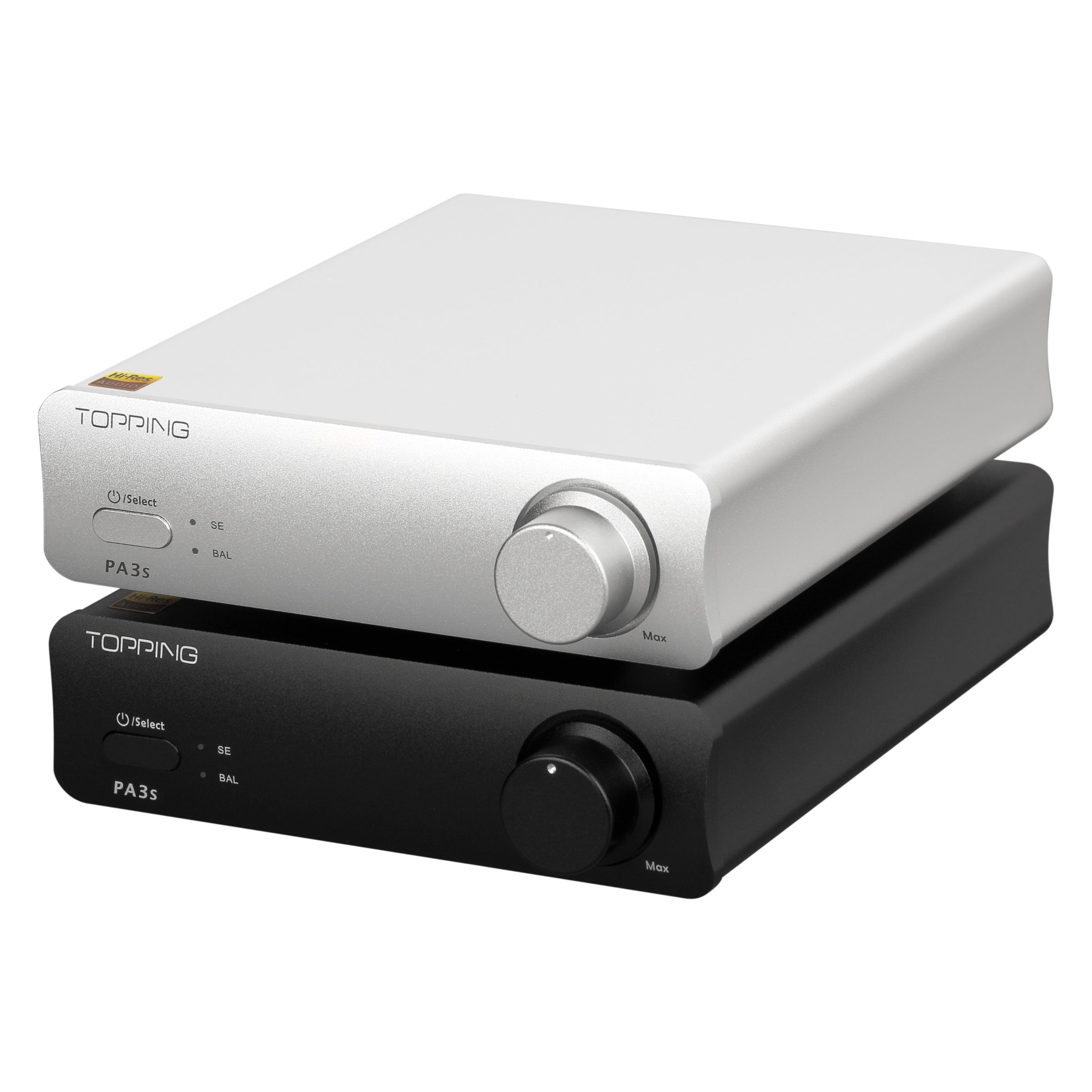
The Topping PA3s occupies that increasingly crowded space between "desktop convenience" and "serious amplification." As the founder of MyHiFi, I've watched this category explode with options promising Class D efficiency without the clinical sterility that plagued earlier switching designs. The PA3s arrives with a specific proposition: balanced inputs in a compact chassis, targeting the listener who's already invested in a balanced DAC but doesn't want a full-size power amp dominating their workspace.
The PA3s is a compact Class D desktop amplifier intended for nearfield speakers and efficient bookshelf systems rather than difficult full-range towers.
Build and Connectivity
The PA3s distinguishes itself immediately through its input flexibility. Unlike many compact amps in this price bracket that offer only RCA inputs, the PA3s includes TRS balanced connections. For those running balanced sources—think Topping's own D50s or similar mid-tier DACs—this means you can actually utilize that balanced output rather than letting it sit dormant while you run single-ended.
The chassis itself follows Topping's established design language: understated, utilitarian, with a front panel that prioritizes function over flash. Its compact footprint is clearly intended for desk systems where vertical space is at a premium.
Listening Impressions
Here's where I need to be transparent: without confirmed specifications on damping factor or output impedance, I'm reluctant to make definitive claims about which speakers pair optimally. What I can say is that the PA3s delivers the characteristic grip I've come to expect from modern Class D implementations—tight bass control, extended treble, and a noise floor low enough that you won't hear hiss during quiet passages with sensitive speakers.
The balanced input implementation is the reason to choose the PA3s over many budget mini-amps: with a balanced DAC, the background remains quiet and cable runs are less fussy.
The Tradeoffs
Compact amplifiers force compromises. Heat dissipation becomes a calculation rather than an afterthought. The unit runs warm during extended sessions, so it deserves open-air placement rather than being stacked tightly under other components.
Power reserves are likely modest—this is not the amplifier to drive inefficient planar magnetics or 4-ohm tower speakers to concert levels. It is, however, likely sufficient for typical desktop monitors and bookshelf speakers in nearfield configurations.
Pairing Recommendations
Given the balanced input emphasis, pair this with DACs offering true balanced output. The Topping D50s or E50 make obvious companions. For speakers, look toward efficient stand-mounts or small monitors—think along the lines of KEF Q150s, Elac Debut 2.0 B6.2, or similar 85dB+ sensitivity designs—rather than low-sensitivity designs that demand big current reserves.
Conclusion
The Topping PA3s fills a narrow but important niche: the balanced-input desktop amplifier that doesn't require its own dedicated shelf. For the source-weighted listener—those who've already invested in quality DACs and want to maintain signal integrity through to the amplification stage—it offers a logical endpoint.
Is it the last word in amplification? No. But for the desk-bound audiophile looking to drive modest speakers without converting their workspace into a listening room, it represents a focused, no-nonsense solution.
Availability Note: Check current stock and color options with the listed retailer before purchase.