Schiit Magni 3 Review: The $99 Benchmark That Redefined Entry-Level Headphone Amplification
The Schiit Magni 3 arrived at a pivotal moment in personal audio. At a time when "budget audiophile" often meant compromising on build integrity or sonic transparency, Schiit Audio consolidated its Magni and Magni Uber variants into a single $99 offering that fundamentally shifted expectations for what an entry-level headphone amplifier could achieve. Years after its release—and even with its own successors (the Magni 3+ and Magni Heresy) now occupying the spotlight—the original Magni 3 remains a reference point for value engineering done right.
This is not a product that dazzles with features. It is a statement of focus: discrete analog circuitry, serious power delivery, and a build quality that belies its price. For those stepping up from laptop headphone jacks or entry-level DAC/amp combos, the Magni 3 represents the point of diminishing returns for many listeners—a rare sweet spot where additional spending yields rapidly diminishing audible benefits.
---
Design & Build: Industrial Minimalism
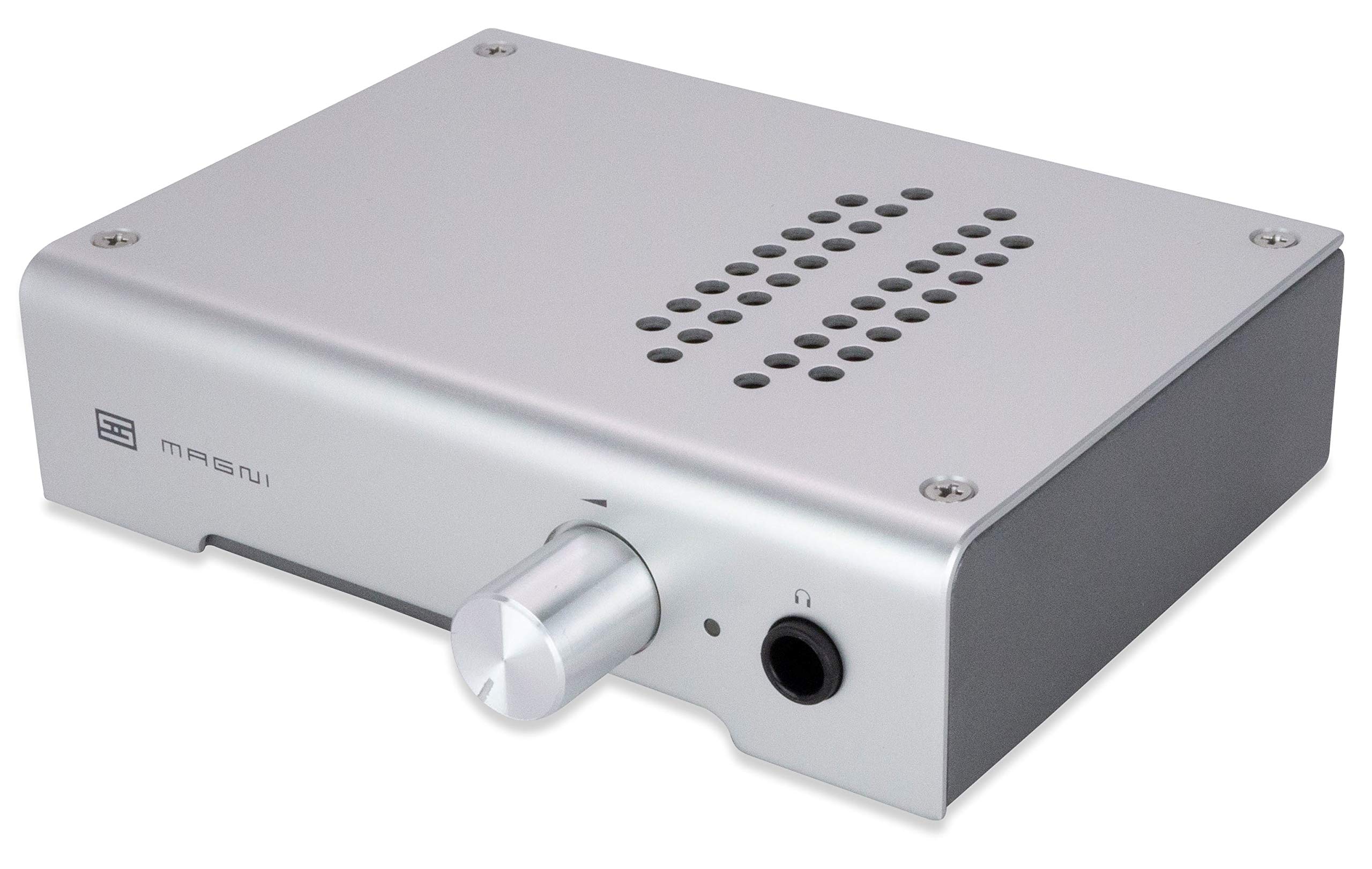
The Magni 3’s aesthetic is unmistakably Schiit: brushed aluminum top plate, simple rectilinear chassis, and a no-nonsense front panel consisting solely of a ¼” headphone jack, a white LED power indicator, and a volume potentiometer. Measuring roughly the size of a thick wallet, it occupies minimal desk real estate and is described in the retained evaluations as substantial—something that cannot be said for many plastic-clad competitors at this price point.
Construction is handled in California, with Schiit employing a fully discrete, fully complementary, all-bipolar, symmetrical current-feedback topology. The chassis serves as a heatsink; the unit is reported to run warm during operation without recurring reports characterizing that warmth as alarming. A notable ergonomic caveat is the external wall-wart power supply—a 24VA/14VAC transformer that, while providing clean regulated power with over 6000µF of filter capacitance, is bulky and may frustrate users with crowded power strips.
Rear-panel connectivity includes RCA single-ended inputs and outputs (the latter functioning as a switched preamp output for powered monitors), alongside a gain toggle offering low (approximately 6dB) and high (approximately 17dB) settings. The volume potentiometer features an improved curve compared to earlier iterations, with a slower ramp-up from low levels that aids fine-tuning. However, like most analog potentiometers in this price class, reports note slight channel imbalance at the lowest settings—a trait mitigated by using the low-gain setting and maintaining the volume control above the 9 o’clock position.
---
Technical Performance: Discrete Topology, Serious Power
Where the Magni 3 distinguishes itself is in its amplifier architecture. Unlike many budget competitors relying on integrated op-amp solutions, Schiit employs a discrete current-feedback design with a DC servo to eliminate capacitors from the signal path. This approach typically reserves itself for amplifiers commanding significantly higher price tags.
The specifications reflect this engineering priority. Total harmonic distortion sits below 0.001% at 1V RMS (20Hz–20kHz), rising to only 0.02% at 5V RMS into 32 ohms. Signal-to-noise ratio is a commendable 108dB unweighted, while crosstalk measures -70dB—figures consistent with a low noise floor in the documented use cases, provided the volume pot is not set too low.
Power delivery is robust: 2W RMS per channel into 32 ohms, scaling to 3W into 16 ohms and approximately 420mW into 300 ohms. This places the Magni 3 in a rare category of amplifiers capable of driving both efficient IEMs and demanding planar magnetic headphones (such as the HiFiMan HE-400i or older Audeze models) with useful rated headroom. The output impedance is specified at under 0.25 ohms, ensuring minimal frequency response deviation with low-impedance, multi-driver IEMs, though reports indicate that extremely sensitive Campfire Audio Andromeda-style IEMs may reveal slight hiss on high gain.
---
Sound Quality: Weight, Control, and Musicality
The retained published reviews broadly describe a sonic balance that prioritizes authority and control over clinical sterility. The low end is taut and well-defined, offering significantly better bass control and pitch definition than its predecessors. Sub-bass extension is present without bloat, providing a foundation that lends weight to electronic music and orchestral crescendos alike.
The midrange presents with dynamic energy. Vocals carry presence and body, avoiding the thin, recessed character that plagues some neutral-solid-state designs. The upper midrange, in particular, exhibits a forwardness that brings electric guitars and brass instruments to the forefront of the mix—a trait that some listeners may perceive as slight brightness compared to warmer tube-hybrid alternatives like Schiit’s own Vali 2, but which contributes to a sense of immediacy and engagement.
Treble response is smooth and well-extended, lacking the etch or glare that can fatigue during extended sessions. The soundstage is wider than expected for a compact desktop unit, with adequate depth and precise imaging that allows for clear separation of instruments in complex mixes. This is not an analytical, microscope-for-detail presentation in the vein of the Objective2 or Topping’s NFCA designs; rather, it is a musical, slightly warm presentation that forgives poorly recorded material while retaining sufficient resolution to satisfy critical listeners.
The relay-based muting circuit deserves mention—upon power cycling, the outputs mute for several seconds to prevent DC thumps from reaching sensitive drivers, a thoughtful protection mechanism often omitted in budget amplifiers.
---
Real-World Use & Pairing Recommendations
The Magni 3’s dual gain settings prove essential for maximizing its versatility. Low gain is optimal for sensitive IEMs and efficient dynamic headphones (Sennheiser HD599, Philips Fidelio X2), allowing the volume pot to operate in its linear range while minimizing channel imbalance. High gain becomes necessary for high-impedance classics like the Sennheiser HD600/650 (300 ohms) or Beyerdynamic DT880/990 (600 ohms), though even here, the Magni 3 maintains composure without audible noise floors.
For planar magnetic headphones, the Magni 3’s 2W output provides sufficient headroom to avoid dynamic compression during transient peaks. It pairs exceptionally well with the Sennheiser HD6XX series, where its slight warmth complements the headphones’ midrange richness, and with the HiFiMan HE-400i, where its grip on the bass region tightens the planar’s sometimes loose low-end.
As a preamp for powered desktop speakers, the Magni 3 is reported to perform adequately, though its sonic character—particularly its slight warmth—may color the presentation more than a dedicated passive preamp or studio monitor controller.
---
The Competition: Context in a Crowded Market
The Magni 3’s most direct competitor is the JDS Labs Atom, priced similarly at $119. The Atom offers a more neutral, clinical presentation with slightly better measured distortion figures and a smoother volume potentiometer. However, the Magni 3 counters with superior build quality (aluminum vs. plastic), a more engaging sonic character, and the inclusion of preamp outputs. Subjectively, the Atom prioritizes accuracy while the Magni 3 prioritizes musical enjoyment—neither approach is objectively superior, but the Magni 3’s weightier presentation often proves more satisfying with rock, jazz, and classical genres.
Within Schiit’s own lineup, the Vali 2 ($149) offers tube-hybrid warmth and rolling capabilities for those seeking a softer, more romantic presentation, though it lacks the Magni 3’s absolute power and damping factor. The Magni 3+ and Magni Heresy (both $99) have since superseded the original Magni 3, with the 3+ offering improved discrete performance and the Heresy providing op-amp-based THX-AAA-like measurements. However, the original Magni 3 remains competitive, offering a slightly warmer, more "analog" presentation than the Heresy’s clinical precision and nearly matching the 3+ in subjective listening tests.
---
Value Assessment & Verdict
Composite Rating: 88/100 (Highly Recommended)
Technical Performance: 85/100 Build Quality: 88/100 Value: 95/100 Versatility: 82/100
The Schiit Magni 3 is the definitive answer to the question, "Do I need a separate headphone amplifier?" For $99, it provides performance that renders the headphone outputs of most integrated amplifiers and computer soundcards obsolete. Its discrete topology, substantial power reserves, and thoughtful features (preamp outputs, gain switching, relay muting) establish a benchmark that few competitors have meaningfully undercut.
The caveats are minor but worth noting: the wall-wart power supply is unwieldy, the volume potentiometer requires careful gain management to avoid channel imbalance, and the unit runs warm. These are acceptable trade-offs for the sonic authority and build integrity provided.
The Magni 3 is for buyers assembling a first separates-based headphone system who find one at a sensible used or old-stock price. It is not for anyone wanting an internal DAC, balanced connections or a compact power supply. Against the JDS Labs Atom, choose the Magni for its metal case and weightier reported balance; choose the Atom for a more neutral presentation and smoother control. Price context: MSRP at publication was $99; review refreshed July 2026. Check availability and current pricing.
Methodology
This older review was refreshed from its original research, manufacturer specifications, independent measurements where available, professional evaluations and owner patterns. MyHiFi has not performed hands-on testing of this product. Confidence: High.
Where to Buy:
MyHiFi may earn a commission from purchases made through affiliate links. This does not influence our editorial decisions or source selection.