Cambridge Audio CXA82 Review: The Evolution of a Modern Classic
The integrated amplifier market around the $1,200 mark has become a battleground of compromise. Most offerings force you to choose between analog soul and digital convenience, between power and finesse. The Cambridge Audio CXA82—effectively the second-generation successor to the company’s multi-award-winning CXA81—arrives promising to dissolve those tradeoffs. It replaces not just one but two previous stalwarts (the CXA81 and the step-down CXA61), consolidating the line into a single statement piece. Manufacturer information and published reviews describe more than a cosmetic refresh; this assessment does not rely on MyHiFi listening tests.
Design & Connectivity: Purpose-Built Minimalism
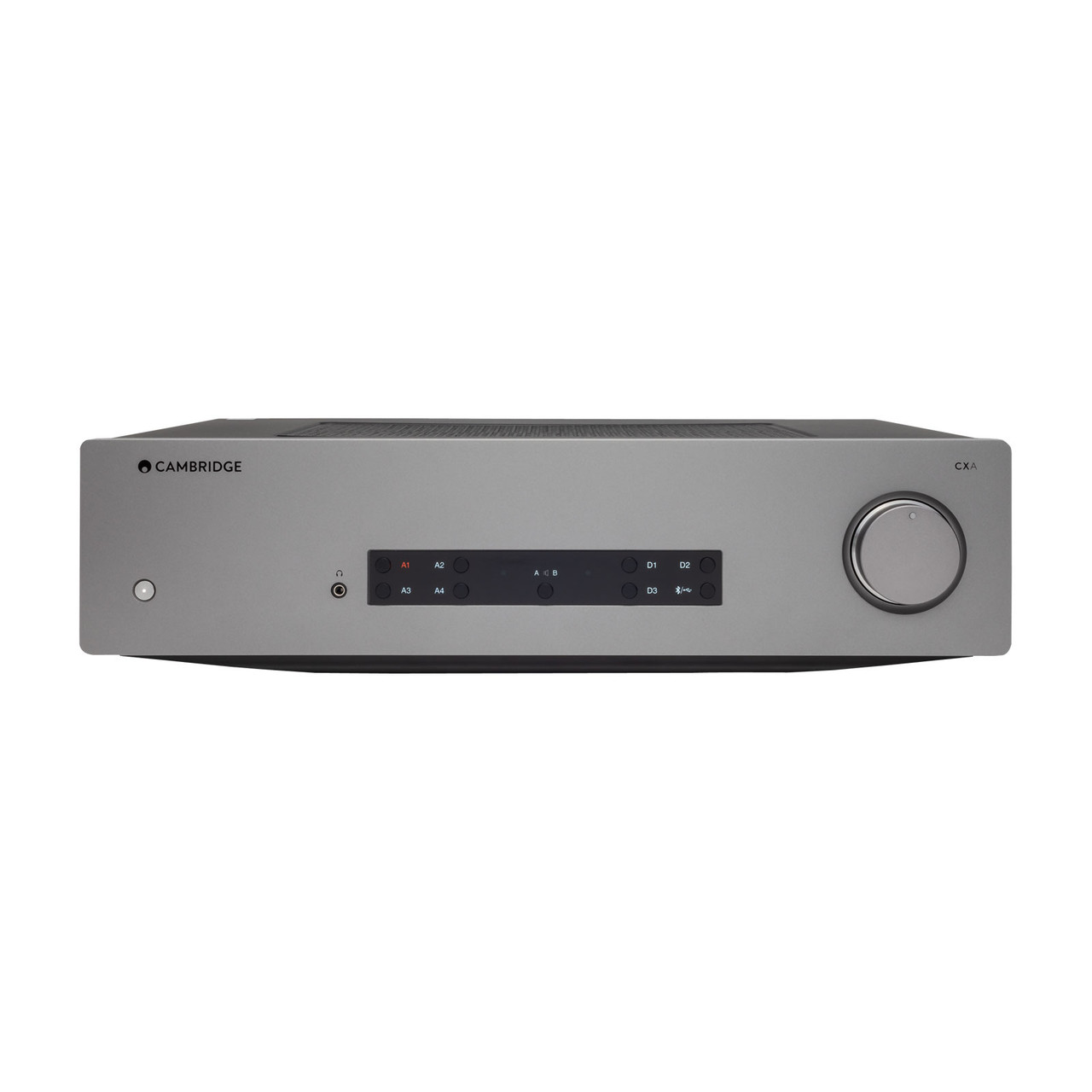
At first glance, the CXA82 betrays little of its internal overhaul. The chassis retains the same Luna Grey finish and floating front-panel aesthetic as its predecessor—a design that still feels contemporary five years on. The absence of color options (Lunar Grey is your only choice) might frustrate those matching existing gear, but the execution is undeniably premium. The motorized volume knob—smooth, weighted, and responsive to remote commands—delivers a tactile satisfaction rarely found at this price point.
Connectivity is comprehensive without being overwhelming. You get three RCA line-level inputs, a balanced XLR input (a genuine rarity in this class), coaxial and dual optical inputs, USB Type-B for computer audio, and Bluetooth aptX HD for wireless streaming. There’s also a pre-out for future expansion and a dedicated subwoofer output, which proves invaluable for 2.1 setups.
The omission, however, is glaring: there is no phono stage. At this price, most competitors include a moving-magnet input, and its absence here forces vinyl enthusiasts to budget another $200–$400 for a standalone phono preamp. It’s a curious decision that suggests Cambridge Audio views this amplifier primarily as a digital hub with analog accommodation, rather than the other way around.
Under the Hood: Class A/B in a Class D World
While much of the industry has migrated to efficient Class D amplification, the CXA82 remains stubbornly, admirably analog. It delivers 80 watts per channel into 8 ohms and 120 watts into 4 ohms via a custom Class A/B output stage fed by an oversized toroidal transformer. Dual power supply taps effectively give each channel its own reservoir, contributing to a soundstage that feels properly dual-mono in its separation.
The digital heart has been upgraded to an ESS ES9018K2M SABRE32 DAC, capable of handling PCM up to 32-bit/384kHz and DSD256. This isn’t just a chip swap—Cambridge Audio’s engineers reportedly swapped ten op-amps in the signal path and retuned the analog stages for improved depth and channel separation. The result is a DAC section that resolves fine detail with considerably more authority than the outgoing model.
The Listening Experience: Authority with a Caveat
Professional reports using speakers including the Harbeth P3ESR XD and Paradigm Founder 80F describe strong control. The amplifier grips the lower registers with surprising authority for an 80-watt design, filling out the lower mids and bass with a warmth and presence that suggests significantly more power on tap. Dynamic shifts—from whisper-quiet jazz passages to explosive rock crescendos—are handled with composure, never sounding strained or compressed.
The soundstage is broad and well-defined, with precise instrument placement and a sense of air around performers that rivals separates costing twice as much. High-frequency detail is crisp and extended, perhaps overly so for some tastes. In bright rooms or with forward-sounding speakers, the CXA82’s treble presentation can edge toward fatigue during long sessions. One listener noted switching to a warmer external DAC and even employing tone controls to tame the top end, ultimately preferring the darker presentation of a Schiit Vidar/Saga combination for their specific system.
This highlights the CXA82’s primary character: it is revealing. It will not flatter poor recordings or harsh source material. Paired with neutral or slightly warm transducers, it delivers a sophisticated, refined presentation that leans toward analytical accuracy rather than romantic coloration. The Bluetooth implementation, while convenient, unsurprisingly sacrifices some of the USB input’s resolution and should be considered a background listening option rather than critical playback.
Measurements & Objective Performance
Independent measurements specific to the CXA82 were not verified for this refresh. Measurements of the CXA81 are not transferred to this model, and no inference is made from its predecessor’s SINAD, noise floor or linearity. Unverified measurements were not used in the score. Users with sensitive headphones should note that the integrated headphone amplifier—while functional—exhibits some hiss and lacks the refinement of dedicated headphone amps. This is a speaker amplifier first, headphone amp second.
System Pairing & Real-World Use
The CXA82 excels as the centerpiece of a mixed-source system. It pairs beautifully with streamers like Cambridge’s own CXN100 (utilizing the balanced XLR connection), and its subwoofer output integrates seamlessly with REL or similar high-level subwoofer connections. In nearfield desktop setups with standmount monitors, the amplifier’s smooth volume tracking and low noise floor make it suitable for intimate listening, though its physical size demands significant desk real estate.
Avoid pairing this amplifier with bright, analytical speakers or aggressive metal-dome tweeters unless you prefer a clinically detailed presentation. Instead, look toward warm, rich transducers—KEF’s Meta series, Dynaudio’s Emit line, or the aforementioned Harbeths—to complement the CXA82’s resolving nature.
Comparisons & Competition
Against the Arcam A15—its closest rival—the CXA82 offers superior digital connectivity and a more powerful, spacious presentation, but surrenders some rhythmic cohesion and musical drive. The Arcam flows better with complex, propulsive music; the Cambridge renders space and detail with greater precision.
For those considering separates, a Schiit Modi 3+ paired with a Vidar amplifier offers a darker, more relaxed tonal balance for similar money, though you sacrifice the integrated convenience, remote control, and digital input flexibility.
Verdict
The Cambridge Audio CXA82 is a sophisticated, forward-looking integrated amplifier that consolidates the best aspects of its predecessors while addressing their shortcomings. It offers genuine high-end features—balanced inputs, premium DAC performance, robust Class A/B power—at a mid-fi price, provided you can accept the missing phono stage and carefully match it to your speakers.
Technical: 82 Build: 90 Value: 88 Versatility: 80
Overall: 86/100 – Highly Recommended
Price context: MSRP at publication was $1,199; review refreshed July 2026. Check the retailer for current pricing. The CXA82 is for listeners who want robust Class A/B speaker power, balanced analog input and an internal DAC. It is not for vinyl users unwilling to add a phono stage, buyers who need HDMI, or already-bright systems. Against the Arcam A15, choose the Cambridge for digital connectivity and rated power; choose the Arcam if its phono provision and reported rhythmic character fit better.
Methodology
This older review was refreshed from its original research, manufacturer specifications, independent measurements where available, professional evaluations and owner patterns. MyHiFi has not performed hands-on testing of this product. Confidence: Moderate. Unverified CXA82 measurements were not used.
MyHiFi may earn a commission from purchases made through affiliate links. This does not influence our editorial decisions or source selection.