Sennheiser HD 600 Review: The Thirty-Year Benchmark That Still Demands Respect
Three decades of production cycles, driver revisions, and market disruptions have done little to dislodge the Sennheiser HD 600 from its role as a reference point for mid-tier open-backs. In an era where planar magnetic drivers and computational DSP tuning dominate enthusiast discussions, this modest-looking dynamic headphone persists—not through nostalgia, but through a midrange balance that remains highly competitive. Yet persistence is not immunity from critique. The HD 600 needs a quiet room and a source with enough voltage headroom for its 300-ohm load, while its restrained sub-bass favors tonal accuracy over visceral impact. It is a focused critical-listening tool rather than a universal portable headphone.
Design & Build
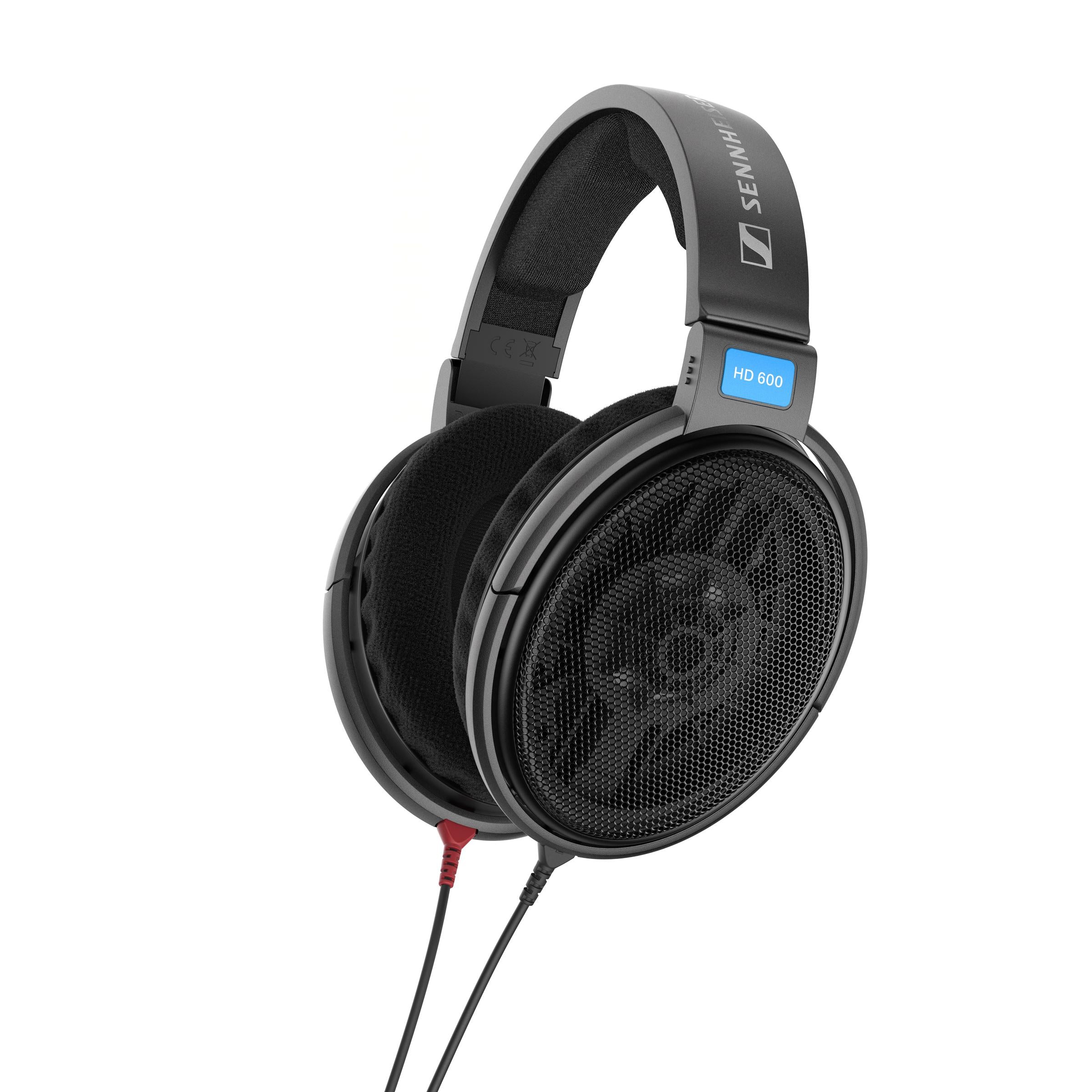
The current graphite HD 600 retains the familiar oval HD 6-series frame, open metal grilles and blue model badges. At approximately 260 grams, its lightweight construction pays dividends during extended sessions. A metal headband frame provides the structural backbone, while replaceable velour earpads and headband padding support long ownership. The plastic exterior does not feel luxurious beside contemporary aluminum and wood-clad competitors, but its low mass, established spare-parts ecosystem and serviceability are practical strengths.
The detachable cable uses Sennheiser's proprietary two-pin cup connectors, a secure system with a large established replacement-cable market but no universal 3.5mm compatibility at the cups. The modular construction—pads, cable, and headband padding are user-replaceable—speaks to a design philosophy of longevity rather than obsolescence. Still, the extensive use of plastic, while durable, lacks the tactile satisfaction of metal-clad competition at similar prices.
Connectivity & Features
As a purely analog, open-back dynamic headphone, the HD 600 offers no wireless connectivity, active noise cancellation, or microphone integration. Its defining electrical characteristics are 300-ohm nominal impedance and an official sensitivity of 97 dB SPL at 1 V. That is substantially less voltage-sensitive than the HD 550, so low-output portable sources may not leave comfortable peak or EQ headroom. A dedicated amplifier is useful when the source cannot provide the required voltage; the 300-ohm rating does not by itself justify claims that expensive amplification changes the headphone's basic tuning.
The open-back architecture necessitates quiet listening environments; sound leakage is bidirectional, making these unsuitable for offices or shared spaces. There is no isolation from external noise, which becomes part of the listening equation. This is a headphone designed for the dedicated listening room or professional studio, not the commute.
Sound Performance
The HD 600’s sonic signature centers on what many consider the most accurate midrange reproduction available under $1,000. Vocals and acoustic instruments exhibit exceptional timbral correctness, with a textural density that reveals bow pressure on strings and breath control in vocal performances. A gentle presence peak centered around 3 kHz enhances intelligibility without veering into harshness, while distortion measurements remain exceptionally low throughout the critical midrange band.
The controversial "Sennheiser veil"—a gradual treble roll-off above 10 kHz—remains perceptible when compared to modern bright-neutral targets. This is not a detail-forward, analytical presentation; micro-details in the upper octaves require attentive listening. The trade-off is a non-fatiguing signature that permits hours of critical evaluation without listener exhaustion.
Bass response proves more divisive. Below 50 Hz, the response attenuates significantly, reaching approximately -6 dB at 20 Hz. The result is articulate, defined mid-bass that lacks the physical slam and sub-bass extension required for electronic music, modern hip-hop, and cinematic orchestral crescendos. The low-end is present and musical, but not propulsive.
Soundstage perception is intimate rather than expansive. Width is narrower than many modern open-back alternatives, and the presentation prioritizes image coherence and midrange focus over theatrical immersion.
Comparisons
Against the Drop x Sennheiser HD 6XX (essentially the HD 650 driver), the HD 600 reveals a slightly cooler, more neutral midrange. The 6XX offers warmer upper-bass energy that masks the treble veil while sacrificing some midrange purity. For casual listeners, the 6XX represents superior value at roughly half the street price, though purists maintain the HD 600’s tuning remains the more accurate reference.
The Sennheiser HD 660S2 doubles the investment but delivers superior technicalities—enhanced resolution, dynamics, and bass extension—while maintaining the family’s tonal house sound. The HD 600 retains relevance through its midrange transparency and lower price of entry, though the 660S2 renders it technically obsolete for those prioritizing absolute performance.
Planar magnetic alternatives like the Hifiman Sundara offer superior bass extension and a wider soundstage, but introduce quality control variability and require even more robust amplification. The HD 600 wins on consistency, longevity, and midrange timbre, while the Sundara appeals to those seeking planar speed and low-end authority.
Against Beyerdynamic’s DT 880 or DT 990, the HD 600 trades treble energy and detail retrieval for long-term comfort and tonal sanity. The Beyerdynamics expose more high-frequency information but can induce fatigue and sibilance on poorly mastered recordings—trade-offs the HD 600 avoids entirely.
Who It's For
The HD 600 serves audio engineers requiring a reliable midrange reference for vocal and acoustic instrument mixing, classical and jazz enthusiasts prioritizing natural timbre over exaggerated dynamics, and audiophiles building their first dedicated headphone system who seek a neutral baseline. It rewards listeners who value repairability and decade-long product lifespans over annual upgrade cycles.
Conversely, bass enthusiasts and gamers prioritizing spatial width should look elsewhere. The sub-bass limitations and intimate soundstage reduce impact and immersion. Mobile users should verify that their output provides adequate voltage and headroom rather than assuming every phone or dongle will be sufficient. Those seeking "wow factor" or treble-forward detail retrieval may find the presentation overly polite.
Verdict
The Sennheiser HD 600 remains a mandatory audition for anyone building a serious headphone collection, not because it is flawless, but because it establishes the baseline for what neutral, midrange-centric audio reproduction should sound like. Its limitations—strict amplification requirements, plastic construction, and rolled-off sub-bass—are real and significant. Yet its strengths—exceptional midrange accuracy, low distortion, and all-day comfort—justify its enduring presence in studios and enthusiast setups alike.
This is not a headphone that impresses during a five-minute showroom audition. It is a headphone that reveals its value over months of critical listening, teaching your ears what accurate timbre sounds like, even as it asks you to accept its physical and technical constraints. Three decades in, the HD 600 still earns its place—not as a relic, but as a reference.
Scorecard
Rating: Recommended. Composite: 76/100.
Buying decision
Buy the HD 600 for a quiet-room system when vocal and acoustic timbre, low midrange distortion, replaceable wear parts, and a well-established neutral reference matter more than bass impact. Do not buy it for commuting, shared offices, wireless use, or sub-bass-heavy listening. A capable headphone output is part of the budget, not an optional future upgrade.
Its value depends heavily on the actual selling price. The original review identified the HD 6XX as a lower-cost alternative and the Sundara as a wider, deeper-reaching planar option, while the HD 600's case rests on tuning, repairability, and consistency. On July 18, 2026, Sennheiser listed the current graphite HD 600 at US$499.95 in the United States and C$579.95 in Canada; marketplace discounts may be lower. Compare the actual checkout price with those alternatives rather than treating an old promotional price as current.
Verdict
The HD 600 remains easy to recommend for its narrow intended job: accurate, comfortable listening in a quiet room with suitable amplification. Its open construction, 300-ohm load, restrained sub-bass, and intimate stage make it a poor universal headphone. Those limitations are clear enough to plan around, and the replaceable pads, cable, and headband padding support long ownership. The result is a reference-oriented purchase, not a feature-rich one.
Methodology
This review is an editorial assessment based on the product specifications, measurements, comparisons, and listening findings already documented in the original review. MyHiFi did not perform hands-on testing of this unit. We have not reconstructed historical research files or source counts, so claims that could not be supported by the existing record were removed or qualified.
Price context was reviewed in July 2026. MSRP and historical prices may be useful anchors, but live retailer pricing and availability can change; verify the current price before buying.
MyHiFi may earn a commission from purchases made through affiliate links. This does not influence our editorial decisions or source selection.
<!-- Legacy score presentation retained below for data migration reference.
• Technical Performance: 82 • Build Quality: 68 • Value: 85 • Versatility: 58
-->