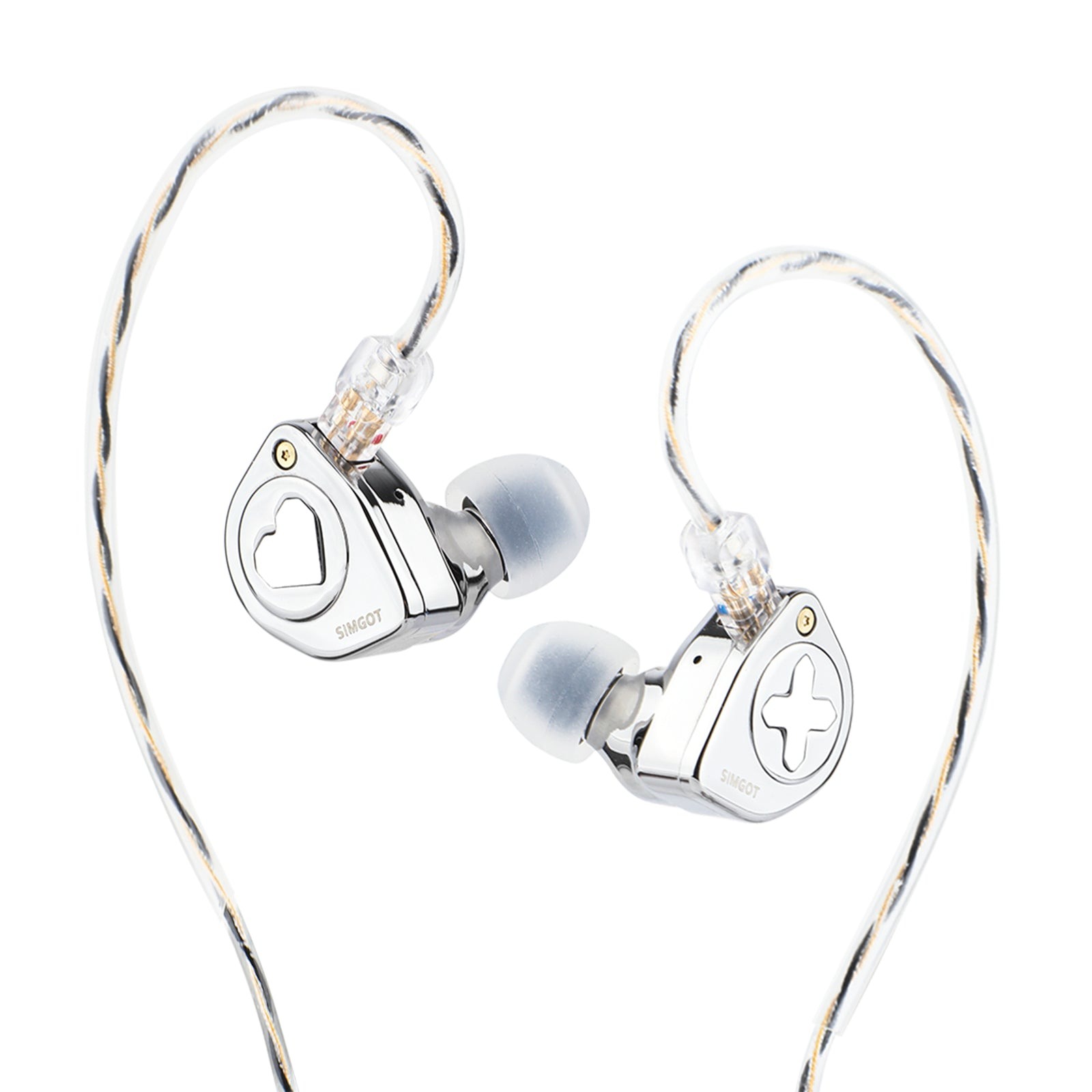
The standard Simgot EW300 compresses a complicated driver layout into a compact US$79.99 metal earphone: a 10mm dynamic driver, 6mm annular planar unit and piezoelectric ceramic driver per side. Threaded silver and gold nozzles adjust the presence region.
The engineering story is more disciplined than the driver count suggests. Independent measurements across different ear simulators repeat the same broad response: substantial sub-bass, a controlled downward slope through midbass, broad ear gain around 3–4kHz and a meaningful nozzle difference from roughly 1–6kHz. Professional and owner evidence describes a warm-leaning, readable and comparatively forgiving Simgot rather than a showcase for relentless treble detail.
The practical complication is fit. The nozzle is short enough that tip choice can change seal, retention and treble more than the filter swap for some ears. Once that is solved, the EW300 is an excellent budget hybrid. Until it is solved, neither nozzle can rescue a poor acoustic seal.
Scorecard
Robust nozzle-specific response evidence and competitive detail; no independent THD/impedance verification, while depth and driver cohesion are inconsistent
Compact CNC-alloy shells, replaceable nozzles and solid 2-pin cable; mirror finish, shallow fit and basic tip selection create friction
Excellent materials, tuning flexibility and sound quality at US$79.99, despite rising from the US$69.99 launch price
Easy to drive with two useful tonal options; fit dependence, 3.5mm-only cable and occasional filter blockage limit universality
Who it is for: listeners wanting strong sub-bass and a warmer balance without abandoning vocal clarity; buyers who find brighter budget Simgot models tiring; people willing to try both nozzles and possibly replace the stock tips; anyone seeking dense metal construction below US$100.
Who should skip it: listeners demanding deep insertion from long nozzles; buyers who want class-leading image depth or perfectly seamless single-driver timbre; people unwilling to maintain removable filters; treble-sensitive listeners without access to tip experimentation or returns.
Verified specifications
| Specification | Published or independently established value |
|---|---|
| Exact version | Standard Edition, mirror silver, passive analog 3.5mm cable |
| Driver topology | 10mm dynamic + 6mm annular planar + custom PZT per side |
| Impedance | 28Ω ±15% at 1kHz, published specification |
| Sensitivity | 121dB/Vrms silver nozzle; 119dB/Vrms gold nozzle at 1kHz |
| Claimed range | 8Hz–40kHz without a published tolerance |
| Nozzles | Silver steel/red ring and gold/pink-ring threaded filters |
| Connectors | Detachable 0.78mm 2-pin |
| Cable | Silver-plated OFC, 3.5mm single-ended |
| Tips and storage | Three silicone sizes and zipper case |
| Weight | No defensible exact-earpiece value located |
Standard, DSP and HBB are not interchangeable
This review covers the silver Standard Edition with its passive 3.5mm cable. The EW300 DSP is a separate USB-C product whose electronics alter the signal and response. The black EW300 x HBB is a collaboration variant. Neither was pooled here.
The Simgot SuperMix 4 is also unrelated despite another mixed-driver label. It uses four driver types, including a balanced armature, in a different shell at a higher price. The EW300's dynamic-planar-PZT system is a three-driver architecture.
Build, accessories and fit
The EW300's polished CNC-alloy shells feel unusually dense and substantial for the price. Recessed 0.78mm sockets, threaded nozzles and a conventional replaceable cable support long-term ownership better than fixed-cable budget designs. The heart and X faceplates make left/right recognition easy once the symbolism becomes familiar.
The mirror finish collects fingerprints, can show scratches and feels cold on first insertion. Owners otherwise treat the shell as solid; no retained standard-version faceplate-peeling or 2-pin socket-failure pattern appeared.
Three silicone-tip sizes are the weakest part of the package. Several listeners achieve an immediate comfortable fit, but the short nozzle causes shallow insertion, weak retention or shell displacement for others. Third-party wide-bore, grippy or longer tips repeatedly solve seal and treble concerns. Tip changes can also alter the perceived nozzle difference, so establish a stable fit before deciding which filter sounds better.
What the two nozzles change
Cross-rig measurements agree that both nozzles preserve the same basic bass shelf. The meaningful change is higher up:
• Silver nozzle with red ring: more output through roughly 1–5kHz, especially around 2kHz and 4–5kHz. Vocals sit farther forward and the presentation has more bite and clarity. • Gold nozzle with pink/purple ring: reduced 2–6kHz presence, creating a larger bass-to-midrange ratio and generally smoother balance.
On one 711-family sample, silver exceeded gold by roughly 3.4dB at 2kHz and 2dB at 4kHz after normalization. A standardized 5128 measurement confirms the same ordering without producing identical absolute values.
Most detailed reports prefer silver, but gold is not a guaranteed comfort switch. Several hear it as warmer and softer; one hears a thinner, more recessed and less coherent result. Ear geometry, insertion, tips and filter foam plausibly explain the disagreement. Treat both as starting points, not genre modes.
Frequency response and bass
Across standardized and 711-family measurements, 20Hz sits approximately 9–12dB above the 500–800Hz normalization region. The shelf slopes downward through midbass rather than holding a broad bass plateau. That supports audible sub-bass weight without automatically making the lower midrange thick.
The evidence supports satisfying extension and quantity without consensus basshead level. Some reports find punch and texture convincing; others hear softened kicks, average speed or interference during dense passages. There is no accessible independent exact-standard distortion sweep, so low distortion should not be claimed without data.
Midrange, treble and driver integration
A broad rise from roughly 1kHz to 3–4kHz keeps vocals intelligible. Silver adds presence; gold pulls voices slightly back. The midrange usually retains warmth and body without broad veil.
The fault line is timbre. Some listeners hear coherent, natural vocals. Others detect a metallic planar/PZT edge, slightly artificial overtones or crossover integration that becomes obvious on complex material. The EW300 does not sound like three disconnected drivers by default, but neither does the evidence support flawless cohesion.
Treble is generally smoother than the brighter Simgot EW200 family sound described in direct comparisons. Silver retains clarity and articulation; gold reduces presence further. High-volume listening, shallow insertion and cool-toned sources can still expose edge. Treble above roughly 6–8kHz changes too much with fixture and insertion to assign one precise PZT peak or claim universal extension.
Stage, imaging and detail
Lateral width is often good for the price, and owners frequently praise positional clarity for games. Depth and layering are less consistent. Reports range from above-average placement and useful depth to a flatter image with moderate separation when arrangements become dense.
The EW300 retrieves competitive detail around US$80, but it is not a technical replacement for the more expensive SuperMix 4. In an inspected direct comparison, SuperMix 4 provides greater nuance, stage and imaging; EW300 sounds thicker and more intimate.
The Truthear Pure remains another sub-US$100 alternative. Its value case rests more on measured tuning discipline and a conventional hybrid layout, while the EW300 offers denser metal construction and two physical filters. No controlled exact head-to-head was found in this research set, so the choice should rest on fit, tuning flexibility and construction rather than an invented winner.
Drivability and source behavior
Published sensitivity is 121dB/Vrms with silver and 119dB/Vrms with gold. Independent verification was not found, but phones, dongles and portable players consistently provide adequate level. A competent dongle is sufficient.
A 15Ω series-adapter experiment changed bass and mids very little after normalization while treble shifted more. It is not an impedance sweep, and insertion error can be similar in treble, so it cannot prove a flat 28Ω load. Use a normal low-output-impedance source.
Owner patterns and maintenance
Twenty-six firsthand owner/reviewer bodies were coded. Fifteen explicitly establish the Standard silver edition. Eleven use the unsuffixed EW300 name without mentioning DSP or HBB; they are retained as lower-confidence fallback rather than silently treated as exact-variant proof.
Tip and nozzle choice dominates the corpus. Most owners describe comfortable wear, strong bass, clarity and good value. Minority complaints include shallow fit, metallic or sharp treble, muddier mids in busy tracks and heavy/cold shells.
Two owners reported nozzle/filter blockage, one explicitly associated with recurring moisture. Two imbalance reports include one presence-region mismatch and one quiet side traced to a clogged nozzle. There was no qualified standard-edition driver-rattle report or silver faceplate-failure pattern. No credible 12-month reliability corpus exists.
Keep the spare nozzle set dry, let the earphones air after use and inspect the filter before assuming a driver has failed when one side becomes quieter. Avoid pushing moisture deeper into the nozzle. Persistent imbalance after swapping clean nozzles and checking the cable warrants an exchange.
Price and value
The Standard Edition launched at US$69.99. As of July 16, 2026, it was in stock at US$79.99 and C$115.99. Exact-standard marketplace listings showed 4.5/5 from 469 global ratings in the US and 4.4/5 from 462 in Canada; the pools were kept separate and were not substituted for inspected owner reports.
The ten-dollar increase does little damage to the value case. Metal shells, two useful filters, replaceable cable and a competent three-driver tuning remain unusually complete below US$100. Budget for alternative tips if the stock set does not anchor the short nozzle properly.
Verdict
The Simgot EW300 succeeds by making complexity accessible rather than spectacular. Its sub-bass shelf, readable midrange and moderated treble create a more forgiving alternative to brighter budget Simgot models. The silver and gold nozzles provide a real presence-region choice, and the polished metal build exceeds most expectations at US$79.99.
It falls short of Exceptional because fit can dominate tuning, technical depth and cohesion are not consistently superior, and the independent evidence lacks THD, impedance and sensitivity verification. Solve the seal, try silver first, and keep gold as the smoother-ratio alternative. With those expectations, the standard EW300 is one of the strongest warm-leaning hybrid values below US$100.
Methodology
This assessment combines exact-standard identity and pricing records, nozzle-specific response measurements across standardized and 711-family fixtures, six professional evaluations and 26 firsthand owner/reviewer bodies. DSP, HBB and SuperMix 4 evidence was excluded except for explicit comparison. MyHiFi has not performed hands-on testing of this product. Outside source names and quotations are retained only in the private research dossier.
MyHiFi may earn a commission from purchases made through affiliate links. This does not influence our editorial decisions or source selection.