
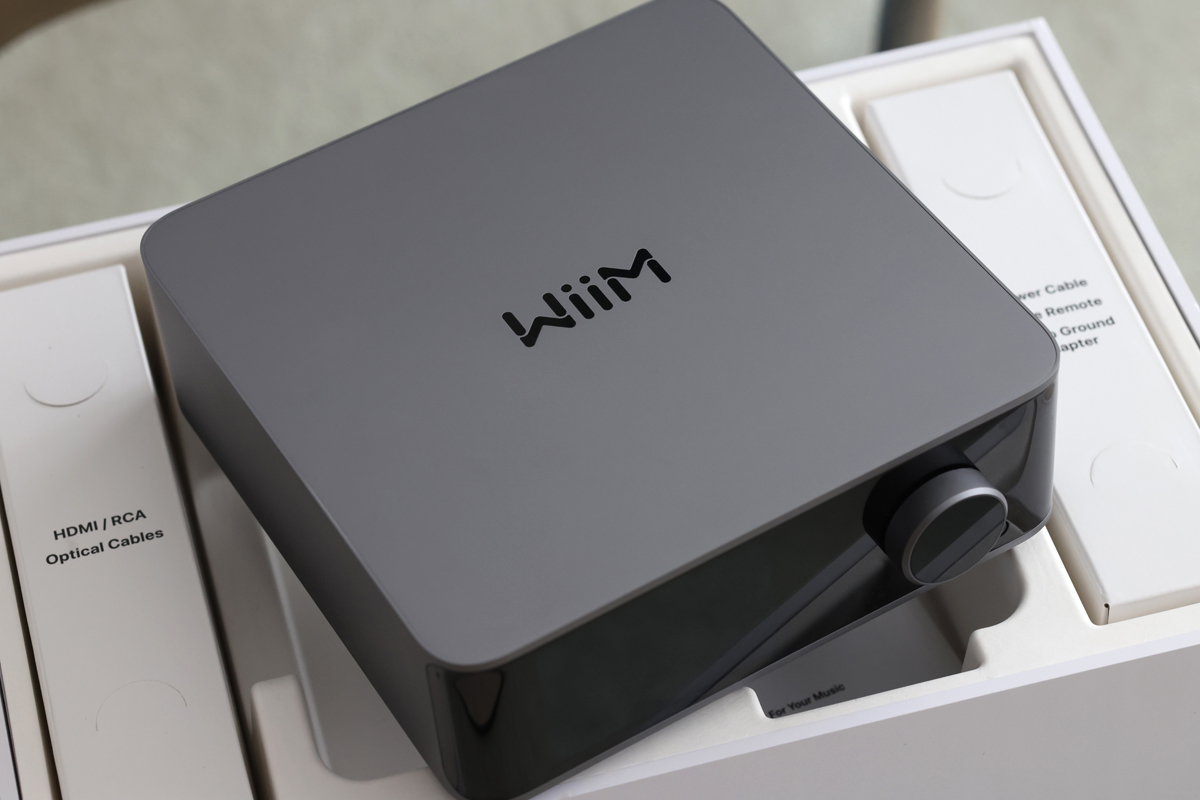
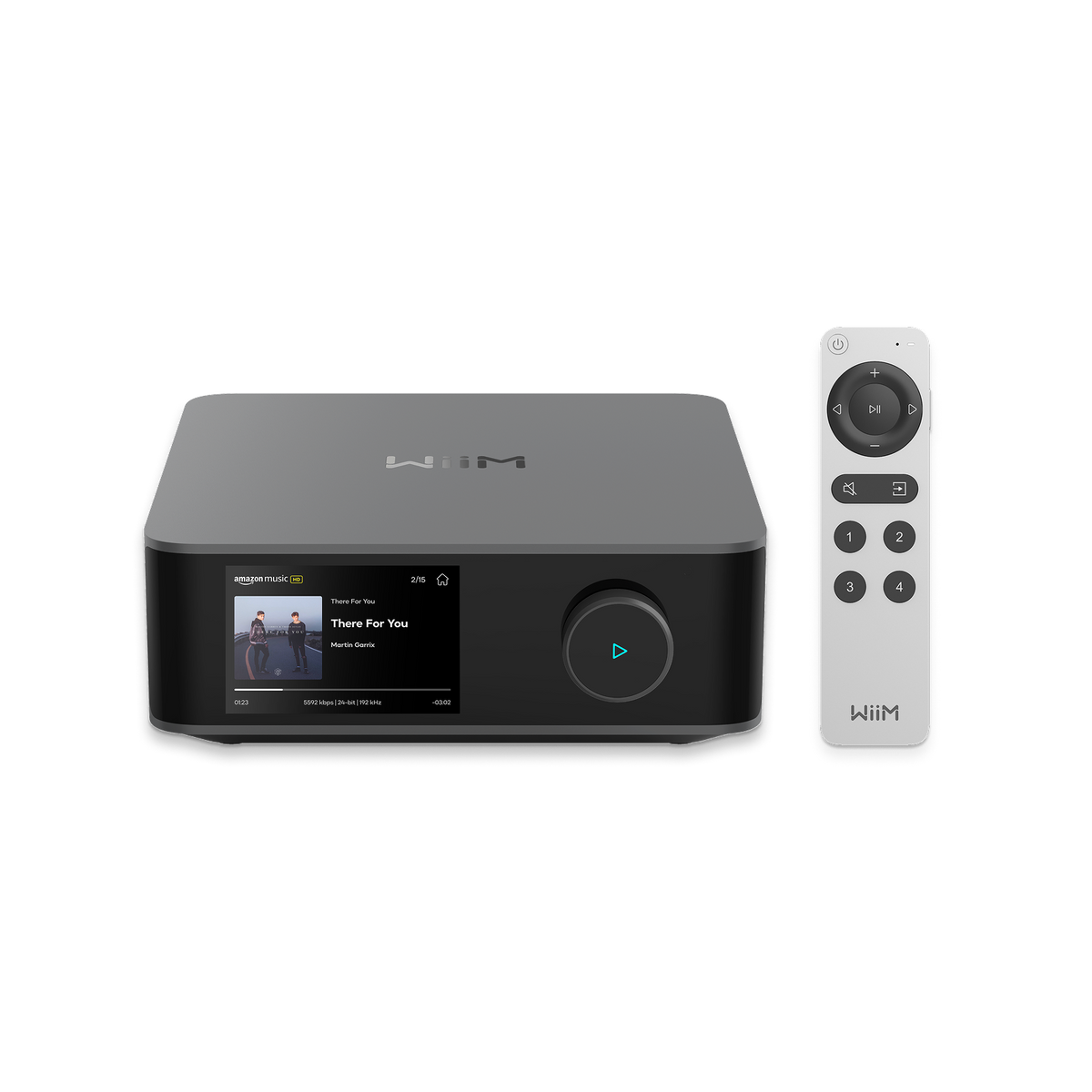
One-line verdict: Ultra is the better control center; Amp Ultra is the better complete passive-speaker system. The US$200 difference buys measured speaker power, not a universal feature upgrade.
Why this matchup is easier than it looks
The two products share a 3.5-inch touchscreen, WiiM Home control, network streaming, HDMI ARC, optical input, RoomFit, parametric EQ, bass management and a mono subwoofer output. Their names therefore suggest a simple hierarchy. The hardware says otherwise.
WiiM Ultra is a source and preamplifier. It must feed powered speakers, a power amplifier or another integrated amplifier. Amp Ultra contains the speaker amplifier itself. Its binding posts connect directly to passive speakers, while Ultra has no speaker-level output. Start with the speakers, not the feature list: powered or already amplified means Ultra; passive and unamplified means Amp Ultra.
What the extra US$200 buys
Amp Ultra's premium is primarily a power stage and the engineering around it. One independently purchased unit produced 100 watts per channel into 8Ω and 200 watts into 4Ω at 0.10% THD+N with both channels driven. At 1% THD, output reached roughly 112–114W/8Ω and 219–222W/4Ω. Those are credible integrated-amplifier figures, not a small streaming module stretched by marketing.
Post-filter feedback keeps frequency response within approximately 0.06–0.10dB across static and reactive loads. That matters because a passive speaker's impedance changes with frequency. Amp Ultra is less likely than older load-sensitive Class-D designs to impose a speaker-dependent tonal tilt.
Ultra spends its US$329 differently. Its independently measured line output reaches about 119dB A-weighted SNR and 0.00019% THD+N at 2Vrms, with 0.011dB channel tracking across volume positions. It supplies a clean signal and precise control to amplification elsewhere. Buying Ultra plus a power amplifier can exceed Amp Ultra's price, but preserves the option to choose or upgrade that amplifier.
Inputs and outputs: Ultra is actually more flexible
Ultra provides HDMI ARC, optical, RCA line and MM/MC phono inputs. Outputs include variable RCA, optical, coaxial, USB audio, mono subwoofer and a 3.5mm headphone jack. It can become the front end for active monitors, a vintage power amp, an external DAC or a compact headphone-and-speaker desk.
Amp Ultra accepts HDMI ARC, optical, one RCA line input, network streaming and Bluetooth. It outputs to speaker binding posts, one mono subwoofer and USB audio. It has no variable RCA preamp output, no headphone jack and no phono stage. A turntable therefore needs an external phono preamp; active speakers or a separate power amplifier cannot use a normal variable analog feed.
Both products digitize their analog inputs so EQ, volume, bass management and RoomFit can operate. Neither provides an all-analog bypass. Analog purists should choose neither on the assumption that vinyl remains analog end to end.
Streaming, software and the Apple caveat
Both sit inside the mature WiiM ecosystem with Spotify, TIDAL and Qobuz Connect, Roon, Google Cast, DLNA, internet radio and local playback. App control covers presets, per-input behavior, volume limits, EQ and multi-room grouping. Neither supports AirPlay 2, which can be decisive in Apple-heavy homes.
USB is another easy trap. Neither product is a normal USB computer-audio input. Ultra can read storage and provide digital audio output; Amp Ultra can host storage and operate as a USB Audio Class output. Connecting a laptop by USB-C and expecting either to appear as a conventional DAC input is the wrong use case.
Television and HDMI ARC
Both can pull television sound through HDMI ARC and support stereo PCM plus Dolby Digital handling, while DTS is absent. The appeal is volume control and automatic source behavior without an AV receiver. Ultra passes the processed signal onward to the existing amplifier or powered speakers; Amp Ultra drives passive speakers directly.
Amp Ultra's HDMI record is mixed. One extended evaluation and multiple owners found dependable switching and volume behavior; others reported intermittent silence, waking, freezing or reboots. Firmware has improved latency and compatibility, but television implementations differ. Ultra also depends on ARC behavior, so neither should be purchased without a return path when a particular TV is known to be temperamental.
RoomFit, EQ and subwoofer systems
Both offer RoomFit measurement, editable correction, per-input EQ and subwoofer crossover, level, delay and phase. Amp Ultra later gained automatic speaker/sub timing alignment. These tools are valuable because filters can be reviewed and changed, not because the automatic result is always correct.
Ultra is ideal when a powered-speaker system lacks good bass management. Its variable output feeds the speakers while the mono sub output handles low frequencies. Amp Ultra performs the same control around passive speakers. Each has one mono sub output; dual-sub systems need a splitter or external control.
Room correction should be treated as a starting point. Reported results range from firmer bass and imaging to reduced depth or treble finesse. Measure from a sensible position, inspect the filters and compare with correction disabled rather than trusting the first automatic curve.
Headphones and vinyl
Ultra wins both categories by default. Its 3.5mm headphone output is a useful convenience for ordinary headphones, although headphone-first buyers may still want a dedicated amplifier. Amp Ultra has no wired headphone connection at all.
Ultra also accepts both MM and MC cartridges through its phono input. That is valuable when vinyl should share room correction and subwoofer management. Amp Ultra's line input requires a separate phono stage. In both cases, the analog signal is digitized; buyers committed to a purely analog record path need a conventional analog preamp or integrated amplifier.
Speaker matching
Ultra does not determine speaker compatibility by itself; the downstream amplifier does. It is the right choice when that amplifier is already loved, when active monitors are staying or when future amplifier upgrades are part of the hobby.
Amp Ultra's verified 4/8Ω output and load-stable response make it suitable for many bookshelf speakers and domestic floorstanders. It has convincing headroom for products such as the KEF LS50 Meta at sensible distances and levels. Extremely low impedances, very large rooms and sustained high output still require conventional system calculations.
Value and pricing — July 2026
WiiM Ultra carries a US$329 MSRP. Its value is highest when it replaces several source boxes while preserving an existing amplifier or active speakers. Buying it for passive speakers with no amplifier simply moves the missing US$200 problem elsewhere.
Amp Ultra was in stock at US$529 direct and C$749 through a Canadian marketplace listing when reviewed. It is the better value when its internal amplifier eliminates a separate purchase. If phono, headphones or preamp outputs must then be added externally, the apparently simpler system starts growing boxes again.
WiiM Ultra
- Your speakers are powered or an amplifier already exists.
- You need phono, headphones or flexible analog/digital outputs.
- You want the most versatile system hub for US$329.
- You expect to change the downstream amplifier later.
WiiM Amp Ultra
- Your passive speakers need amplification now.
- One-box streaming, TV, EQ and speaker power is the goal.
- You value verified 100W/8Ω and 200W/4Ω output.
- You can live without phono, headphones and pre-out.
Final buying advice
Choose WiiM Ultra when the rest of the signal chain already exists. It is the more versatile product, with superior routing, phono handling, headphones and outputs for powered speakers or separate amplification. Its 92/100 score is driven by breadth and extraordinary value.
Choose WiiM Amp Ultra when passive speakers are the system. It earns the same 92/100 by replacing the power amplifier without sacrificing the core streaming, HDMI, DSP and subwoofer experience. The US$200 premium is easy to justify when it removes an amplifier purchase—and hard to justify when amplification is already owned.
For the complete product evidence, read the WiiM Ultra full review and WiiM Amp Ultra full review.
MyHiFi may earn a commission from purchases made through affiliate links. This does not influence our editorial decisions or source selection.