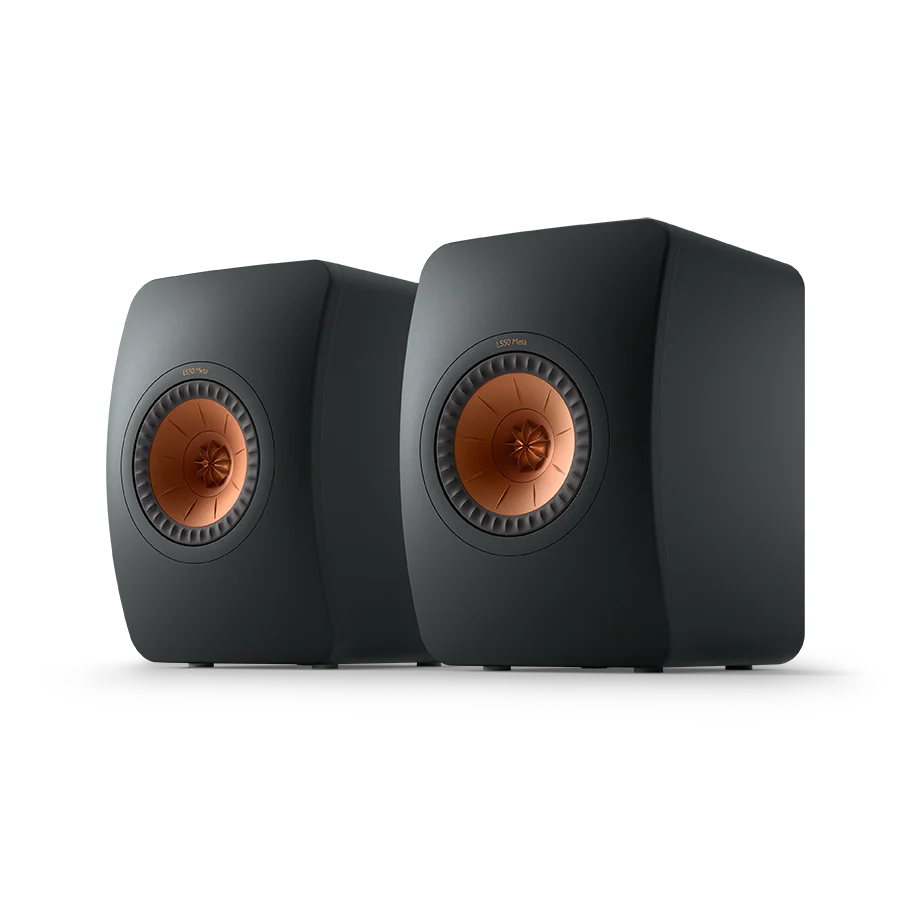
The KEF LS50 Meta is the passive successor to the original LS50, preserving the compact two-way, coaxial-driver formula while adding KEF’s Metamaterial Absorption Technology behind the tweeter. Its appeal is not mysterious: unusually coherent radiation and precise stereo placement from a cabinet that can fit into a small room. Its limitations are equally important. This is an 85dB-sensitive passive standmount with finite bass extension, a rear reflex port and an amplifier requirement that makes the complete system substantially more expensive than the speakers alone.
The buying decision turns on priorities. The LS50 Meta rewards listeners who value coherent imaging, controlled directivity and compact industrial design, but it is not a shortcut to full-range output. Budget for suitable stands, capable amplification and—where deep bass matters—a well-integrated subwoofer.
Design and verified specifications
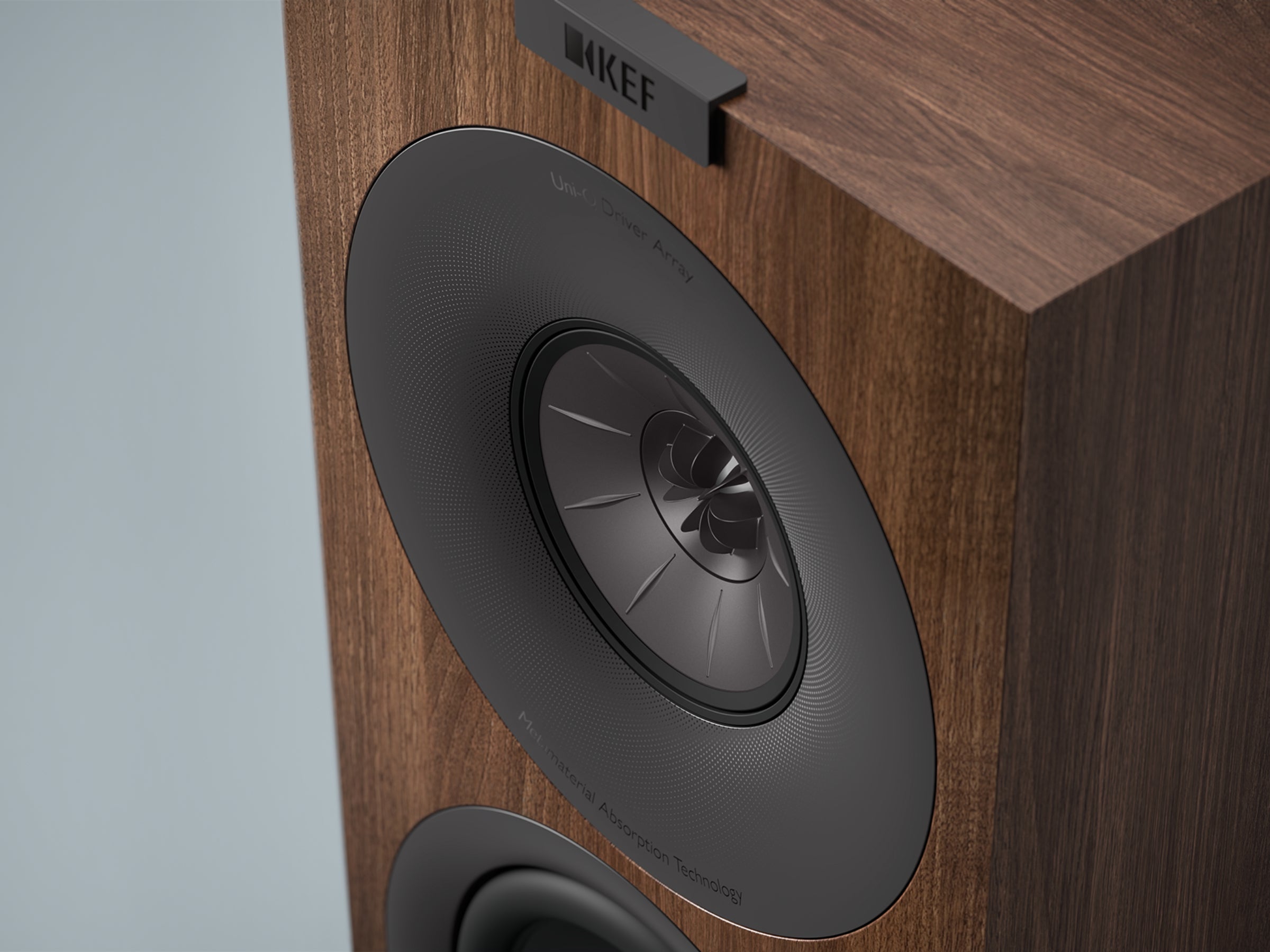
The LS50 Meta is a two-way bass-reflex loudspeaker built around KEF’s 12th-generation Uni-Q array. A 25mm vented aluminum-dome tweeter sits at the acoustic center of a 130mm aluminum-cone mid/bass driver. That concentric geometry is intended to make the pair behave more like a point source through the crossover region, supporting consistent directivity and stable imaging across a useful horizontal listening area.
The enclosure measures approximately 302 × 200 × 280.5mm and weighs 7.8kg per speaker. The curved front baffle and constrained-layer cabinet treatment address diffraction and enclosure vibration, while the flexible elliptical port is mounted on the rear—not underneath. Finish quality is a genuine strength: the compact proportions, integrated driver surround and carefully coordinated color options make the design feel more considered than a plain rectangular monitor. The trade-off is that the visually compact box is dense and deserves rigid stands rather than a casual shelf.
KEF specifies 85dB sensitivity, 8-ohm nominal impedance with a 3.5-ohm minimum, and 40–100W amplifier power. Claimed frequency response is 79Hz–28kHz at ±3dB, with a 47Hz lower limit at -6dB in typical room conditions. Those two bass figures should not be conflated: the LS50 Meta is not a 30Hz full-range loudspeaker. Boundary reinforcement may increase perceived weight, but buyers who need strong output in the bottom octave should plan for a subwoofer.
What MAT changes—and what it does not
Metamaterial Absorption Technology is a maze-like absorber behind the tweeter. KEF says its channels dissipate 99% of unwanted sound radiating from the rear of the tweeter across a specified range. That is a manufacturer claim about rearward energy absorption, not proof that the loudspeaker eliminates virtually all distortion or makes harmonics “inaudible.” The practical evidence pattern is more modest and credible: measurements and comparative reviews generally show a clean, controlled treble and lower coloration than the original LS50.
MAT is part of a wider driver revision that includes changes to the motor, suspension and tweeter cavity. It should therefore be understood as one engineering element rather than a magic disc responsible for every aspect of performance. The principal audible identity still comes from the Uni-Q arrangement, crossover design, cabinet and compact radiating area.
Performance pattern
Published measurements consistently support the LS50 Meta’s strongest claim: controlled, coherent dispersion. The speaker can establish a sharply focused center image and maintain tonal similarity across more than one seat, provided listeners remain reasonably close to tweeter height. This makes it especially convincing in small stereo rooms where imaging and spatial organization matter more than maximum output.
Tonal balance is broadly neutral, with a smooth upper range rather than an intentionally bright “detail” boost. Reports commonly describe articulate midrange, clear vocal placement and treble that remains composed on dense recordings. Those descriptions should not be mistaken for a claim of a specific sound in every room. Toe angle, reflective surfaces and listening distance materially change the direct-to-reflected balance. The controlled radiation helps, but it cannot correct a poor room.
Bass is clean and tuneful within the enclosure’s limits. The rear port contributes useful extension, yet output and distortion constraints become relevant as frequency falls and level rises. In practical terms, acoustic, jazz and most rock can sound proportionate at moderate distances, while electronic sub-bass, organ fundamentals and cinema effects expose the missing bottom octave. A properly integrated subwoofer can relieve excursion demands and make the LS50 Meta a more capable high-level system.
Dynamic scale is the other compact-speaker constraint. The LS50 Meta can play convincingly in nearfield and modest rooms, but it is not the natural choice for large spaces, distant seating or sustained concert levels. The modest sensitivity means the volume control may sit higher than expected, and the 3.5-ohm minimum favors an amplifier comfortable delivering current into low impedances.
Setup and system matching
Solid stands, tweeters near seated ear height and some clearance behind the rear port are sensible starting points. There is no universal wall distance: room modes and desired bass balance matter more than a fixed number. KEF supplies port bungs to reduce low-frequency output where boundary gain is excessive. Desktop use is possible, but the cabinet is large for a desk and reflections from the work surface can compromise the very imaging precision buyers are paying for. Short stands or isolation platforms help.
Amplifier matching should be based on current capability and room demands rather than folklore about a mandatory wattage. A competent integrated amplifier rated honestly into 4 ohms is a safer match than a weak device advertised with a large peak-power number. The speakers do not require exotic cables or a specific amplifier “flavor.” If the system sounds bright or dull, placement, room response and the recording are more plausible first checks.
The passive format has benefits: owners can choose amplification, add room correction upstream and retain the speakers if electronics change. It also reduces plug-and-play versatility. There is no DAC, streaming, volume control or room calibration onboard, unlike the active LS50 Wireless II.
Rivals and value
The original launch context was roughly $1,499 per pair. Availability and street pricing in July 2026 may vary because the model is no longer new; no current transaction price was independently verified for this refresh. Buyers should compare live listings, warranty coverage and whether stands are included.
The KEF R3 Meta is the logical step up. Its three-way architecture and dedicated bass driver provide greater low-frequency authority and dynamic ease, but at higher cost and with a larger cabinet. The Dynaudio Emit 20 is a conventional two-way alternative for buyers prioritizing fuller bass and a less explicitly point-source presentation. The active Neumann KH 120 II is a useful cross-category rival for desktop or studio buyers: amplification and calibration capability are built in, while styling and domestic simplicity favor different priorities.
At full original MSRP, the LS50 Meta’s value is good rather than unbeatable because stands, amplification and potentially a subwoofer increase system cost. At a legitimate clearance price with warranty, its combination of build, measured directivity and imaging can become much more compelling. Used buyers should inspect driver condition, cabinet damage and matched finish, and should not assume transferable warranty coverage.
Who it is for—and who it is not for
The LS50 Meta is for listeners building a high-quality passive system in a small or medium room, especially those who value stable imaging, coherent vocals and restrained treble. It also suits careful nearfield installations where there is enough desk depth and proper support.
It is not for buyers seeking deep bass without a subwoofer, high sensitivity for low-powered amplifiers, effortless large-room output or an all-in-one streaming solution. Listeners who sit far away or routinely play at very high levels should consider a larger three-way standmount or floorstander.
Verdict
The LS50 Meta earns its reputation through disciplined engineering rather than implausible claims. Its Uni-Q array produces unusually coherent spatial behavior, MAT contributes to a clean treble implementation, and the cabinet feels appropriately premium. Bass depth, sensitivity and system cost prevent it from being universal, but none undermines its core achievement as a compact passive monitor.
Composite Score: 86/100 (Highly Recommended)
• Technical Performance: 92/100 • Build Quality: 88/100 • Value: 82/100 • Versatility: 80/100
MyHiFi weights Technical Performance at 30%, Value at 30%, Build Quality at 25% and Versatility at 15%. The weighted result is 86.2, rounded to 86/100, within the Highly Recommended band.
Methodology
This assessment draws on verified manufacturer specifications, published measurements and recurring patterns in professional evaluations. Confidence: High for design, electrical behavior and broad performance character; moderate for long-term ownership. MyHiFi did not perform hands-on testing of the KEF LS50 Meta. The historical source archive was not reconstructed.
MyHiFi may earn a commission from purchases made through affiliate links. This does not influence our editorial decisions or source selection.