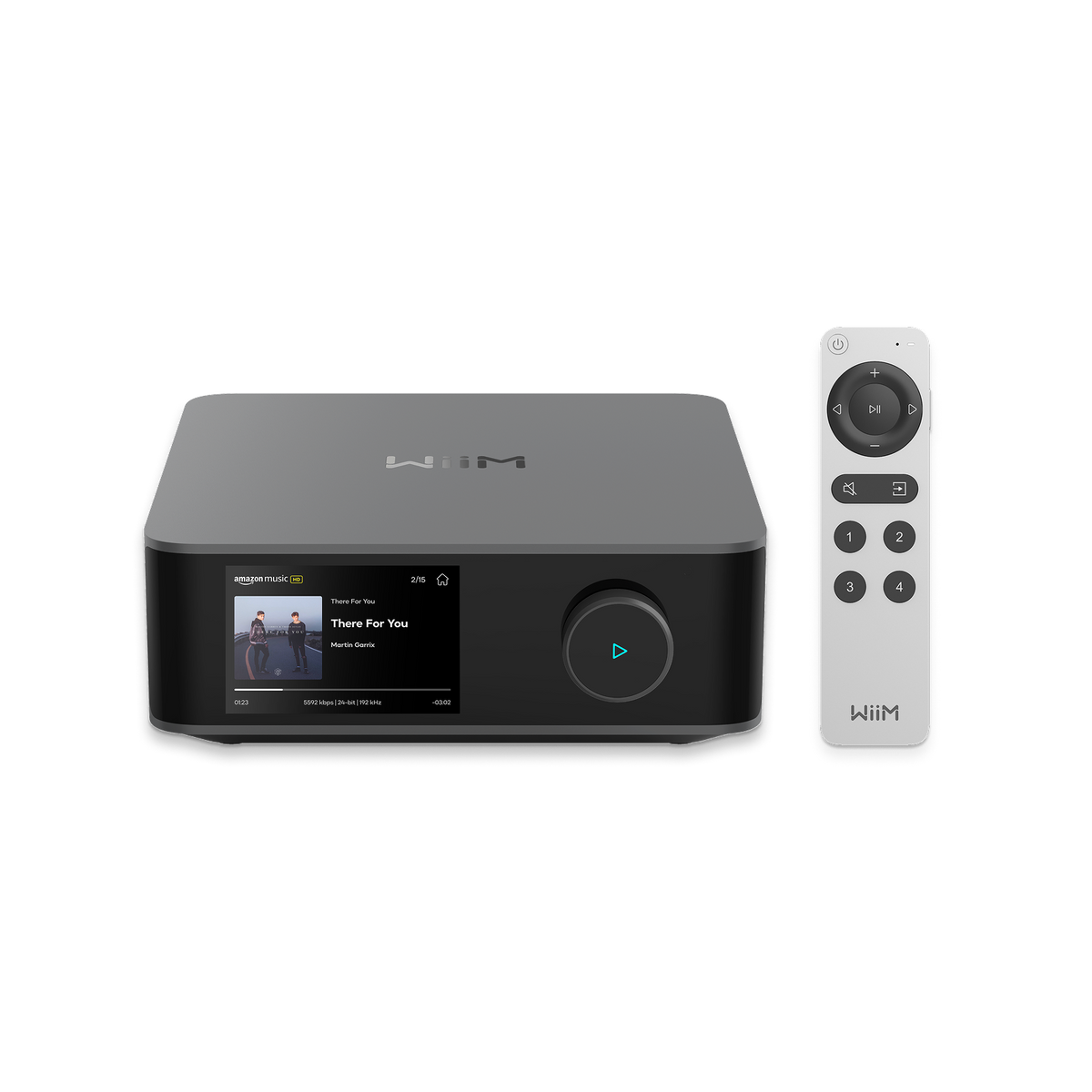
The WiiM Amp Ultra asks a difficult question of traditional hi-fi: how many separate boxes are still necessary? Its compact aluminum chassis combines network streaming, HDMI ARC, optical and analog inputs, room correction, bass management, a touchscreen and independently verified power of 100 watts per channel into 8 ohms or 200 watts into 4 ohms.
This is not the standalone WiiM Ultra with an amplifier attached as an afterthought. The Amp Ultra uses two Class-D output chips with post-filter feedback, a modern stereo DAC and a thermal system built around a heat pipe and regulated cooling. Its digital paths measure cleanly, and its frequency response barely changes across static and reactive speaker loads.
The compromises sit around the edges rather than the power stage. There is no AirPlay, phono stage, wired headphone output or preamp output. The single analog input is digitized. HDMI reliability is excellent in one extended professional test but mixed across owners, and automatic room correction is a starting point rather than guaranteed truth.
Scorecard
Verified 100W/8Ω and 200W/4Ω output, low load dependence and strong digital-path measurements; analog input and burst behavior are less exceptional
Compact aluminum chassis, excellent remote and useful display; warm operation, no physical power switch and isolated hardware failures prevent a higher mark
Streaming, amplification, HDMI, room correction and bass management would normally require several components well above $529
Broad streaming, speaker and subwoofer integration; no AirPlay, phono, headphones, pre-out, USB audio input or DTS
Who it is for: buyers building a powerful two-channel or 2.1 system around passive speakers; television viewers who want HDMI convenience without an AV receiver; listeners who value app control, per-input EQ and room correction; anyone comparing a compact integrated system with several separate components.
Who should skip it: vinyl users without an external phono stage; AirPlay-dependent households; wired-headphone listeners; owners who already have a preferred power amplifier; buyers needing preamp outputs, multiple analog inputs, DTS or guaranteed plug-and-forget HDMI behavior across every television.
Verified specifications
| Specification | Published or independently measured value |
|---|---|
| Amplifier architecture | Dual Class-D amplifier chips with post-filter feedback |
| Rated output | 100W/ch into 8Ω; 200W/ch into 4Ω, two channels driven |
| Independent output | 100/200W at 0.10% THD+N; 112–114/219–222W at 1% THD |
| DAC | ESS ES9039Q2M |
| Analog stages | Six OPA1612 op-amps |
| Inputs | HDMI ARC, optical, RCA line, network, Bluetooth 5.3 |
| Outputs | Speaker binding posts, mono subwoofer, USB audio output |
| Streaming | Roon, Spotify/TIDAL/Qobuz Connect, Google Cast, DLNA |
| Display | 3.5-inch glass touchscreen plus rotary/push control |
| Dimensions and weight | 200 × 211 × 76.2mm; 2.45kg |
Design and controls
The Amp Ultra is 200mm wide and 76.2mm tall, with an internal universal power supply and aluminum chassis. Its 3.5-inch display handles album art, status, sources, presets and basic settings; service browsing and advanced DSP remain app-driven. A rotary control and rechargeable metal remote cover everyday playback without a phone.
The chassis becomes warm under sustained use. Owner readings around 42–43°C externally and 55–57°C internally did not produce a broad shutdown pattern. There is no rear power switch; one system measured network standby around 3–6 watts, while full disconnection creates a roughly half-minute reboot.
Inputs, streaming and missing paths
HDMI ARC accepts stereo PCM and Dolby Digital 5.1 for conversion into stereo or 2.1 output. It is ARC rather than eARC, and DTS is unsupported. The 2V RCA input is digitized at up to 24-bit/192kHz; there is no pure-analog bypass.
Roon, Spotify/TIDAL/Qobuz Connect, Google Cast, DLNA and local libraries are supported over Wi-Fi 6E or Ethernet. Bluetooth 5.3 is limited to SBC/AAC. AirPlay 2, phono, wired headphones, a second analog input and variable preamp output are absent.
The USB port deserves careful wording. It can host storage and operate as a multichannel USB Audio Class 2.0 output. It is not a USB audio input for connecting a computer to the internal DAC. That distinction is easy to miss in product summaries.
Amplifier measurements: the headline is real
The clearest result is power. One independently purchased unit produced 100W per channel into 8Ω and 200W into 4Ω at 0.10% THD+N, close to the official 0.08% criterion. At 1% THD, its channels reached 112/114W into 8Ω and 219/222W into 4Ω. A 2Ω sweep reached protection around 256W; this demonstrates current capability, not a continuous 2Ω rating. Burst testing yielded no usable result.
Post-filter feedback is more than a brochure term here. Across 2, 4 and 8Ω static loads plus reactive simulations, audible-band frequency response shifted by only about 0.06–0.10dB. That makes tonal balance far less dependent on a speaker's changing impedance than older load-sensitive Class-D implementations.
Digital inputs measured around 99–100dB SINAD at 5W, with approximately 102dB SNR at 5W and 118dB at full power under a 20kHz bandwidth. The digitized analog path measured around 87dB SINAD at 5W—still transparent for ordinary sources, but not a pure path for an exceptional analog front end. One official specification pairs 0.005% THD+N with -106dB, mathematically inconsistent values; path-specific measurements are safer.
RoomFit, EQ and subwoofer integration
RoomFit generates correction from a phone or compatible microphone, while the app offers per-input graphic/parametric EQ plus subwoofer crossover, level, delay and phase. Firmware added automatic speaker/sub timing alignment in April 2026.
Results vary. Two installations improved bass integration and stereo firmness; two others lost bass depth, treble finesse or agility and required revision or disabling. RoomFit is valuable because its filters remain editable, not because the first pass is automatically correct. One mono sub output means dual subs require splitting or external control.
Software, HDMI and owner reliability
The app's streaming, grouping, per-input defaults, volume limits, EQ, presets and firmware controls are unusually deep. Most owner setups and updates were straightforward.
HDMI ARC is less uniform. One multi-week test and several owners reported dependable switching and volume control; others experienced intermittent silence, freezing after pause, unwanted waking or reboots. Current firmware reduced input latency to approximately 35–40ms and addressed TV, input, display, sub-alignment and playback issues, but neither electrical bench recorded its firmware.
More than 20 inspected owners generally reported stable streaming and ample output. Isolated cases included a failed amplifier stage, one catastrophic electrical failure, a hissy unit replaced by a quiet one, channel imbalance and sudden maximum volume. Serious individually, these do not establish a recurring failure rate.
Sound and speaker pairing
Measurements support a fundamentally neutral amplifier whose audible-band response barely changes with speaker load. Professional listening descriptions cluster around clean, controlled and clear, with firm bass and stable central imaging. Speaker and room choice still matter: lively loudspeakers can sound brighter, while warmer models add lower-midrange body.
Dynamic character produced genuine disagreement. Some evaluations heard forceful, energetic behavior and strong high-level ease. Others wanted more microdynamic shading, rhythmic propulsion and physical punch despite the power reserves. This is not a conflict the wattage number resolves. Continuous power determines headroom; perceived expression also depends on speakers, level, recording and comparator.
The Amp Ultra has enough measured output for insensitive bookshelf speakers and many floorstanders at domestic distances. Owners reported successful pairings from affordable compact models through KEF LS50 Meta and larger towers. Extremely low-impedance loads and very large rooms still deserve conventional amplifier/speaker calculations rather than relying on the 2Ω protection test.
Comparisons
The WiiM Ultra is the better choice when an existing power amplifier or active speakers are staying. It adds phono handling, headphone output and variable analog outputs that the Amp Ultra lacks. The Amp Ultra replaces those routing options with a verified high-power speaker stage and a more direct passive-speaker system.
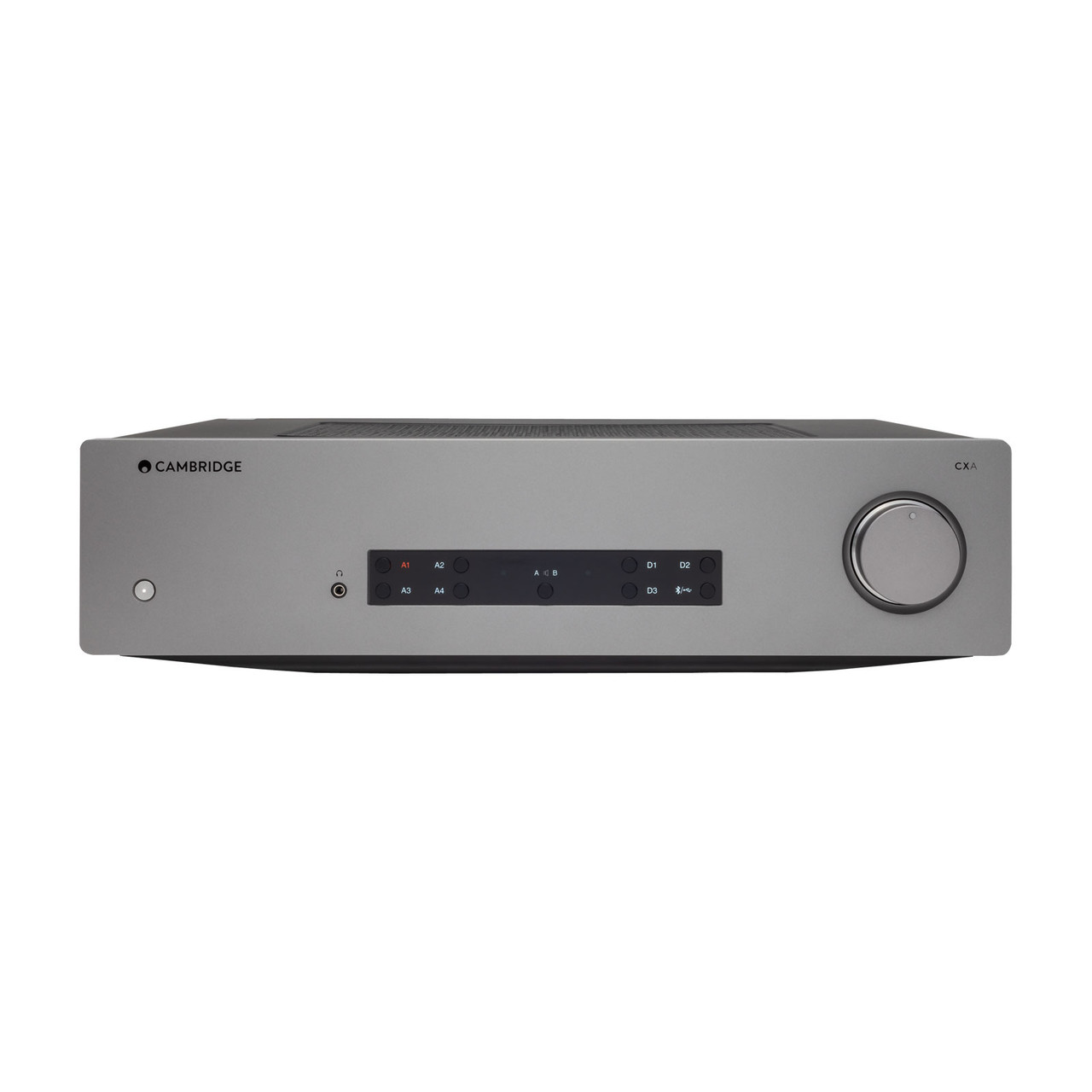
The Cambridge Audio CXA82 provides a more traditional analog-integrated experience, multiple physical inputs and a conventional upgrade path. The Amp Ultra offers substantially more digital integration, room correction, HDMI and independently verified 4Ω power for less money, but every analog source is digitized.
With the KEF LS50 Meta, the Amp Ultra's measured load stability and 200W/4Ω capability are persuasive. Room correction can help tame placement-related bass issues, but the LS50 Meta still benefits from sensible distance, level and subwoofer choices.
For the Micca RB42, the amplifier has abundant headroom and creates an unusually capable budget streaming system. The electronics cost far more than the speakers, but RoomFit and bass management provide a clear future upgrade path.
The Eversolo Play is the closest current all-in-one rival. It offers a much richer touchscreen and more direct browsing, while the Amp Ultra counters with greater measured output and a lower price. Comparative listening repeatedly favors Eversolo for spatial openness and WiiM for power; neither conclusion is level-matched consensus.
Value and verdict
The WiiM Amp Ultra was US$529 direct and C$749 through a Canadian marketplace listing on July 16, 2026. Both were in stock. Regional marketplace pools showed 4.7/5 from 682 US ratings and 671 Canadian ratings, kept separate because storefront overlap is possible.
At that price, its competitors are not only integrated amplifiers. They are also a streamer, DAC, HDMI adapter, room-correction processor, subwoofer controller, remote and power amplifier purchased separately. A stack can surpass any individual function, but it will struggle to match the total cost, footprint and integration.
The WiiM Amp Ultra earns 92/100 and an Exceptional rating. Its power claims survive independent testing, its software makes complex systems approachable, and its omissions are clearly defined. The Amp Ultra makes separates defend every box, cable and dollar they add.
MyHiFi weights Technical Performance at 30%, Value at 30%, Build Quality at 25% and Versatility at 15%. The weighted composite is 91.95, producing a 92/100 Exceptional result.
Methodology
This assessment uses two independent exact-model electrical measurement packages, six substantial professional evaluations, more than 20 inspected firsthand owners, separate regional retailer aggregates, manufacturer architecture/manual/firmware documentation and live July 2026 pricing. One measured unit was reviewer-purchased and one manufacturer-supplied; neither disclosed firmware. Confidence is High for continuous 4/8Ω output, digital and analog path performance, load invariance, hardware identity and current price; Moderate for app, HDMI, RoomFit, sub integration and subjective speaker pairing; Low-to-Moderate for burst headroom, long-term failure rate, current-firmware bench equivalence and USB output behavior. MyHiFi did not perform hands-on testing.
Affiliate disclosure: MyHiFi may earn a commission from purchases made through affiliate links. This does not influence our editorial decisions or source selection.