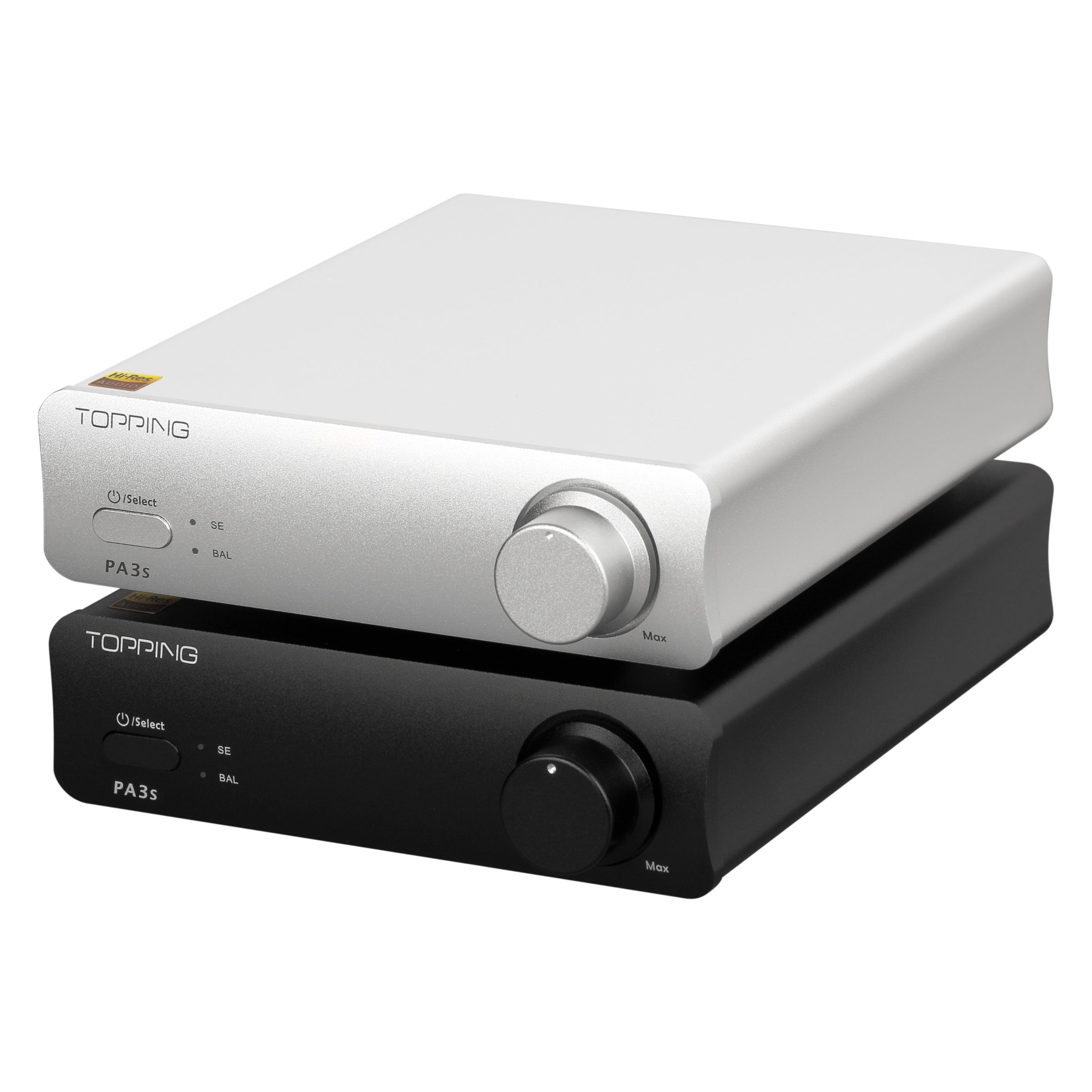
The Topping PA3s is a compact stereo power amplifier built for desktop and small-room systems. Its clearest point of distinction in the existing product record is a pair of balanced TRS inputs alongside conventional RCA inputs. That makes it relevant to buyers who already own a DAC or preamplifier with balanced outputs and want a small power amplifier rather than another integrated amplifier with duplicated source controls.
The available material is not strong enough to support a conventional scored recommendation. Exact power output, dimensions, weight, thermal behavior, damping factor, output impedance, and measured noise performance were not verified in the original record. There is also no preserved evidence that supports first-hand sound or pairing claims. This article therefore remains a Preliminary Assessment. It describes the buying decision that can be supported without filling those gaps with guesses.
Decision summary
Consider the PA3s if you need all three of the following: a compact stereo power amplifier, balanced TRS inputs, and a separate DAC or preamplifier to control volume and select sources. Do not choose it solely on an assumed power rating or on claims about a particular sound character; those points are not established by the evidence retained for this review.
Buyers driving low-sensitivity speakers, difficult 4-ohm loads, or speakers in a large room should verify the manufacturer's continuous-power specifications and the amplifier's load rating before purchase. Buyers who need multiple sources, a remote, tone controls, a phono input, a DAC, or Bluetooth should instead consider an integrated amplifier that explicitly includes those functions.
Design and connectivity
The PA3s follows a straightforward power-amplifier layout. The existing material identifies balanced TRS and unbalanced RCA inputs, a compact chassis, a front volume control, and speaker outputs. The balanced connection is the feature that separates it from many small amplifiers that accept RCA only.
Balanced inputs can reduce noise picked up over longer cable runs or in electrically busy desktop systems, provided the source has a genuine balanced output and the connection is implemented correctly at both ends. They do not automatically improve fidelity, increase power, or make the entire amplifier internally balanced. The preserved record does not establish the PA3s circuit topology beyond the use of modern Class D amplification, so broader claims would be speculation.
The compact format is suited to a desk or shallow shelf. It also reduces the area available for heat dissipation. The original draft asserted that the unit ran warm during extended use, but that statement implied hands-on testing that MyHiFi did not perform and has been removed. Prospective buyers should follow the manufacturer's ventilation guidance rather than infer thermal limits from the enclosure size.
System matching
The PA3s is a power amplifier, so it needs a source with volume control. A DAC/preamp with balanced TRS or compatible balanced outputs is the most obvious match, but RCA sources remain relevant when cable runs are short and free of noise. Connector compatibility should be checked carefully: balanced TRS, XLR, and unbalanced RCA are not interchangeable merely because adapters exist.
No speaker pairing is endorsed here. The earlier draft named the KEF Q150 and ELAC Debut 2.0 B6.2, then admitted that those pairings were unconfirmed. Those recommendations have been removed. Speaker sensitivity alone is not enough to establish a safe match; nominal impedance, impedance minima, listening distance, room size, and desired output all affect the demand placed on an amplifier.
For nearfield use at moderate levels, compact Class D power amplifiers can be practical because they occupy little space and avoid duplicating controls already present on a DAC. That category-level observation is not proof of the PA3s's output into a particular loudspeaker. Verify the current manual and manufacturer rating for the exact speaker load before building a system around it.
What is missing
The original record does not verify the following information:
• continuous output into 4- and 8-ohm loads under stated distortion conditions; • minimum supported speaker impedance; • dimensions and weight; • gain, input sensitivity, output impedance, or damping factor; • independent noise, distortion, crosstalk, and thermal measurements; • sustained output under a demanding load; • current warranty terms and retailer availability.
These are consequential omissions for a power amplifier. A peak or headline wattage figure without test conditions would not resolve them, which is why no power number has been added from memory.
Preliminary scorecard
| Dimension | Status | Reason |
|---|---|---|
| Technical Performance | Not scored | No verified power, load, noise, or distortion evidence in the retained record. |
| Value | Not scored | A current July 2026 price and verified competing specification set are unavailable. |
| Build Quality | Not scored | The compact chassis is documented, but materials, dimensions, thermal behavior, and durability are not sufficiently established. |
| Versatility | Not scored | Balanced TRS and RCA inputs are useful, but the full verified connection and control set is incomplete. |
| Composite | Not scored | Evidence is insufficient for a defensible weighted composite or rating band. |
Value and alternatives
The PA3s's value turns on price, verified power into the buyer's speaker load, and whether balanced inputs solve a real system problem. If balanced connectivity is unnecessary, a wider range of compact RCA-input amplifiers may qualify. If source selection and remote volume are required, an integrated amplifier may be better value even if it occupies more space.
MyHiFi has not independently verified a current July 2026 street price or stock status. The frontmatter therefore retains MANUAL_SEARCH_REQUIRED rather than directing readers to an unverified product listing. Check the exact model, seller, warranty, current manual, and return policy before purchase.
Verdict
The PA3s has a coherent role on paper: a compact stereo power amplifier for a system that already has source selection and volume control, with balanced TRS inputs as its most useful differentiator. The retained evidence does not establish how much difficult-load power it can sustain, how quiet it measures, or how it compares at a current price. That prevents a responsible recommendation and score.
For now, the correct conclusion is Preliminary Assessment. Buyers with efficient speakers and a balanced DAC/preamp may find the format appealing, but they should verify the missing electrical and commercial details rather than treating this page as a substitute for them.
Methodology
This assessment uses only the facts and limitations preserved in the earlier MyHiFi draft. MyHiFi did not perform hands-on testing of this unit. Historical research files and source counts were not reconstructed, and first-person listening, temperature, noise-floor, and speaker-pairing claims were removed because the retained record did not support them.
Price context was reviewed in July 2026. No live price or availability was independently verified; retailer listings can change and should be checked before buying.
MyHiFi may earn a commission from purchases made through affiliate links. This does not influence our editorial decisions or source selection.