DALI Rubikore 2 Review: Flagship DNA in a Terrestrial Package
The DALI Rubikore 2 arrives at a fascinating inflection point for the Danish manufacturer. As the replacement for the long-serving Rubicon 2—a speaker that became something of a default recommendation for discerning listeners seeking Scandinavian warmth without Scandinavian prices—it inherits both a legacy and a challenge. More importantly, it represents the most aggressive trickle-down exercise yet from DALI’s £85,000 KORE flagship, packing genuinely exotic driver technology into a standmount that costs roughly 3% of its aspirational sibling.
At £2,299 ($2,500 / AU$4,199), the Rubikore 2 occupies the upper-mid tier of the two-way standmount market, competing directly with established heavyweights like the KEF R3 Meta and the Bowers & Wilkins 705 S3. Yet DALI’s approach here is distinctively idiosyncratic: where competitors chase absolute neutrality or studio-monitor precision, the Rubikore 2 unapologetically prioritizes musical engagement and tonal richness.
Design & Engineering
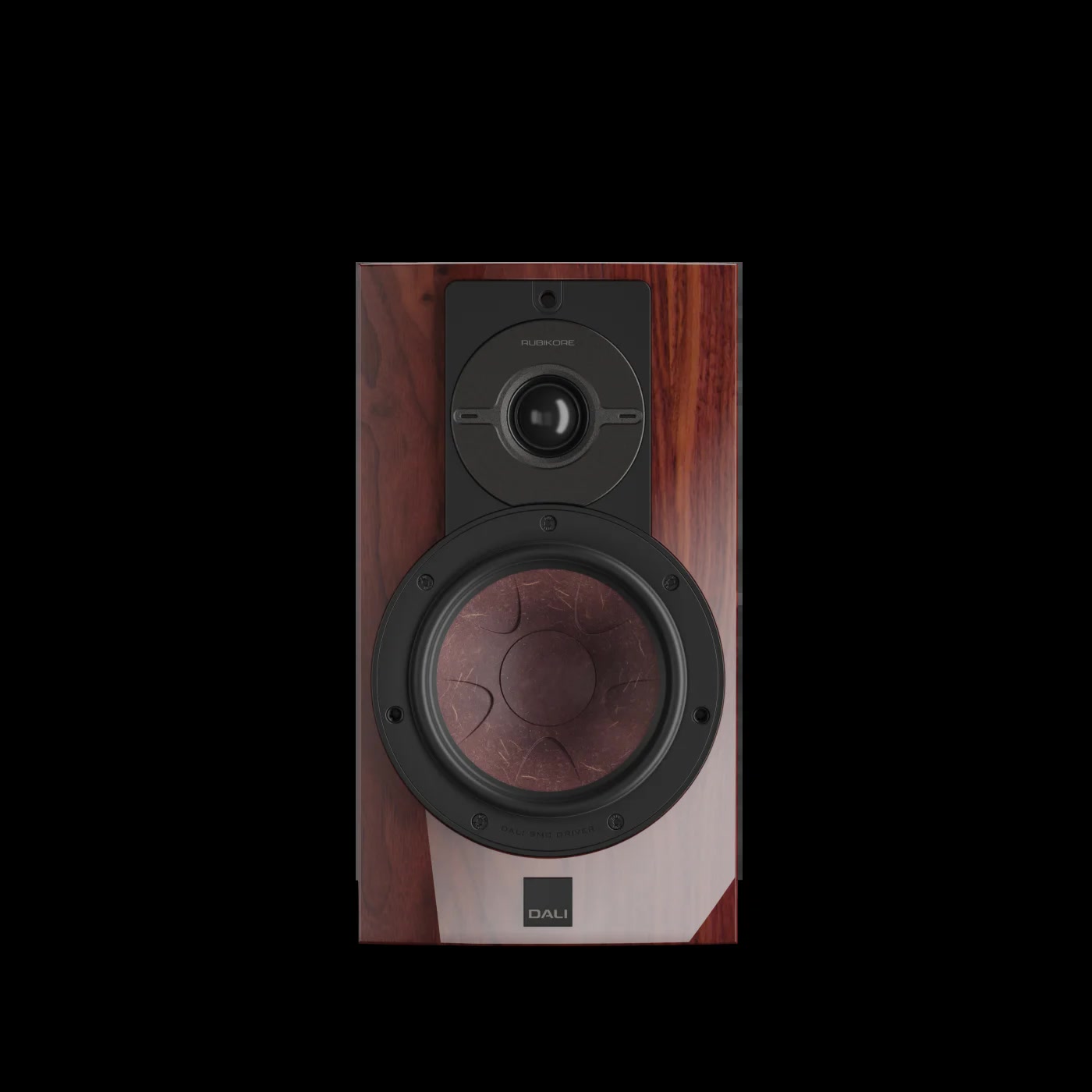
Physically, the Rubikore 2 betrays its Rubicon lineage—same curved front baffle, same compact footprint (350 x 195 x 335mm), same substantial 9.5kg heft. The cabinet remains internally braced and extensively damped, available in high-gloss black, white, maroon, or natural walnut. The finish quality is impeccable, though DALI’s refusal to adopt magnetic grilles—opting instead for visible plastic lugs—remains a curious aesthetic compromise at this price point.
The technical story lies in the drivers. The 29mm soft-dome tweeter is a direct descendant of the KORE’s unit, notable for its omission of ferrofluid cooling. By eliminating this damping fluid, DALI claims improved transient response and lower dynamic compression, though the trade-off is a tweeter that demands careful amplifier matching to avoid stridency. Below it sits the 165mm “Clarity Cone” mid/bass driver, constructed from DALI’s proprietary paper-and-wood-fibre pulp and reinforced with five asymmetrical indentations to break up cone resonances.
Crucially, this driver incorporates SMC (Soft Magnetic Compound)—a material previously reserved for the Epicon range and above—within its double-magnet motor system. SMC’s low electrical conductivity minimizes eddy currents and flux modulation, theoretically reducing distortion and improving micro-detail retrieval. The crossover, set at 2.8kHz and utilizing Mundorf components, omits the SMC-Kore inductors found in the larger Rubikore 6 and 8 floorstanders, a sensible cost-saving measure that nonetheless differentiates the standmount from its siblings.
The rear-firing “Continuous Flare” bass reflex port, tuned to 44Hz, employs a gradually expanding diameter to minimize port noise and compression. DALI’s insistence on zero toe-in—famously acronymed as “Don’t Angle Loudspeakers Inwards”—remains in effect, positioning the speakers parallel to the wall for optimal dispersion characteristics.
Performance
The Rubikore 2’s sonic signature is immediately recognizable as DALI’s handiwork, yet distinctly evolved from the Rubicon 2 it replaces. Where the previous generation offered a relaxed, somewhat laid-back presentation, the Rubikore 2 is noticeably more forward, dynamic, and rhythmically propulsive. This is not a speaker that fades into the background; it demands attention.
Bass extension is remarkable for the cabinet size. The claimed 50Hz (-3dB) lower limit is believable in-room, with the Rubikore 2 delivering genuine weight and authority that belies its standmount status. More impressive than depth is the textural nuance—acoustic bass lines resolve with proper woody resonance, while synthesized low-end remains taut and controlled. The Continuous Flare port proves its worth here, avoiding the chuffing or one-note boom that plagues lesser reflex designs.
The midrange is the Rubikore 2’s undeniable strength. Vocals emerge with a creamy, organic saturation that recalls the best of British monitor tradition, yet with a distinctly Scandinavian sense of air and space. The wood-fibre cone’s character—slightly warm, slightly rich—rewards acoustic and jazz recordings with a palpable sense of body. String textures are particularly well-served, offering rosined detail without the metallic edge that can afflict aluminum-cone competitors.
The treble is where opinions diverge. The ferrofluid-free tweeter is exceptionally resolving and extended, contributing to a soundstage that is wide, deep, and precisely imaged. However, the top octave can present as excitable or “brittle” with certain recordings or electronics, particularly during the initial break-in period. Reviewers note that positioning the speakers closer to the rear wall—approximately 20cm—helps tame potential brightness through boundary reinforcement, while DALI’s no-toe-in policy prevents excessive on-axis energy. System matching is critical: bright, analytical amplifiers will exacerbate the tweeter’s forward nature, while warmer, Class A or tube-adjacent solid-state designs complement it beautifully.
One limitation worth acknowledging: the Rubikore 2 is not a quiet-listening specialist. Below moderate volumes, the speaker’s dynamic snap and bass authority diminish noticeably, suggesting a design optimized for active, engaged listening rather than background ambiance. Its 87dB sensitivity and 4-ohm nominal impedance also demand an amplifier with current delivery capability, though the 40-150W recommended range suggests modestly powered but high-quality integrateds will suffice.
Comparisons & Context
Against the outgoing Rubicon 2, the Rubikore 2 represents a clear technical advance—tighter bass, more extended highs, and greater transparency—while sacrificing some of the older model’s forgiving, “wall-of-sound” soundstage width. Listeners prioritizing absolute relaxation may prefer the discontinued model at clearance prices, but the Rubikore 2’s superior resolution and dynamic punch make it the objectively superior speaker.
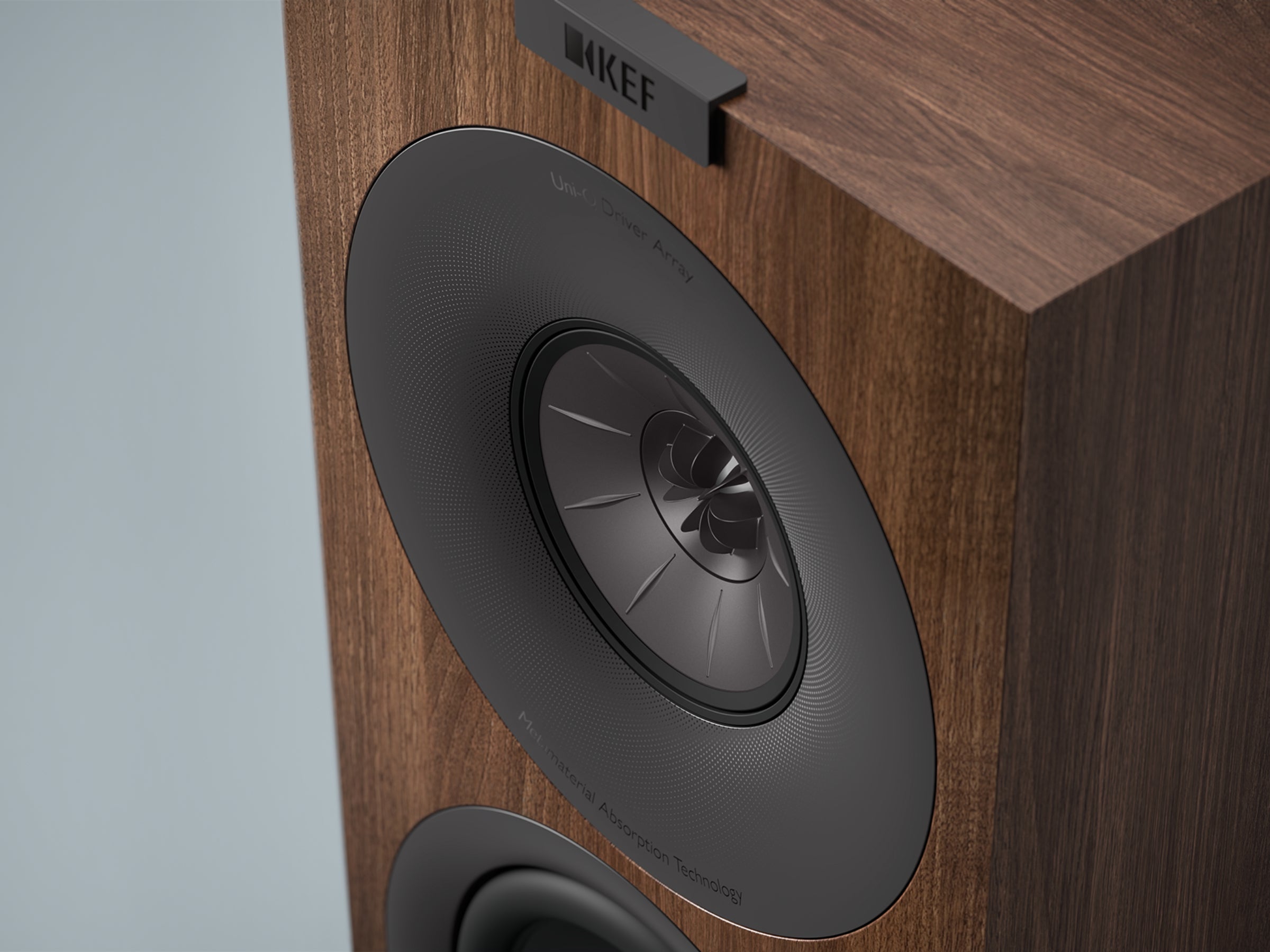
Compared to the KEF R3 Meta, the DALI offers a warmer, more organic tonal balance versus the KEF’s clinical accuracy. The R3 Meta’s Uni-Q array provides superior off-axis consistency and a more neutral midrange, but the Rubikore 2 counters with superior bass extension and a more emotionally engaging rhythmic drive. For listeners seeking “fun” over “reference,” the DALI is the compelling choice.
Within DALI’s own hierarchy, the Rubikore 2 notably lacks the hybrid ribbon/dome tweeter found in the Rubikore 6 and 8 floorstanders. While this keeps the standmount’s proportions elegant, it means the 2 doesn’t quite achieve the effortless air and ultra-high-frequency extension of its larger siblings. Those seeking the full “KORE experience” in compact form may need to look to the more expensive Epicon 2, though the Rubikore 2’s value proposition is arguably stronger.
Pairing Recommendations
The Rubikore 2 thrives with amplification that respects its 4-ohm load and tames its treble enthusiasm. The Arcam SA20’s Class G topology provides excellent control and a slightly warm tonal balance that complements the DALI’s character. Similarly, the Cambridge Audio CXA81 offers sufficient current delivery and a neutral-slightly-warm presentation that allows the speakers’ midrange richness to shine without exacerbating top-end energy. For tube-curious listeners, the Rubikore 2’s relatively flat impedance curve makes it more tube-friendly than many modern designs, though output transformers with robust 4-ohm taps are recommended.
Stand choice is critical: the rear-ported design benefits from sturdy, mass-loaded stands positioned to allow the port to breathe. The 44Hz tuning means wall proximity is actually beneficial, contrary to conventional wisdom about rear-ported designs.
Verdict
The DALI Rubikore 2 is a sophisticated exercise in trickle-down engineering that largely succeeds in democratizing flagship-level driver technology. Its combination of exceptional bass depth for the size, a gorgeously saturated midrange, and genuine dynamic authority makes it one of the most engaging standmounts available under £2,500.
The caveats are specific but significant: the treble requires careful system matching and room positioning, and the speaker refuses to perform at its best at whisper-quiet levels. These are not flaws so much as character traits—this is a speaker built for active listening, not passive consumption.
MyHiFi Composite Rating: 86/100 (Highly Recommended) Technical: 88 | Build: 86 | Value: 86 | Versatility: 83
The Rubikore 2 is for listeners who value rich midrange tone, strong bass for the cabinet size and energetic delivery. It is not for low-volume background use, bright systems or buyers seeking strict neutrality. Against the KEF R3 Meta, choose the DALI for warmth and rhythmic energy; choose the KEF for more even off-axis behavior and a more neutral midrange.
Price context: MSRP at publication was $2,500, with £2,299 and AU$4,199 also cited; review refreshed July 2026. Check current regional pricing.
Methodology
This older review was refreshed from its original research, manufacturer specifications, independent measurements where available, professional evaluations and owner patterns. MyHiFi has not performed hands-on testing of this product. Confidence: Moderate.
MyHiFi may earn a commission from purchases made through affiliate links. This does not influence our editorial decisions or source selection.