KEF Q Concerto Meta Review: The Three-Way Sweet Spot
The KEF Q Concerto Meta arrives at a curious inflection point for the British loudspeaker manufacturer. With the LS50 Meta cementing itself as a modern classic and the R3 Meta occupying the premium standmount tier, the Q Series has historically served as the accessible entry point to KEF’s Uni-Q coaxial philosophy. Yet the Concerto Meta—reviving a nameplate last seen in 1969—represents something more ambitious than a mere iterative update. It is the first three-way bookshelf speaker in the Q Series lineage, and it carries the distinct burden of bridging the gap between the compact LS50 Meta and the substantially more expensive R3 Meta.
At its $1,299-per-pair launch context, the Concerto Meta entered a crowded bracket. Manufacturer data, measurements and published reviews point to a speaker that prioritizes tonal completeness and controlled directivity over conspicuous treble. Price context: MSRP at publication was $1,299 per pair; review refreshed July 2026. Check the retailer for current pricing.
Architecture and Acoustic Design
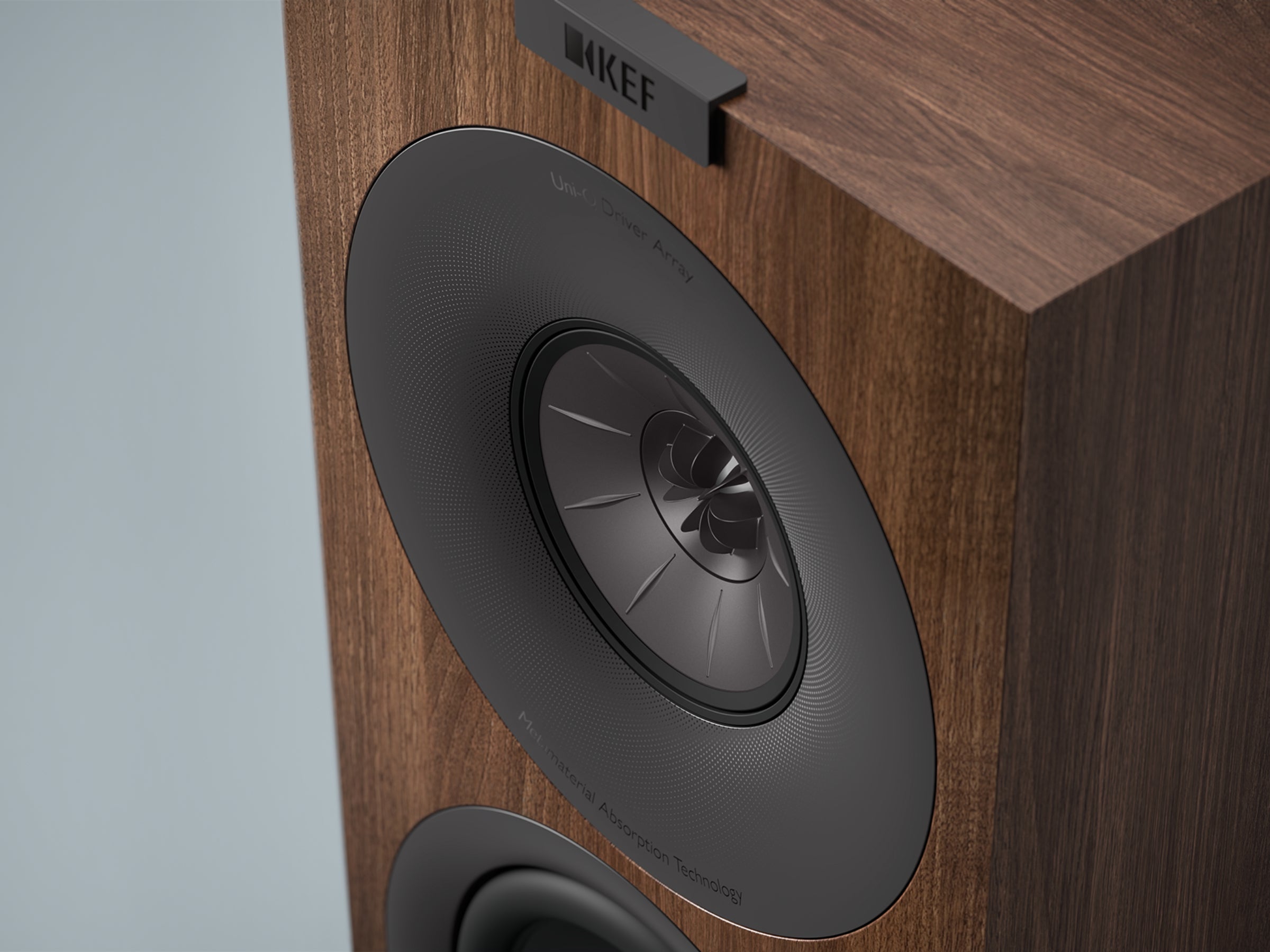
The Concerto Meta’s three-way topology is the headline feature, and it’s worth unpacking why KEF broke from the two-way tradition that has defined the Q Series since its inception. The 12th Generation Uni-Q driver array—comprising a 0.75-inch vented aluminum dome tweeter concentrically aligned with a 4-inch aluminum midrange—handles frequencies above 430Hz. Below that, a dedicated 6.5-inch aluminum-skinned paper cone woofer manages the low-frequency spectrum, crossed over at 2.9kHz to the tweeter.
This separation of labor matters. By offloading bass duties to a dedicated driver, the Uni-Q array is freed from the excursion-limited compromises inherent in two-way designs. The midrange driver can operate within its optimal pistonic range, while the woofer—augmented by a rear-firing flared reflex port—delivers bass extension claimed to reach 48Hz at ±3dB. More significantly, the inclusion of Metamaterial Absorption Technology (MAT)—that maze-like structure positioned behind the tweeter—reportedly absorbs 99% of rearward radiation that would otherwise reflect back through the dome and color the output.
The exact measurement methodology behind that figure is proprietary, but the acoustic result is a tweeter that exhibits remarkably low distortion characteristics and a lack of the "hash" or grain that can plague aluminum dome designs.
The cabinet itself measures 16.5 inches tall, 8.3 inches wide, and 12.7 inches deep, weighing in at 20.9 pounds per speaker. It’s a substantial presence—significantly larger than the LS50 Meta and approaching the physical footprint of the R3 Meta. The vinyl-wrapped finish (available in satin black, satin white, or walnut) is executed with the precision expected at this price point, though it lacks the lavish real-wood veneer of the R Series.
Measured Performance and Real-World Behavior
Laboratory measurements reveal a frequency response that tilts gently downward on-axis—a deliberate voicing choice that, when combined with the speaker’s excellent directivity index, results in an exceptionally linear in-room response. The Listening Window (a spatial average of nine amplitude responses in the ±10° vertical and ±30° horizontal range) tracks closely with the on-axis response, indicating that the Concerto Meta maintains its tonal character across a wide seating area.
The 85dB sensitivity rating and 4-ohm nominal impedance demand careful amplifier consideration. This is not a speaker for budget Class D chip amps or entry-level AV receivers operating in the latter halves of their volume ranges. The load favors amplifiers capable of solid current into 4 ohms. A blanket 100-watt minimum is not established here; room size, listening distance and current capability matter alongside the headline power rating.
The rear-firing port introduces placement sensitivity. While KEF provides foam port bungs for near-wall installations, the speaker truly breathes when given 12 to 18 inches of clearance from the front wall. In smaller rooms, boundary reinforcement can elevate the low bass slightly, though the 430Hz crossover point ensures that mid-bass bloom remains controlled and does not muddy vocal intelligibility.
Sonic Character: The Anti-LS50?
Where the LS50 Meta presents a hyper-resolved, almost analytical window into recordings—sometimes to the point of clinical sterility—the Concerto Meta takes a different tack. The additional bass driver and larger cabinet volume confer a sense of physical scale and dynamic ease that the smaller speaker simply cannot match. Bass is taut and articulate rather than boomy, with sufficient extension to render acoustic double bass with proper heft and electronic music with genuine sub-bass presence down to the high 30Hz range in-room.
The midrange is where the three-way architecture pays dividends. Vocals exhibit a naturalistic body and chest resonance that two-way designs often thin out in pursuit of crossover simplicity. The concentric Uni-Q array maintains KEF’s trademark imaging precision—soundstaging is holographic, with stable center-fill and precise lateral placement—but the presentation is notably less "forward" than previous Q Series iterations. Some listeners may perceive this as a slightly "darker" tonal balance compared to the Q3 Meta or older Q350, but this is better understood as a reduction in upper-midrange emphasis rather than a lack of resolution.
Treble performance is refined and smooth, lacking the metallic bite that characterized earlier aluminum dome iterations. The MAT treatment works as advertised, delivering high-frequency detail without the fatigue that can accompany extended listening sessions on more aggressive designs.
Comparative Context and Pairing Recommendations
Within KEF’s own ecosystem, the Concerto Meta renders the buying decision more complex than a simple linear progression. The Q3 Meta ($800/pair) remains an excellent two-way option for smaller rooms or nearfield listening, but it cannot match the Concerto’s dynamic headroom or bass authority. The R3 Meta ($2,199/pair) offers superior cabinet construction, lower distortion, and slightly cleaner bass articulation, but the gap in performance is narrower than the 70% price premium would suggest. For many listeners, the Concerto Meta represents the point of diminishing returns in KEF’s standmount hierarchy.
Against external competition, the Concerto Meta distinguishes itself from the Bowers & Wilkins 606 S3 and similar offerings through its superior off-axis consistency and wider sweet spot. While the B&W may offer slightly more pronounced treble sparkle, the KEF’s tonal coherence across the listening window makes it the more forgiving choice for rooms that lack extensive acoustic treatment.
Amplifier pairing is a recurring consideration. Reports favor neutral-to-warm solid-state designs, including suitable integrated amplifiers from Arcam, Cambridge Audio and NAD’s Classic series. Reports also indicate that modest tube amplifiers can struggle with the 4-ohm load at higher levels, while higher-current designs fare better. Avoid pairing with bright, analytical solid-state amplifiers, as the combination can emphasize the slight upper-treble rolloff in a way that sounds constrained rather than relaxed.
Home Theater Versatility
As the anchor of a 5.1 system, the Concerto Meta excels. The timbral match with KEF’s Q6 Meta center channel and Q4 Meta surrounds is seamless, and the speaker’s dynamic capabilities prevent the front soundstage from collapsing during complex action sequences. The dedicated midrange driver ensures that dialogue—whether anchored to the center or panned across the front stage—remains intelligible without the chestiness that can afflict smaller two-way designs when pushed to theatrical levels.
Verdict
The KEF Q Concerto Meta is a mature, thoughtfully engineered loudspeaker that prioritizes long-term listening satisfaction over immediate sonic gratification. It demands proper amplification and careful placement to reveal its full capabilities, but rewards those investments with a balanced, authoritative presentation that challenges speakers costing significantly more.
Composite Score: 87/100 (Highly Recommended)
• Technical Performance: 90/100 • Build Quality: 85/100 • Value: 88/100 • Versatility: 82/100
The Concerto Meta is for listeners who want floorstander-like scale from stands, broad seating consistency and restrained tonality. It is not for small desks, weak amplification or buyers who want an overtly bright presentation. Choose it over the KEF Q3 Meta for bass authority and headroom; choose the Q3 Meta for smaller rooms and lower cost. The R3 Meta remains the step up for cabinet finish and lower distortion.
Methodology
This older review was refreshed from its original research, manufacturer specifications, independent measurements where available, professional evaluations and owner patterns. MyHiFi has not performed hands-on testing of this product. Confidence: High.
MyHiFi may earn a commission from purchases made through affiliate links. This does not influence our editorial decisions or source selection.