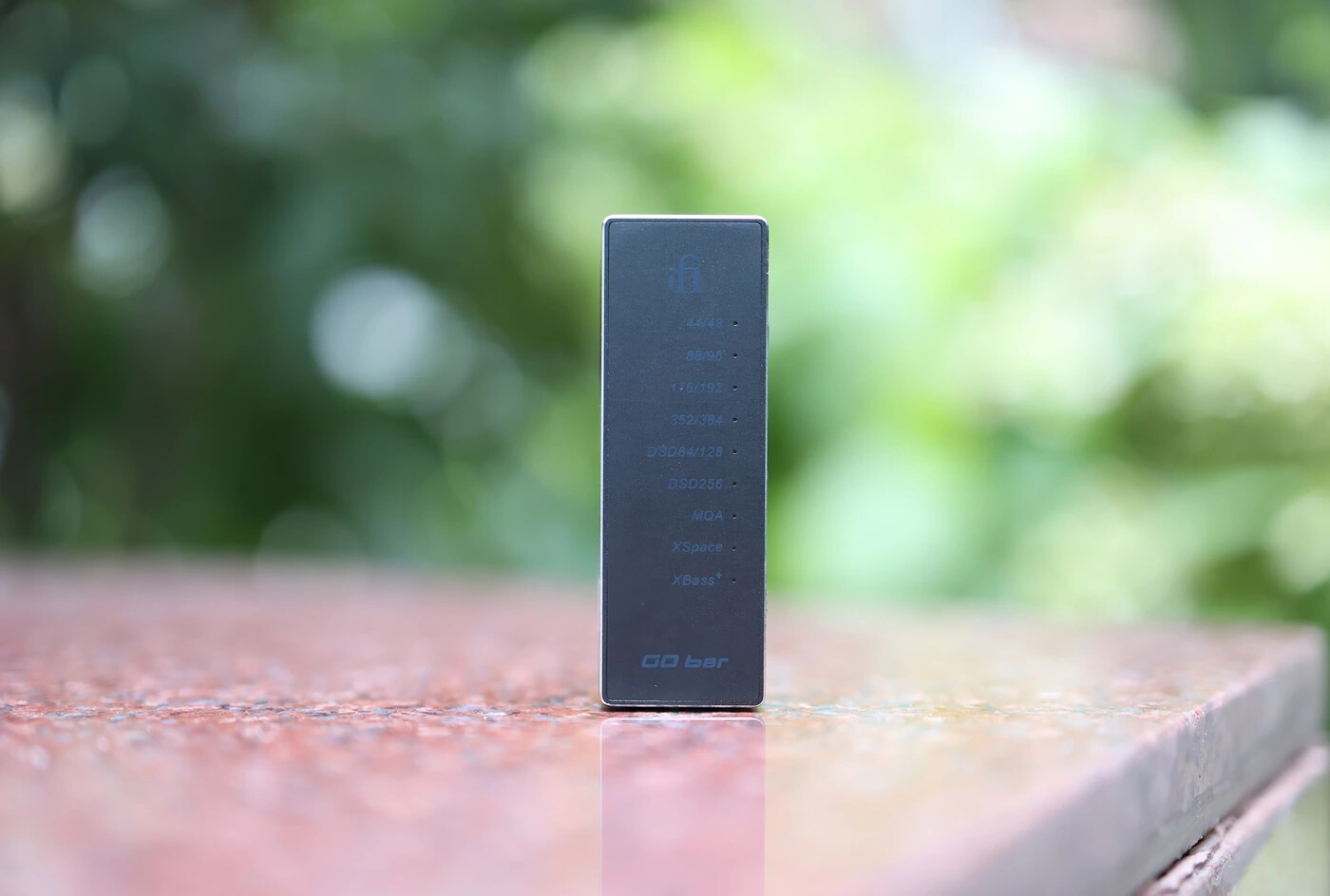
The portable audio landscape has reached its logical extreme: a $329 aluminum USB stick promising desktop-grade DAC architecture and enough amplification to drive planar magnetics from your phone’s bus power. The iFi GO bar represents this precipice—cramming dual Cirrus Logic CS43131 chips, MQA rendering, and 475mW of balanced output into a form factor barely larger than a flash drive. But physics demands compromise, and the central question isn’t whether iFi packed impressive specs into a small space, but whether you can actually use that power without burning your pocket or draining your battery before the commute ends.
Design and mobile use
The GO bar trades the cable-style flexibility of budget dongles for a rigid aluminum chassis that feels substantial but creates immediate ergonomic friction. The chassis houses a crisp OLED display—genuinely useful for confirming sample rates and filter modes without app bloatware—but the fixed USB-C connection and substantial strain relief create leverage points during movement. Unlike the pliant cables of the Questyle M15 or the Apple USB-C adapter, the GO bar’s construction assumes stationary use; pocketed, it becomes a torque risk for your phone’s port. Thermal management during sustained high-power delivery remains a practical concern—measurement databases note heat accumulation during extended DSD256 sessions, though not to the point of shutdown. The build quality is premium in materials but questionable in long-term durability for true mobile use.
Outputs, decoding and controls
Beneath the hood, the dual-mono CS43131 configuration delivers the specifications of a desktop unit: THD+N hovering around 0.001% at standard listening levels, sub-1Ω output impedance on both 4.4mm balanced and 3.5mm single-ended ports, and decoding capability through DSD256. The balanced output provides that headline 475mW @ 32Ω—sufficient for HD 560S or LCD-X to satisfying levels—while single-ended drops to approximately 300mW.
The feature set differentiates itself through hardware-based processing. Four digital filters offer genuine sonic tailoring: Fast Roll-off maximizes apparent air and extension but introduces hardness on compressed masters; GTO (Gibbs Transient Optimized) provides a minimum-phase alternative that reduces pre-ringing artifacts on acoustic material; Bit-Perfect bypasses oversampling entirely, yielding slightly unfocused presentation with standard 44.1kHz files but preferred by some for DSD64.
More controversial are the analog-domain DSP modes. xBass injects roughly +4-6dB centered at 150Hz with gradual slope—effective for thin-sounding IEMs but noted to bleed into the lower midrange, potentially congesting dense rock mixes. xSpace utilizes interaural time delay manipulation rather than frequency-domain processing, creating a theater-like expansion of headstage width at the cost of center-image density and vocal presence. These operate without software latency, preserving tonal balance while altering spatial cues, though xSpace proves unsuitable for mono-critical content or vocal-focused monitoring.
Sound character and load matching
The GO bar’s sonic signature occupies a "detailed-neutral with polite treble" position, deliberately avoiding the "ESS glare" common in competitors utilizing ES9218/9280 chips. The dual CS43131 implementation presents a slightly warm midrange tilt that emphasizes vocal body and instrumental texture over stark analytical separation—characteristics that reveal themselves during extended listening sessions where fatigue becomes the ultimate arbiter of quality.
However, the performance envelope reveals context-dependent limitations. Bench testing indicates a slight rise in THD+N above 5kHz when utilizing the 4.4mm balanced output at maximum gain settings, suggesting minor stability margins in the output buffer stage when driving highly reactive loads. While likely inaudible at typical listening SPLs, it underscores that this remains a portable device straining against physical limits.
Genre suitability follows these technical contours. Jazz, acoustic, and vocal-centric pop benefit from the GO bar’s textural warmth and the GTO filter’s transient honesty. Electronic and modern pop demand the Fast Roll-off filter to maximize the sense of air, though poorly mastered material exposes the slight hardness this introduces. Aggressive metal and EDM requiring maximum transient impact occasionally find the GO bar "too polite"—the CS43131’s inherent smoothness trading excitement for refinement.
Rivals and value decisions
Against the Questyle M15 ($299), the GO bar offers superior technical transparency and raw power but loses on tonal "musicality"—the M15’s warmer, more romantic tuning better serves vocal jazz enthusiasts who don’t require 475mW. The Lotoo PAW S2 ($249) provides superior UI and physical controls with a strictly neutral/dry presentation, but lacks the GO bar’s analog processing modes and cannot match its output authority. Shanling’s UA5 ($259) offers distinct tube coloration and midrange bloom through its hybrid topology, though its battery-dependent design contradicts the GO bar’s bus-powered simplicity. For budget-conscious users, the ddHiFi TC44C ($199) utilizes similar dual CS43131 chips but lacks the power, display, and processing sophistication—making the GO bar’s $100+ premium a question of whether you need the power overhead or simply want the features.
Who should buy it, and who should not
The GO bar justifies its price for three specific user profiles: commuters utilizing full-size planar headphones or high-impedance dynamics (150Ω+) who genuinely require substantial portable power; Tidal Masters subscribers needing MQA end-point rendering in a mobile context; and IEM users seeking hardware DSP solutions without software EQ latency or battery drain.
Conversely, pure IEM users with sensitive multi-BA drivers—Campfire Andromeda-tier sensitivity—pay significantly for power they cannot utilize, with no audible fidelity improvement over $150 competitors like the Fiio KA3. Users prioritizing pocketability above all should look to cable-style dongles; the GO bar’s rigidity and thermal output make it less "pocket-friendly" than marketing suggests. Those driving Susvara or HE6se-tier planars remain unserved—475mW, while class-leading for a dongle, remains insufficient for these specific loads.
Verdict
The iFi GO bar succeeds as a technical achievement—delivering measured performance that justifies its premium positioning for specific high-power use cases. The dual CS43131 implementation avoids listening fatigue while providing genuine amplification authority previously impossible in bus-powered devices. Yet the form factor creates practical limitations for the very mobile use cases it targets, and the feature set exceeds the requirements of typical IEM users who comprise the majority of the dongle market.
Composite Score: 78/100 (Recommended)
• Technical Performance: 82 • Build Quality: 78 • Value: 71 • Versatility: 85
MyHiFi weights Technical Performance at 30%, Value at 30%, Build Quality at 25% and Versatility at 15%. The weighted result rounds to 78/100, within the Recommended band.
Price context
Launch MSRP was $329. Current pricing varies by market and promotion. This review was refreshed in July 2026. Buyers should compare live prices and decide whether the extra output power, display and hardware processing justify the premium over simpler dongles.
Methodology
This older review was refreshed from its original research, verified specifications, measurements where available, and recurring patterns across professional reviews and owner reports. MyHiFi did not perform hands-on testing of the iFi Audio GO bar. No claims were added by reconstructing missing historical research files.
Affiliate disclosure: MyHiFi may earn a commission from purchases made through affiliate links, at no additional cost to you. Affiliate relationships do not determine scores or recommendations.