Topping DX3 Pro+ Review: The Objective Choice for Desktop Audio
The desktop DAC/amp category has become a battleground of diminishing returns. For years, the safe recommendation under $300 was a modular Schiit stack or a DragonFly Red for the space-constrained. Then Topping released the DX3 Pro+, and the conversation shifted. At $199, this compact aluminum box promises reference-grade measurements, LDAC Bluetooth, and enough headphone power to drive most planar magnetics—all while occupying less desk real estate than a hardcover book. Manufacturer specifications, independent measurements and published reviews support its central case: unusually complete desktop performance for the launch price. Price context: MSRP at publication was $199; review refreshed July 2026. Check the retailer for current pricing.
Design & Build: Functional Minimalism
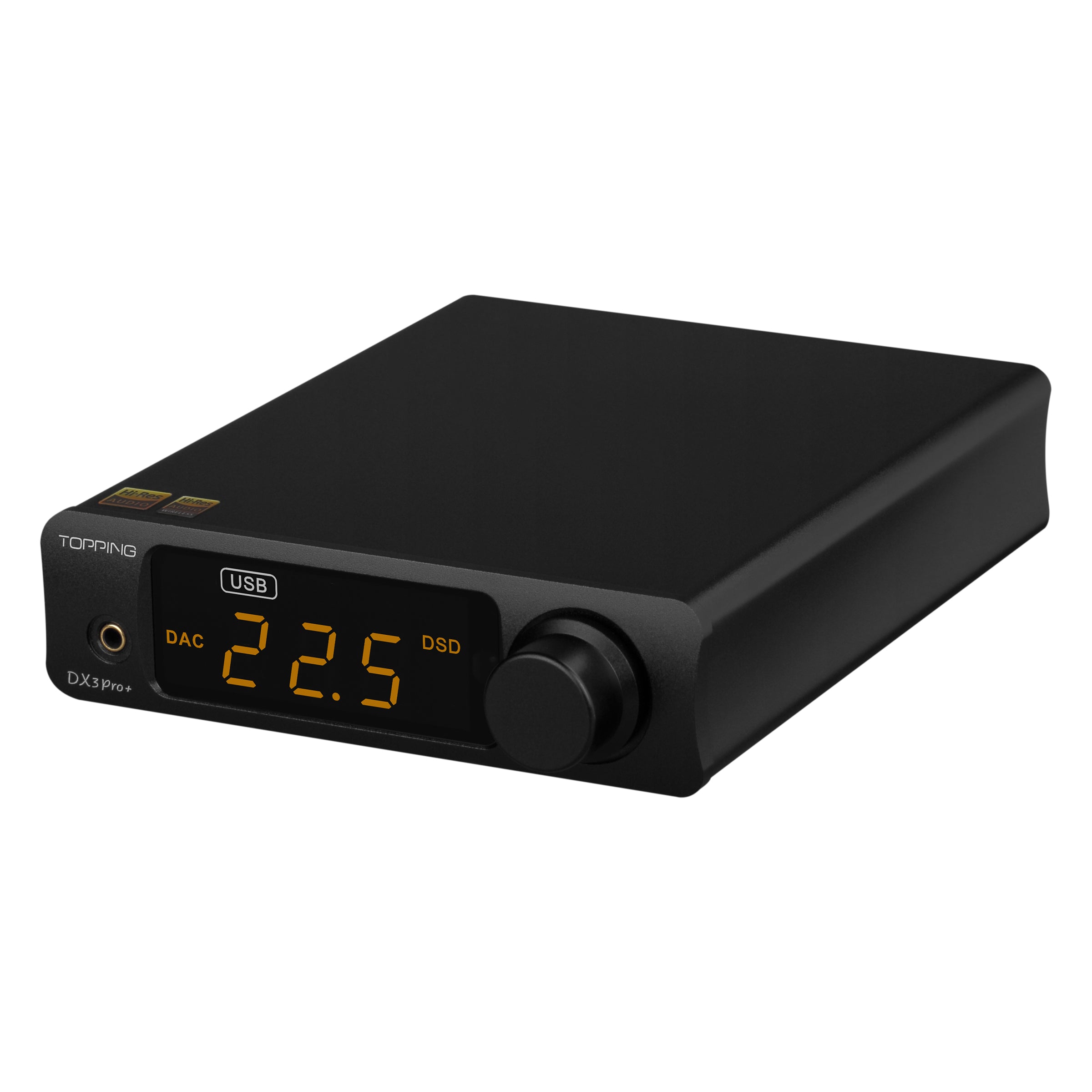
The DX3 Pro+ eschews the aggressive gamer aesthetic plaguing desktop audio. Its extruded aluminum chassis features subtle concave curves along the sides that catch desk lighting without screaming for attention. The unit sits on four tall rubber feet that create a floating effect, aiding ventilation and keeping the bottom panel from scratching delicate surfaces.
The front panel is dominated by a crisp OLED display utilizing a dual-color scheme: cool blue for input selection and warm orange for volume/sample rate information. It’s legible from across a room, though the seven-segment font feels more industrial than luxurious. The multifunction volume knob provides satisfying tactile detents—perhaps too satisfying, as the metallic click travels through the chassis and can be audible during late-night listening sessions in quiet rooms.
Build quality is solid, though not premium. The professional-review pattern characterizes the remote as lightweight and plasticky, with less decisive button travel than the main unit. It’s functional, but this is clearly where Topping saved costs to hit the $199 price point. The rear panel offers a comprehensive I/O array: dual coaxial inputs, optical, USB-B, and a Bluetooth antenna mount, alongside RCA line outputs that can be configured as fixed-level DAC outputs or variable pre-amp signals.
Features & Connectivity: The Complete Package
Internally, the DX3 Pro+ represents a significant revision from its predecessor. Topping replaced the dual AKM AK4493 chips with a single ESS ES9038Q2M Sabre DAC, paired with an XMOS XU208 USB controller capable of native DSD512 and PCM up to 32-bit/768kHz. The Bluetooth implementation deserves special mention: utilizing a Qualcomm QCC5125 chipset, the DX3 Pro+ supports LDAC, aptX HD, and aptX LL, but crucially bypasses the Bluetooth chip’s internal DAC, routing the digital signal directly to the ES9038Q2M for conversion. This eliminates the weak link common in many wireless-enabled DACs.
The headphone amplifier section employs Topping’s NFCA (Nested Feedback Composite Amplifier) topology, delivering a claimed 1.8W per channel into 32Ω through the single-ended 3.5mm jack. While balanced outputs are absent—a notable omission for the price—the amp offers two gain settings (+6dB and +19dB) and four distinct output modes: Headphone Amp, Headphone Amp + Line Out, DAC Only, and Pre-Amplifier. This flexibility allows the unit to serve as a digital preamp for powered monitors or active speakers, with the remote enabling volume control over the RCA outputs.
Technical Performance: Measurement-Grade Fidelity
In controlled measurement environments, the DX3 Pro+ performs at levels that would have cost four figures just five years ago. The THD+N (Total Harmonic Distortion plus Noise) is specified at 0.00015% for both the DAC and amplifier sections—a 60% improvement over the previous generation’s DAC performance and an 85% improvement in the amp section. Dynamic range exceeds 120dB, and the noise floor sits low enough to render the unit silent even with sensitive IEMs.
The frequency response is ruler-flat, and intermodulation distortion is vanishingly low. Output impedance is sufficiently low to avoid frequency response variations with multi-driver IEMs or low-impedance headphones. In practical terms, this means the DX3 Pro+ adds no audible coloration of its own; it is a transparent window into your source material and headphones.
Sound Quality: Unvarnished Truth
The evidence pattern is defined largely by what is absent. There is no warmth, no bloom, no artificial soundstage expansion—just the unadulterated signal. On tracks like Massive Attack’s Teardrop, the low-end extension is tight and controlled rather than plush or forgiving. The bass is articulate, revealing textural details in electronic kick drums that warmer DACs smooth over.
The midrange is notably neutral. Vocals on Nick Cave’s Skeleton Tree emerge with stark intimacy, neither pushed forward nor recessed. This clinical presentation can initially sound lean compared to the slight mid-bass bump of competitors like the Fiio K5 Pro ESS, but it rewards with superior long-term listening fatigue resistance and micro-detail retrieval. Highs are extended and airy without the ESS “glare” that plagued earlier Sabre implementations, suggesting Topping has implemented proper filtering and power supply isolation.
Transient response is a particular strength. The DX3 Pro+ unmasks subtle dynamic shifts in acoustic recordings, allowing the attack of piano hammers and the decay of concert hall reverberation to exist in distinct layers. This is not a “fun” sound signature; it is an accurate one.
Select Comparisons
Versus Schiit Modi 3E + Magni Heresy: The Schiit stack offers the flexibility of upgrading the amp or DAC separately and provides a balanced output option on the Magni. However, the DX3 Pro+ measures objectively cleaner, offers superior Bluetooth implementation, and occupies half the space. The Schiit stack imparts a slight warmth that some prefer, but the Topping is more resolving.
Versus Fiio K5 Pro ESS: The K5 Pro ESS utilizes the same ES9038Q2M chip but presents a slightly warmer, more forgiving tonal balance. The DX3 Pro+ edges ahead in raw transparency and Bluetooth codec support (LDAC versus the Fiio’s aptX HD), though the Fiio’s physical controls feel more robust. For analytical listening, choose the Topping; for all-day listening comfort, the Fiio may win.
Versus AudioQuest DragonFly Red: The DragonFly remains the portability champion, but the DX3 Pro+ offers superior power delivery for high-impedance headphones and a more stable USB implementation. The DragonFly’s analog volume control introduces channel imbalance at low levels, whereas the Topping’s digital control maintains perfect channel matching across its entire range.
Real-World Use Cases
The DX3 Pro+ is specified to work as a desktop hub. USB supports computer sources, while its gain options cover use cases from sensitive IEMs to headphones such as the Sennheiser HD 650. LDAC adds convenient phone playback. MyHiFi has not conducted a controlled wired-versus-wireless comparison.
As a preamp for powered monitors like the KEF LSX II or Edifier MR5, the DX3 Pro+ allows seamless switching between headphone and speaker listening while maintaining a digital volume control that preserves bit-depth at normal listening levels. The relay-based muting prevents the audible pops and thumps that plague lesser DACs when switching sample rates or powering on.
Tradeoffs & Limitations
No product is perfect at $199. The lack of a balanced headphone output means users of high-end planar magnetics may eventually want to upgrade to a dedicated balanced amp like the Topping L50 or Schiit Magnius to extract maximum performance. The remote, while functional, feels like an afterthought. The clicky volume knob, though precise, generates mechanical noise that can be distracting.
Sonically, the clinical presentation may disappoint those seeking analog warmth or “tube-like” euphony. Pairing the DX3 Pro+ with already-bright headphones like the Beyerdynamic DT 990 Pro can result in a fatiguing treble response. This is a component that demands honest headphones and quality source files; it will not flatter compressed Spotify streams or poorly mastered recordings.
Verdict
The Topping DX3 Pro+ represents the maturation of the “objective” school of audio design—performance validated by measurements, translated into an accessible, affordable package. It is not the warmest, nor the most luxuriously built, but it is arguably the most honest DAC/amp available under $200.
Scoring:
• Technical Performance: 94/100 (Reference-grade measurements, exemplary Bluetooth implementation) • Build Quality: 82/100 (Solid chassis undermined by cheap remote and clicky knob) • Value: 96/100 (Unmatched feature set for the price) • Versatility: 88/100 (Excellent I/O and preamp functionality, held back by lack of balanced output)
Composite Score: 91/100 — Exceptional
The DX3 Pro+ is for desktop users who want one compact unit for headphones, powered speakers and wireless playback. It is not for buyers who need a balanced headphone socket, modular upgrades or deliberately warm voicing. Against the FiiO K5 Pro ESS, choose the Topping for LDAC and measured transparency; choose the FiiO for warmer voicing and sturdier-feeling controls.
Methodology
This older review was refreshed from its original research, manufacturer specifications, independent measurements where available, professional evaluations and owner patterns. MyHiFi has not performed hands-on testing of this product. Confidence: High.
MyHiFi may earn a commission from purchases made through affiliate links. This does not influence our editorial decisions or source selection.