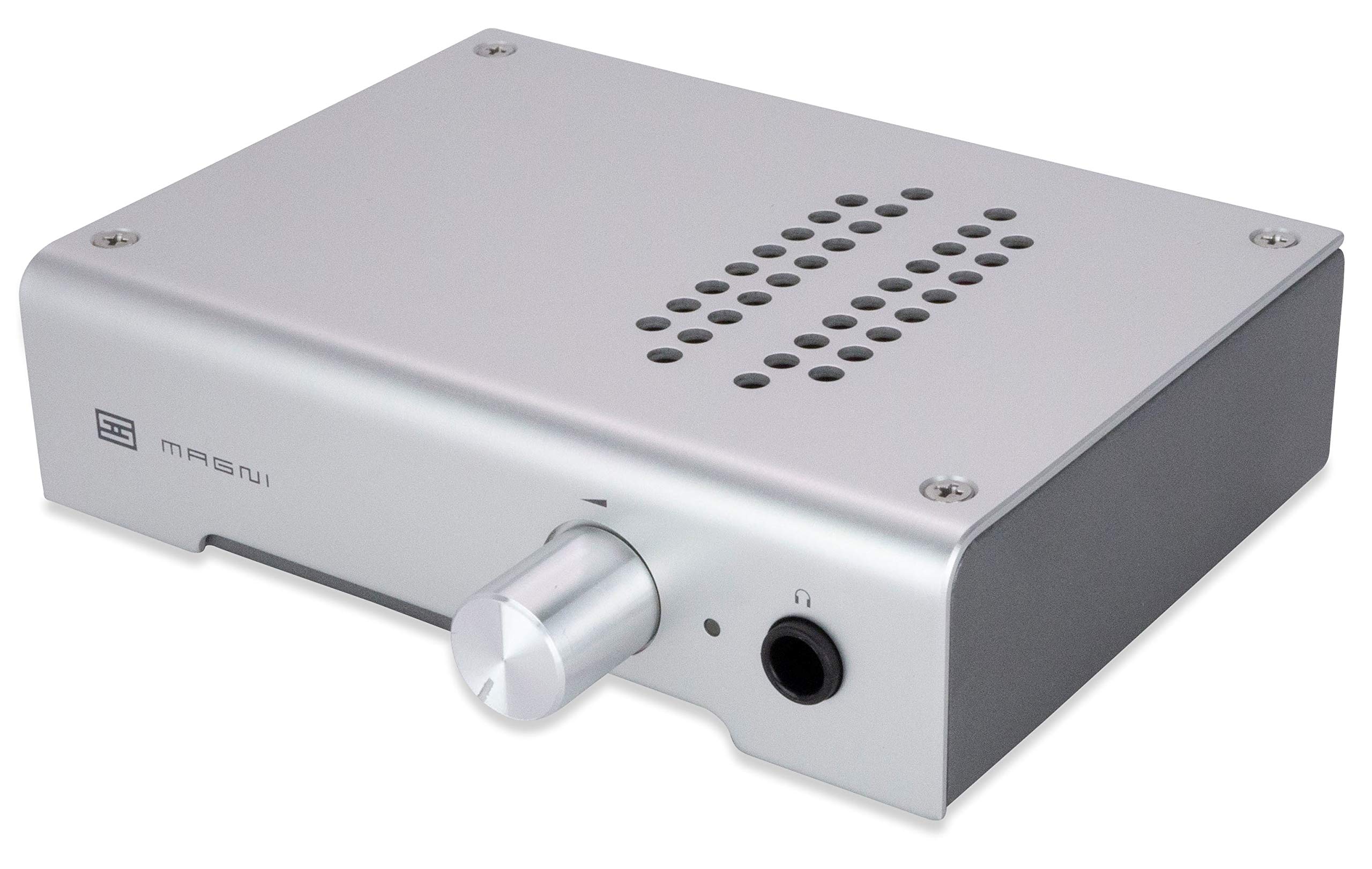
Midgard replaced Magnius in Schiit’s range and introduced the company’s mixed-mode Halo output. The important distinction is practical rather than semantic: Halo is an optional load-dependent behavior on the four-pin XLR jack, while abundant conventional output and flexible preamp connections form the amplifier’s core value.
Midgard is a $219 launch-price desktop headphone amplifier and preamplifier with RCA and XLR inputs, corresponding preamp outputs, a conventional 6.35mm headphone jack and a four-pin XLR Halo jack. Its case rests on abundant output, low noise and distortion, broad load compatibility and unusual engineering at a moderate price. It is not a DAC, its XLR headphone output is not a conventional balanced power stage, and its always-active preamp outputs require care.
Design and controls
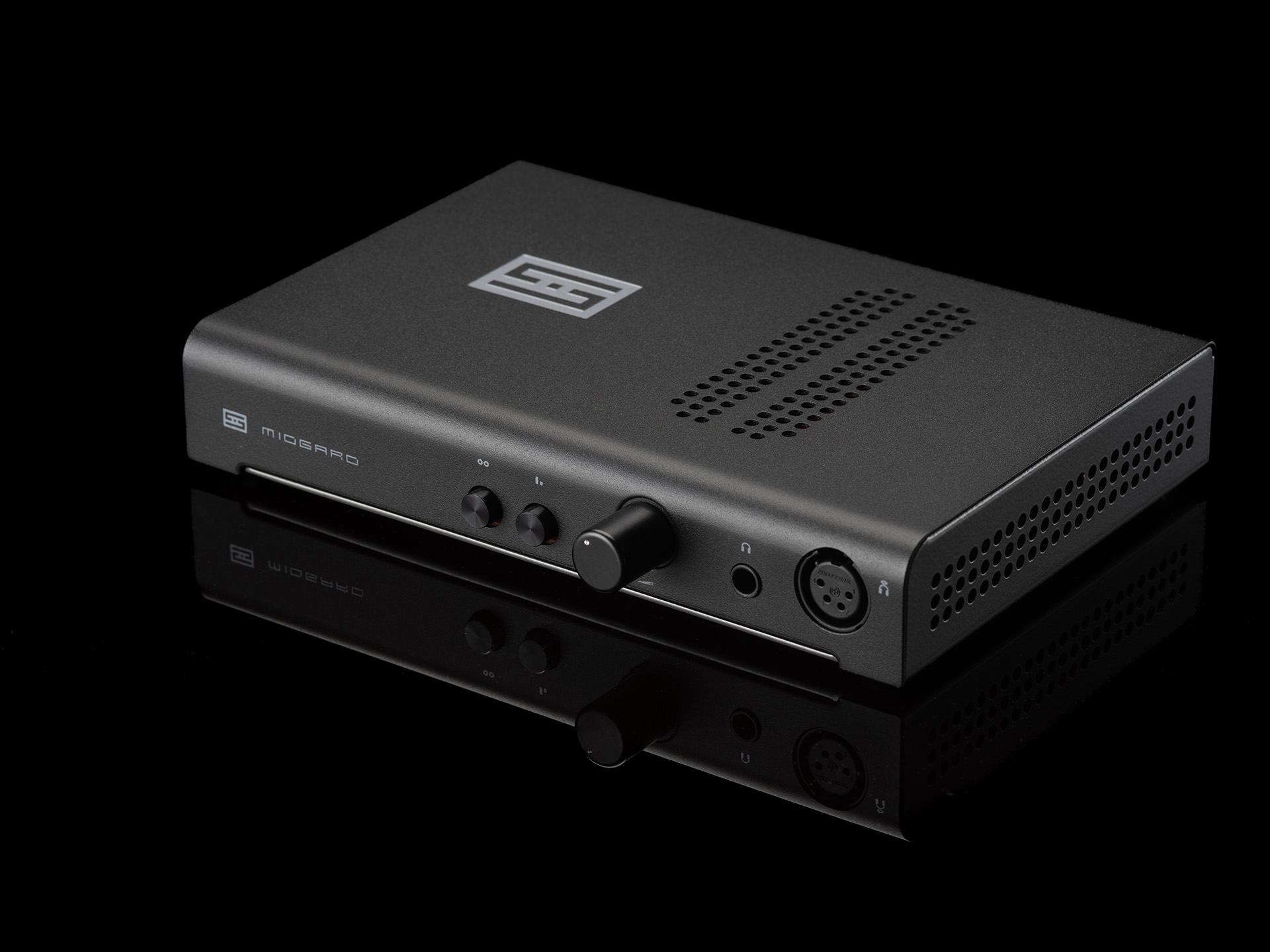
The enclosure follows Schiit’s utilitarian desktop format: a folded metal chassis, front-mounted metal volume knob, two headphone outputs and toggle switches for input and gain. The aesthetic is functional rather than luxurious, but the substantial case and simple physical controls are appropriate to equipment intended to remain on a desk for years. An external AC transformer keeps the mains transformer out of the signal chassis, at the cost of a bulky wall connection.
Rear connections include stereo RCA and three-pin XLR analog inputs, plus both RCA and XLR preamplifier outputs. Input selection is convenient for switching between two sources or between consumer and balanced studio equipment. Balanced XLR input can reduce susceptibility to interference in an appropriate system, but it does not turn the internal amplifier or headphone output into a fully differential balanced design.
There is no digital input, converter, Bluetooth receiver, display or remote control. Midgard must be paired with a DAC or another analog source. That separation can be beneficial for long-term upgrades, but buyers seeking a one-box desktop system should include source cost and cable clutter in the comparison.
Power and verified operating data
Schiit specifies up to 5W per channel into 32 ohms and 750mW per channel into 300 ohms, with lower output into 600 ohms. This combination of current and voltage capability covers the large majority of dynamic and planar headphones. It does not make every extreme load an ideal pairing, nor does it justify unsafe listening levels. Required output depends on headphone sensitivity, impedance behavior, equalization and desired peak level.
Low and high gain settings make the volume range more usable across loads. Schiit publishes very low distortion and noise figures under defined conditions, including 4V output into 300 ohms. Those numbers support transparent operation within the tested envelope. Claims that distortion is beyond audibility in every circumstance or that the amplifier is completely silent with every sensitive IEM would go beyond the evidence; source noise, gain, grounding and transducer sensitivity remain relevant.
The conventional 6.35mm output has very low specified output impedance. The Halo XLR output is around 2 ohms because of its feedback arrangement. Both suit most full-size headphones, while very low-impedance multi-driver earphones may be the safer electrical match for the conventional jack. Users should start on low gain and at minimum volume whenever changing headphones.
What Halo is
Halo is Schiit’s mixed-mode feedback system. The four-pin XLR connection provides separate return paths for the channels, allowing the amplifier’s feedback network to incorporate current-related information from the headphone load alongside voltage feedback. The objective is greater control of driver behavior as impedance changes. It is an interesting implementation, but it should not be described as directly monitoring physical diaphragm motion; the amplifier senses electrical behavior at its output, not the cone with a separate motion sensor.
The Halo socket is also not a standard “balanced output” in the usual dual-differential sense. Schiit states that both headphone connections receive the same available power. A four-pin XLR cable is required to preserve separate channel returns, and headphones must be wired compatibly. Never use an adapter that shorts negative terminals together on an output that requires separate returns.
Published reports characterize the difference between Halo and the conventional output as load-dependent and often subtle. Dynamic-driver impedance variation provides a more plausible opportunity for an effect than a nearly flat planar impedance curve. Buyers should treat Halo as an optional experiment attached to an already capable amplifier, not as a guaranteed transformation or the sole reason to purchase Midgard.
Performance evidence pattern
Midgard’s measurable frequency response is essentially flat through the audible band under standard loading. Consequently, descriptions of strong bass, open mids or smooth treble are better understood as the absence of obvious frequency coloration combined with adequate headroom—not as independent tone controls built into the amplifier. A transparent amplifier cannot add missing sub-bass to a headphone or correct a treble peak without equalization.
The recurring professional evidence pattern is of a clean, composed amplifier that avoids strain with common full-size loads. Its high power into low impedance supports demanding planars, while its voltage at 300 ohms suits Sennheiser and Beyerdynamic dynamics. Low noise and sensible gain make it usable with more efficient headphones, though a dedicated low-power device may provide finer adjustment for exceptionally sensitive IEMs.
Spatial claims require particular caution. An amplifier with flat response and sufficiently low distortion should preserve information from the source; it does not manufacture a wider recording. Reports of greater openness through Halo may reflect the interaction with a particular headphone, level matching or expectation. The defensible strength is that Midgard has the linearity and headroom not to become an obvious bottleneck in a well-matched chain.
Preamplifier operation
RCA and XLR preamp outputs allow Midgard to control powered monitors or a separate power amplifier. This materially improves versatility and permits a shared desktop volume control for headphones and speakers. The critical operational caveat is that the preamp outputs remain active when headphones are connected. Users must mute or power down speakers before headphone listening if they do not want both to play.
There is no output selector or remote, so the feature is best suited to arm’s-reach systems. XLR preamp connectivity is valuable with compatible monitors and longer cable runs, although system grounding and input sensitivity still need attention. Since there is no fixed line-output mode, Midgard should be treated as an analog preamp rather than a passive signal-through box.
Rivals and value
Launch MSRP was $219. This review was refreshed in July 2026, but no current price or availability was independently verified. Schiit products are often sold directly and market terms vary; buyers should check current product status, voltage version, shipping, return policy and warranty before ordering. No retailer URL has been invented here.
The JDS Labs Atom Amp 2 is a compact alternative emphasizing straightforward, low-noise amplification and simple operation. It is attractive when balanced input and preamp XLR connectivity are unnecessary. The Topping A70 Pro offers more display-driven control, relay volume and extensive balanced connectivity at a much higher price, suiting users who want convenience and extreme bench performance. Within Schiit’s line, the Jotunheim 2 is the step toward a fully balanced architecture and optional internal modules, but costs more and may duplicate features buyers do not need.
Midgard’s value is exceptional at its original price because it combines serious power, balanced analog input, dual-format preamp output and the Halo experiment in one sturdy chassis. The value score stops short of perfection because a DAC is extra, the external transformer is cumbersome and always-live pre-outs create avoidable friction.
Who it is for—and who it is not for
Midgard is for desktop listeners with multiple analog sources, full-size headphones spanning varied impedances, or powered monitors that benefit from a shared preamp. It is especially sensible for someone who wants ample clean headroom and physical controls without paying for an onboard DAC.
It is not for buyers demanding an all-in-one digital hub, remote-controlled living-room operation or tube coloration. Users of only very sensitive IEMs do not need its output reserves, while anyone expecting the XLR headphone socket to provide conventional balanced amplification should choose based on the actual Halo design rather than the connector’s appearance.
Verdict
The Schiit Midgard is an unusually complete analog desktop amplifier. High output across low- and high-impedance loads, strong published measurements, balanced and unbalanced inputs, and useful preamp connectivity establish the foundation. Halo adds a technically interesting, optional load interaction without compromising the conventional output. Its limitations are practical rather than fundamental: no DAC or remote, a wall transformer and pre-outs that never auto-mute.
Composite Score: 91/100 (Exceptional)
• Technical Performance: 92/100 • Build Quality: 88/100 • Value: 94/100 • Versatility: 88/100
MyHiFi weights Technical Performance at 30%, Value at 30%, Build Quality at 25% and Versatility at 15%. The weighted result is 91.0/100, within the Exceptional band.
Methodology
This assessment draws on verified manufacturer specifications, published measurements and recurring patterns in professional evaluations. Confidence: High for connectivity, output capability and measured behavior; moderate for long-term ownership. MyHiFi did not perform hands-on testing of the Schiit Midgard. The historical source archive was not reconstructed.
MyHiFi may earn a commission from purchases made through affiliate links. This does not influence our editorial decisions or source selection.