The desktop DAC/amp category has a problem. For years, the answer to "what should I buy under $300?" was a separate DAC and a separate amplifier, because all-in-one boxes compromised on one or both. The Topping DX5 II asks: what if one compact unit measured well enough and powered enough headphones that separates stopped making sense?
The answer is 7.6W of balanced output power, dual ESS ES9039Q2M DAC chips measuring in the top-20 best-ever tested by at least one independent laboratory, a built-in 10-band parametric EQ, Bluetooth 5.1 with LDAC, three headphone outputs, balanced and single-ended line outputs, a full-color display, and an internal power supply — all in a 945-gram aluminum box for $299.
The trade-off is a stock tuning that some find bass-lean, USB Type-B rather than USB-C, a PEQ application that is Windows-centric, and a plastic remote that undersells the unit. At $299, these are manageable compromises for a device that out-measures separates costing twice as much.
Scorecard
Top-20 measured SINAD; exceptional DNR, IMD, and power output; linearity slightly imperfect at low levels
Excellent CNC aluminum chassis, internal PSU, bright display; USB-B and plastic remote are the gaps
Separates-level measurement and power at $299 — one of the best price-performance ratios in the category
Three headphone outputs, preamp mode, Bluetooth, 12V trigger; PEQ software is Windows-centric
Who it is for: desktop listeners who want DAC and amplification in one box without compromising measurement; headphone owners who want 7.6W balanced power without buying a separate amp; users who value parametric EQ; system builders who need preamp output and 12V trigger integration.
Who should skip it: listeners who prefer warm R2R coloration over transparent ESS measurement; anyone who requires USB-C input; Mac users who need native PEQ software; listeners who want the absolute lowest noise floor available (it is very low, but not state-of-the-art).
Verified specifications
| Specification | Published value |
|---|---|
| DAC chips | Dual ESS ES9039Q2M (one per channel) |
| USB interface | XMOS XU316 |
| Bluetooth | Qualcomm QCC5125, BT 5.1, LDAC/aptX Adaptive/aptX HD |
| PCM support | Up to 768kHz / 32-bit |
| DSD support | DSD512 native |
| MQA | Hardware decoding |
| THD+N | <0.00006% |
| SNR / DNR | 133 dB / 133 dB |
| Noise floor | 1.8 µVrms |
| Max power (balanced) | 7600 mW × 2 @ 16Ω |
| Power at 32Ω | 6400 mW × 2 |
| Power at 300Ω | 990 mW × 2 |
| Power at 600Ω | 490 mW × 2 |
| Headphone outputs | 4-pin XLR, 4.4mm Pentaconn, 6.35mm SE |
| Line outputs | RCA, 3-pin XLR (fixed/variable) |
| Digital inputs | USB-B, optical, SPDIF coaxial |
| PEQ | 10-band parametric, stored on-device |
| Dimensions | 19.0 × 15.5 × 4.4 cm |
| Weight | 945 g |
| Power supply | Internal (IEC) |
Design and build: aluminum substance
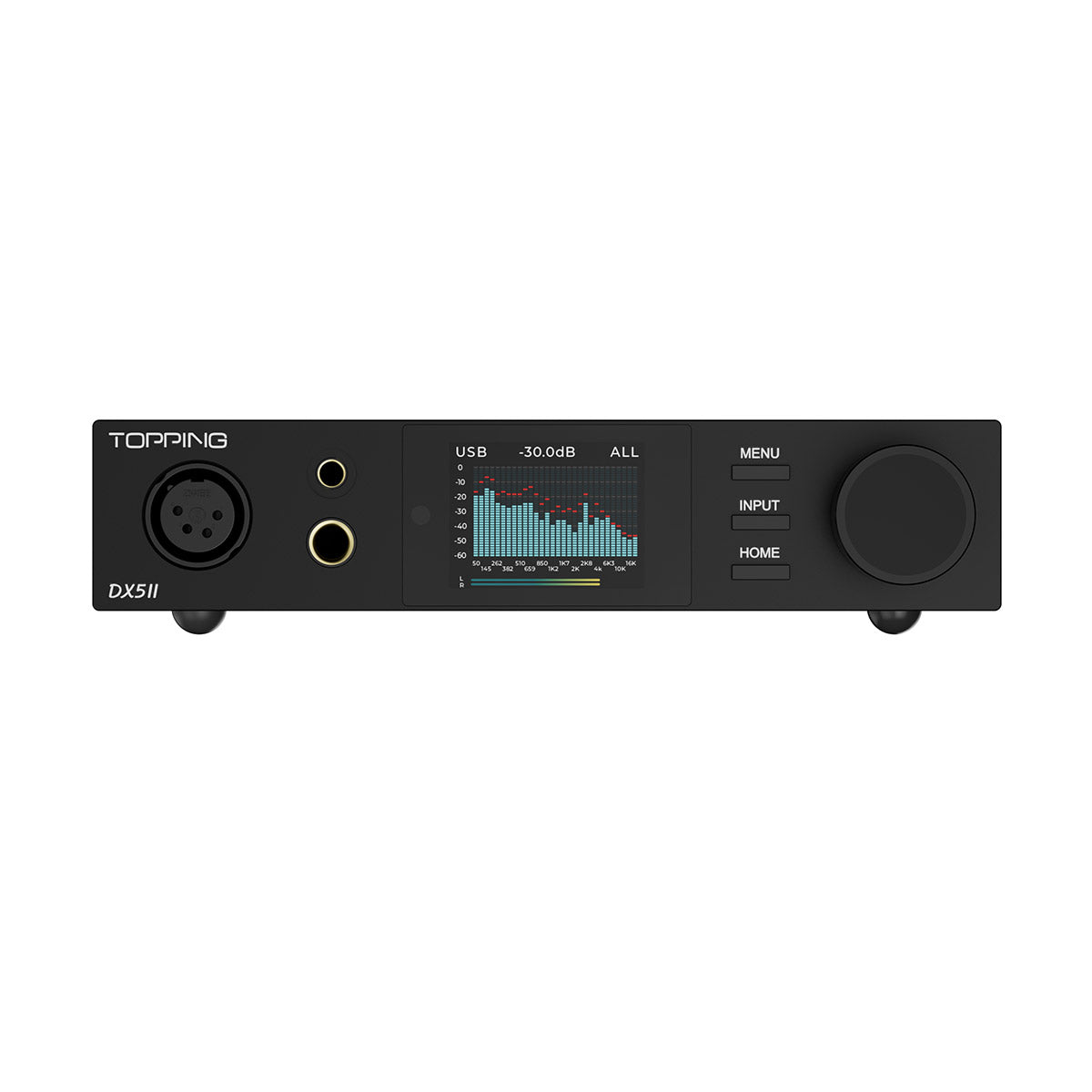
The DX5 II is a compact CNC-machined aluminum box measuring 19.0 × 15.5 × 4.4 cm and weighing 945 grams, available in black, silver, and white. A 2-inch full-color IPS display sits center-left, flanked by three physical buttons and a volume encoder that doubles as a standby switch.
The rear panel earns the all-in-one credentials. USB-B, optical, and SPDIF coaxial inputs cover digital sources. RCA and 3-pin XLR outputs serve preamp duty, switchable between fixed and variable. A 12V trigger in/out supports system integration. The IEC socket means the power supply is internal — no wall wart — and the unit runs cool via passive cooling.
Build quality is consistently praised as excellent for the sub-$300 category. The only physical criticism is a small crevice between panels that gathers dust, and a plastic remote that undersells the aluminum chassis.
What the measurements mean
Independent laboratory testing places the DX5 II in the top-20 best-ever DACs measured by that source. Distortion is vanishingly small. Dynamic range is exceptional. Jitter is negligible at -140 dB. The only measured criticisms are a minor low-level linearity imperfection and a noise floor that, while measurably tiny, stops a hair before record-setting.
The amplifier delivers 7.6W per channel into 16Ω balanced, 6.4W into 32Ω, 990mW into 300Ω, and 490mW into 600Ω. It remains stable down to 12Ω. The practical translation: the DX5 II drives virtually any headphone — from sensitive IEMs to 600Ω dynamics — without strain. The 1.8µVrms noise floor means IEMs are hiss-free on low gain.
The 10-band parametric EQ is a differentiator at this price. It runs on-device, meaning EQ curves are stored in the DX5 II itself rather than requiring a connected computer. The PEQ is described as sonically transparent within reasonable ranges. The main limitation is software accessibility — the Topping Tune application is Windows-centric, with inconsistent Mac support.
Sound character: neutral, transparent and powerful
The DX5 II delivers the Topping house sound: neutral, transparent, and clean. It preserves the transducer's signature — plug in a warm headphone and you hear warmth; plug in an analytical headphone and you hear analysis.
Bass is the primary disagreement. One professional reviewer finds it lean, recommending PEQ to add low-end weight. Others find it controlled and articulate. The DX5 II is measurably flat, and the perceived leanness reflects the absence of bass coloration rather than a deficiency. Listeners accustomed to R2R DACs or tube stages will notice the difference.
The midrange is clean and free of obvious coloration. Vocals carry natural presence without forwardness. The low noise floor reveals microdetail in complex arrangements — a benefit of exceptional dynamic range rather than any tuning trick.
Treble is extended and tidy. Air and energy are present without harshness. One reviewer notes some high-frequency splashiness on certain material, consistent with the transparent ESS DAC signature — it reveals what is in the recording rather than smoothing it over.
Soundstage is a strength on width and center imaging, less so on depth. The DX5 II produces a natural, focused stage rather than an artificially expansive one. Balanced outputs widen and deepen the stage compared to single-ended.
Comparisons: what else should you buy?
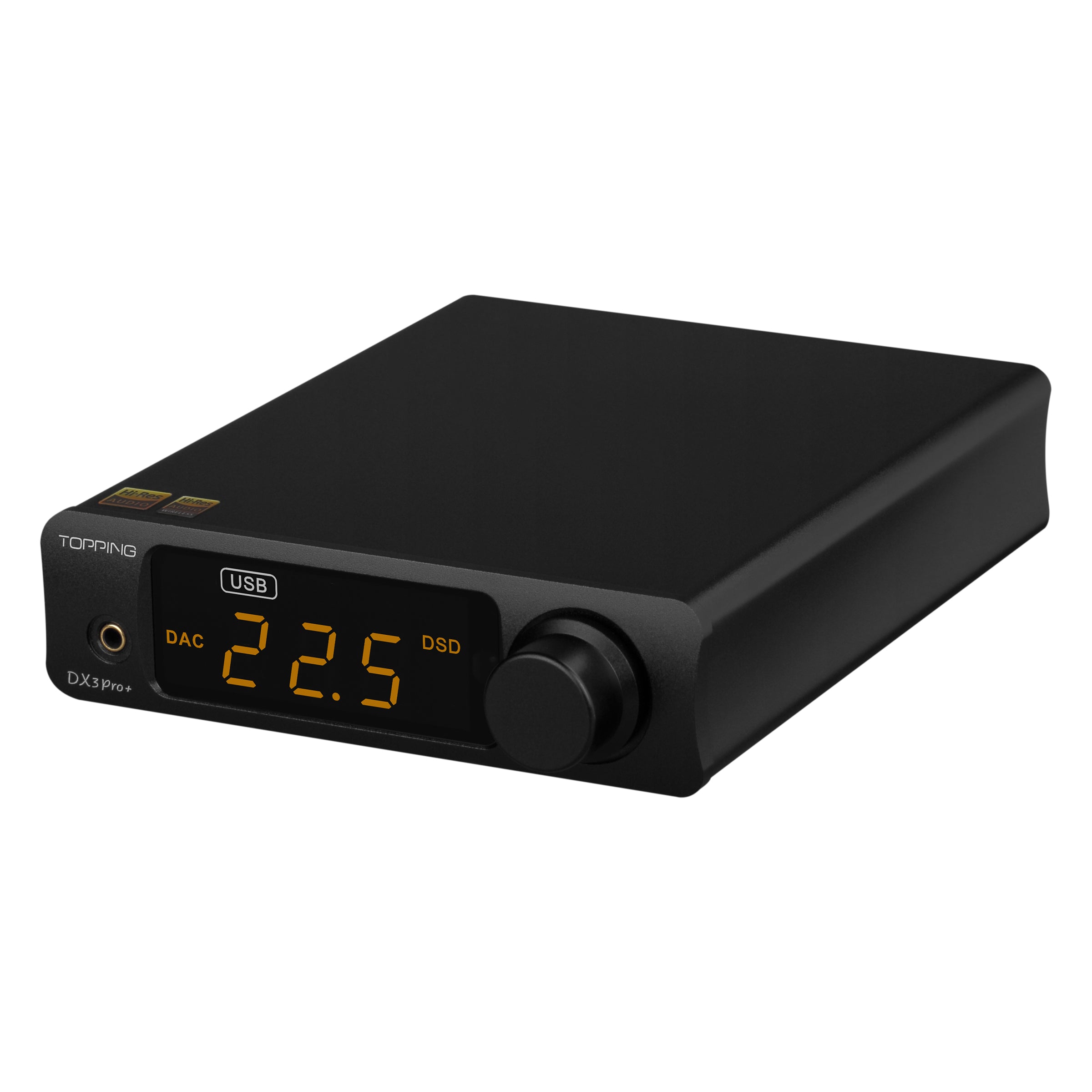
The Topping DX3 Pro+ is the existing MyHiFi reference at a lower price. It uses a CS43198 DAC rather than dual ES9039Q2M chips, offers single-ended headphone output only, and has no PEQ. The DX5 II is a substantial upgrade in measurement, power, and features. Choose the DX3 Pro+ for a budget entry point; choose the DX5 II when you want balanced power and on-device EQ.
The FiiO K11 R2R is the warm alternative. Its resistor-ladder DAC adds organic texture and bass weight that the DX5 II's ESS chips do not. The DX5 II measures better and delivers more power. Choose FiiO for warmth; choose Topping for transparency and EQ.
The iFi ZEN DAC 3 at roughly $229 is the budget competitor. It offers USB-C and XBass processing but delivers only 400mW — a fraction of the DX5 II's 7.6W. Choose iFi for warmth and connectivity at lower power; choose Topping for measurement and headroom.
Pairing and everyday use
The DX5 II is trivially easy to integrate. USB-B handles computer audio; optical covers TV and console duties; Bluetooth with LDAC handles wireless streaming. The 12V trigger automates power-on with compatible amplifiers. Preamp mode with volume memory per input/output means it works as a standalone DAC, headphone amp, or system controller.
The DX5 II's neutral transparency pairs well with characterful headphones. Sennheiser HD 600-series dynamics benefit from the clean power. Sensitive IEMs are hiss-free on low gain. The PEQ allows corrective EQ for headphones with known FR deviations. The display offers three themes with adjustable brightness and auto-dim. The volume encoder provides 200 steps in 0.5dB increments.
Value and verdict
At $299, the Topping DX5 II delivers measurement performance and power that compete with separates costing twice as much. Its 63 Amazon ratings averaging 4.2/5 and 9 Apos ratings at 5/5 reflect a product that earned its audience through specification. The independent measurement community rated it 83.5% "Great" across 503 votes.
The honest qualification is that the DX5 II is transparent rather than musical. It does not add warmth or coloration, and its stock tuning will sound lean to listeners accustomed to R2R or tube stages. The PEQ can address this, but the software is Windows-centric. The USB-B port and plastic remote are cost-saving decisions that are understandable at $299 but noticeable.
The Topping DX5 II earns 90/100 and an Exceptional rating because it makes the separate-DAC-and-amp argument harder to justify under $300. It measures better than it needs to, powers more than it should, and adds on-device parametric EQ that no competitor at this price matches. The DX5 II does not make cheap DACs sound expensive — it makes expensive DACs explain their price.
MyHiFi weights Technical Performance at 30%, Value at 30%, Build Quality at 25% and Versatility at 15%. The resulting weighted composite is 89.65, rounded to 90/100, in the Exceptional band.
Methodology
This assessment draws on one independent measurement source (full laboratory DAC and amplifier test suite), five professional editorial reviews published July–December 2025, 24 manually coded owner reviews from Amazon and Apos Audio, Amazon rating data totaling 63 ratings, official Topping specifications, and live July 2026 pricing. Three of five professional review units were manufacturer-supplied. Confidence: High for measurement and value conclusions, Moderate for subjective sound character. MyHiFi did not perform hands-on testing.
Affiliate disclosure: MyHiFi may earn a commission from purchases made through affiliate links, at no additional cost to you. This does not influence our editorial decisions, scores or source selection.