Most affordable desktop DAC/amps are built around a familiar assumption: the buyer needs a USB input, a volume knob, and enough headphone power to make a planar magnetic behave. The Fosi Audio K7 adds a less glamorous but more practical question: what if that buyer also uses voice chat, a console, Bluetooth, powered speakers, and headphones with different tonal needs?
The answer is a compact US$199.99 control centre with USB-C, optical, coaxial and aptX HD Bluetooth; 3.5mm and balanced 4.4mm headphone outputs; a microphone input; variable RCA preamp output; hardware bass and treble controls; and a measured balanced output above 2 W per channel into 32 ohms. Its RCA path reaches roughly 116 dB signal-to-noise-and-distortion performance—far beyond audibility under normal conditions.
The K7 is not a miniature broadcast interface. It cannot mix sources, offers no sidetone, has no parametric EQ or companion app, and ties microphone operation to its lower-bandwidth USB compatibility mode. It is also tonally lighter through the mid-bass than some rivals. But it combines credible hi-fi performance with gaming-friendly controls more convincingly than most products near $200.
Scorecard
Excellent measured RCA transparency and independently confirmed balanced power; headphone and microphone measurements remain incomplete
Solid aluminum chassis and direct physical controls; tiny display and mixed reports about knob play or click force
DAC, powerful headphone amp, preamp, Bluetooth receiver and microphone control for US$199.99
Four playback inputs, two headphone outputs, tone controls and console-friendly USB mode; no mixing, sidetone, LDAC or app
Who it is for: desktop listeners who divide time between music, gaming and voice chat; owners of balanced-cable planars who want substantial power without a separate amplifier; users who prefer hardware controls over software; powered-speaker owners needing a compact variable preamp.
Who should skip it: buyers needing XLR outputs, a fixed line output, HDMI ARC, parametric EQ, source mixing or a studio-grade microphone interface; owners of 6.35mm-only headphone cables; listeners who prefer a warmer, denser presentation without using tone controls.
Verified specifications
| Specification | Published or measured value |
|---|---|
| DAC | AKM AK4493SEQ stereo DAC |
| USB interface | XMOS XU208; UAC 1.0 and 2.0 |
| Bluetooth | Qualcomm QCC3031, Bluetooth 5.0 |
| Codecs | SBC, AAC, aptX, aptX Low Latency, aptX HD |
| USB formats | PCM to 32-bit/384kHz; native DSD256 |
| Optical/coaxial | PCM to 24-bit/192kHz |
| Headphone outputs | 4.4mm balanced; 3.5mm single-ended |
| Published power at 32Ω | ≥2.1 W/ch balanced; ≥600 mW/ch single-ended |
| Independently measured power | 2.016 W/ch balanced and 547.6 mW/ch single-ended at 32Ω |
| RCA output | Variable single-ended preamp output, approximately 2.19 Vrms near maximum |
| Measured RCA SINAD | 115.8–116.7 dB |
| Microphone input | Front 3.5mm TRS with independent level control |
| Tone controls | Bass −12 to +12; treble −6 to +6; bypass available |
| Power | External 12V/2A supply |
| Dimensions | Approximately 155 × 90 × 43mm |
| Measured weight | Approximately 522g |
Design and controls: a mixing-desk shape without mixer complexity
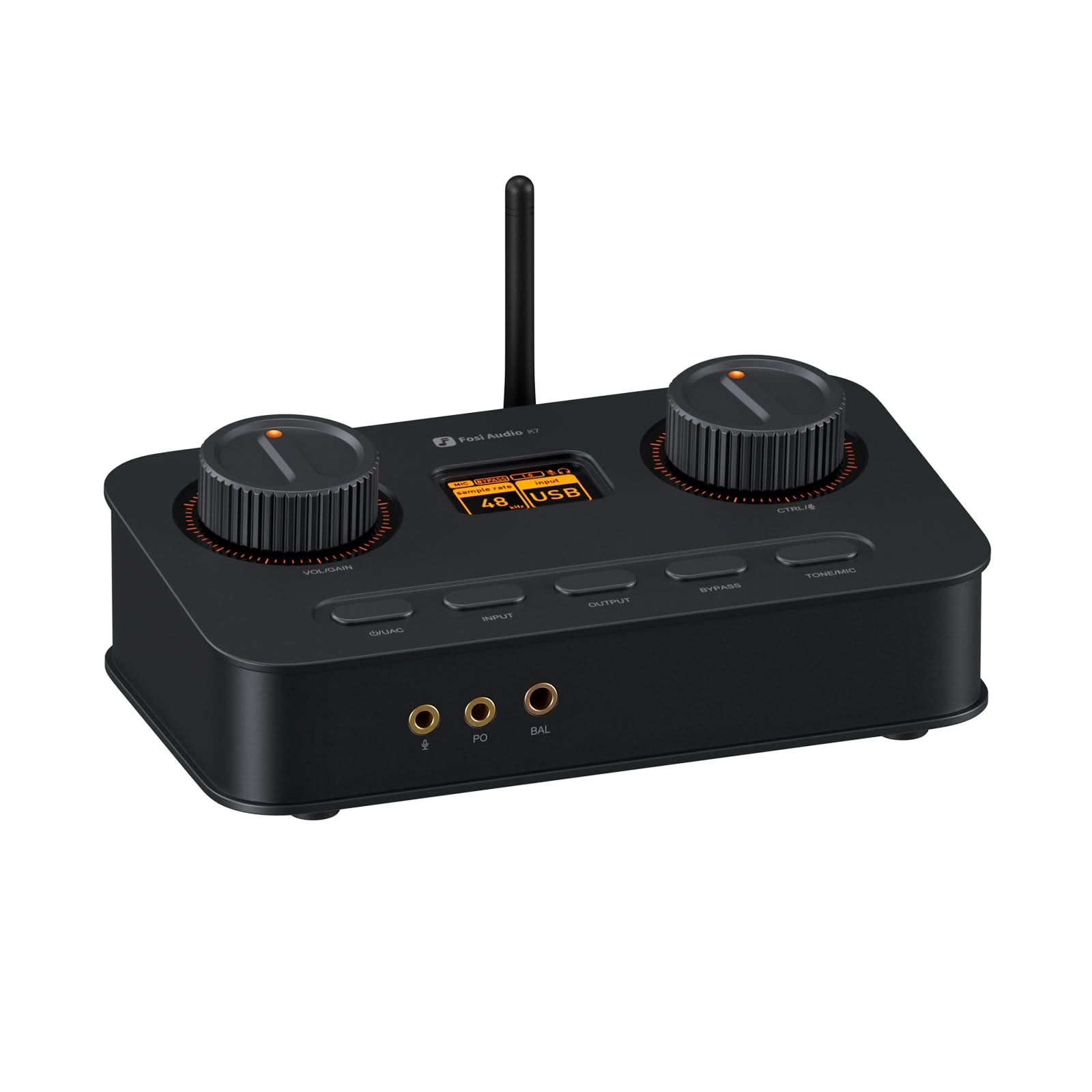
The K7's sloped aluminum chassis is closer to a miniature control surface than a conventional stackable DAC. Two large rotary controls flank a 1.5-inch orange-on-black display. Dedicated buttons handle power and USB mode, input, output, tone bypass and microphone/tone selection. The layout keeps common functions out of nested menus, although the small labels and display are harder to read from across a desk.
Build reports consistently describe a dense, stable enclosure with clean assembly. The point of disagreement is the rotary hardware: some units exhibit slight lateral play, while others feel solid; the push action can require more force than expected, particularly when used to mute a microphone. At roughly 522g, the K7 is heavy enough to remain planted when cables move.
The front panel has 3.5mm microphone and headphone sockets plus a 4.4mm balanced headphone output. The absence of a 6.35mm socket is inconvenient for studio headphones and requires an adapter. Around back are USB-C, optical, coaxial, Bluetooth antenna, variable RCA output and the 12V power input. USB carries signal only—the external supply is mandatory.
Connectivity and gaming: useful hardware, clear boundaries
USB Audio Class 2.0 supports high-resolution playback, while Class 1.0 broadens compatibility with consoles and enables the microphone path. That trade-off matters: microphone use through USB is limited to the lower-bandwidth compatibility mode rather than remaining available during 32-bit/384kHz playback. In practical voice-chat testing, the mic input was clean enough for conferencing and Discord, but no independent microphone noise, latency or frequency-response measurements exist.
The K7 provides independent microphone level adjustment and physical mute, but it does not offer direct sidetone, source mixing, virtual surround, game profiles or XLR microphone support. It is a stereo DAC/amp with a useful chat input—not a substitute for a full USB audio interface.
Bluetooth 5.0 covers SBC, AAC and three aptX variants, including Low Latency and HD. LDAC, aptX Adaptive and aptX Lossless are absent. Only one playback input operates at a time, so USB and Bluetooth cannot be blended.
The bass and treble controls are broad analog-style shelves rather than precise EQ bands. They are effective for nudging a bright headphone downward or restoring weight to a lean pairing, but they cannot correct narrow response problems or save presets. A bypass button makes level-matched before/after checks straightforward.
What the measurements mean
Independent laboratory testing measured the RCA preamp path at about 2.19 Vrms with 115.8–116.7 dB SINAD and roughly 116–117 dB dynamic range. SINAD combines noise and distortion into one figure; at this level, both sit far below normal audibility. Used as a USB DAC feeding powered speakers or another amplifier, the K7 is effectively transparent.
A separate load test measured 2.016 W per channel from the balanced output into 32 ohms and 547.6 mW from the single-ended output. Those results land close to Fosi's 2.1 W and 600 mW claims. The balanced jack therefore has enough reserve for many inefficient planar headphones, while the single-ended path comfortably covers mainstream dynamics and IEMs.
Another Audio Precision sweep reported only 181 mW into 33 ohms and 80 mW into 300 ohms, but the test did not identify the physical jack or gain state. That uncertainty matters more than the numerical disagreement: the lower figure should not be presented as a balanced-output limit. Exact output impedance is also unpublished and unmeasured, although practical reports found no recurring tonal or hiss problem with sensitive IEMs.
Sound and pairings: clean first, warm only when asked
The recurring tonal pattern is neutral through the middle with strong sub-bass reach, restrained mid-bass body and a lively upper range. That combination creates clean separation and crisp dialogue, but some headphones can sound lighter or more forward than they do from warmer sources. The broad bass control helps, though increasing it enough to restore mid-bass weight can also lift the lowest octave more than intended.
Warmer or darker headphones are the easiest match. The K7 has the current reserve to control planar designs such as the HIFIMAN HE400se, while the balanced output provides ample headroom for harder loads. The Sennheiser HD 600 and FiiO FT1 are natural pairings: both benefit from clean drive, and the tone controls can adjust weight without introducing software into the chain. Very high-impedance models above Fosi's recommended 16–300Ω range are less convincing.
Spatially, the K7 preserves separation and front-to-back layering better than it expands width. Gaming reports consistently find positional information clear, but this is conventional stereo imaging—not synthesized surround. Bright IEMs and headphones can expose extra edge in the upper frequencies; darker models tend to produce the more balanced result.
Comparisons: choose the feature philosophy
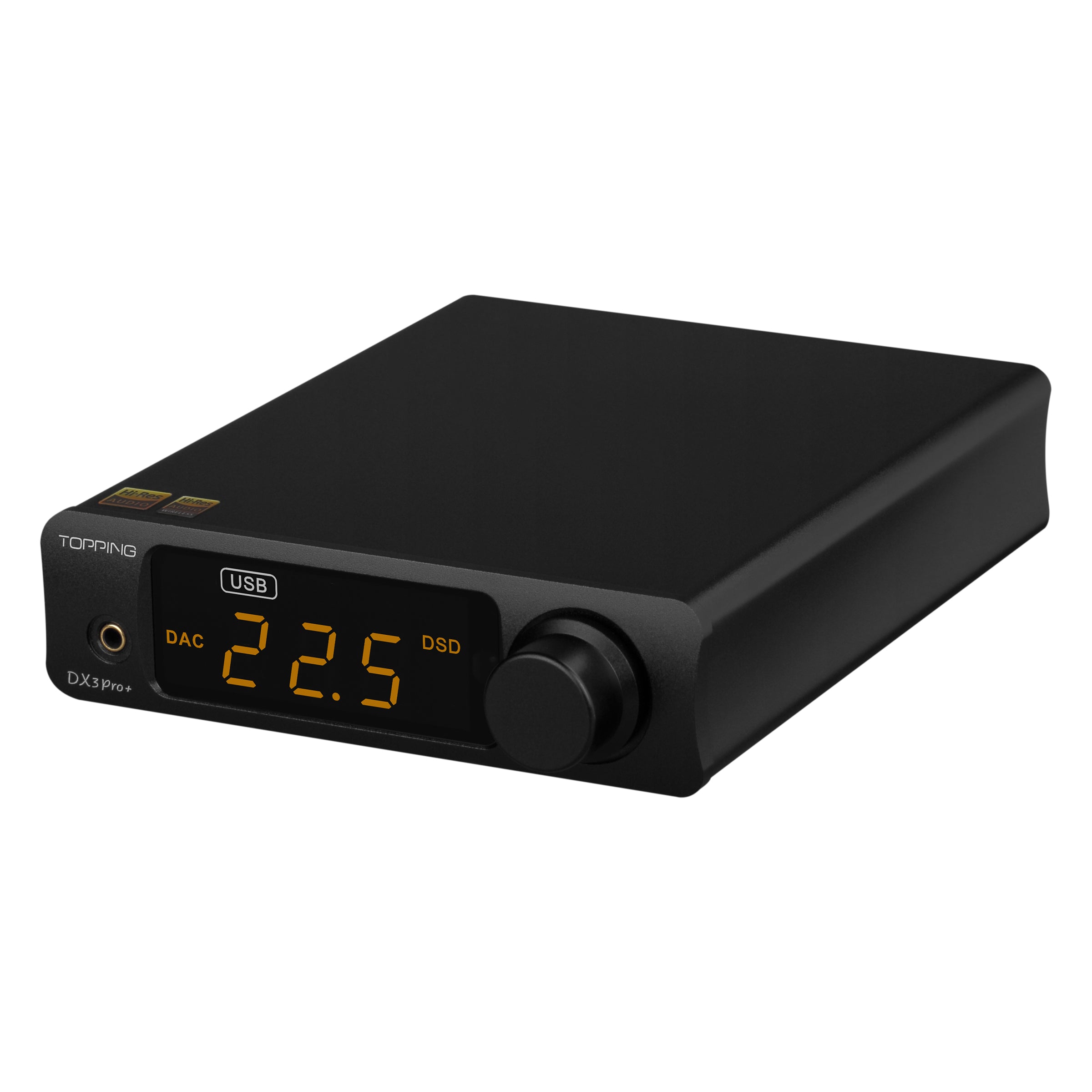
The Topping DX3 Pro+ is the purist alternative. It offers compact DAC/headphone functionality and a remote but lacks the K7's balanced headphone output, microphone input and physical tone controls. Choose Topping for a simpler music-first desk; choose Fosi for mixed music, gaming and chat use.
The FiiO K11 R2R takes the opposite tonal approach. Its resistor-ladder DAC prioritizes density and warmth, while the K7 measures cleaner through RCA and offers Bluetooth, microphone control and tone adjustment. Choose FiiO for a more organic presentation; choose Fosi for connectivity and power.
The Topping DX5 II is the higher-performance step-up at US$299. It adds substantially stronger measured performance, more output options, on-device parametric EQ and greater balanced power. The K7 remains the better value for gamers because it costs $100 less and includes the microphone path.
Value and verdict
The K7 was orderable for US$199.99 and C$279.99 on July 14, 2026. At that price, its strongest argument is not any single benchmark. It is the combination of a transparent DAC/preamp, independently confirmed 2 W balanced output, four playback inputs, hardware tone controls and microphone management in one compact chassis.
The limitations are visible rather than hidden: no app, PEQ, LDAC, HDMI, mixing, sidetone, fixed line mode, XLR output or 6.35mm socket. The young owner corpus also leaves long-term reliability less established than older competitors. Those omissions keep the K7 below the best $300 all-in-ones, but none undercuts its core desktop use case.
The Fosi Audio K7 earns 88/100 and a Highly Recommended rating. It is not the cleanest laboratory instrument or the most complete gaming interface. It is the rare affordable DAC/amp that understands those two worlds often occupy the same desk. The K7's best feature is not balanced power—it is refusing to make the buyer choose between hi-fi and everyday utility.
MyHiFi weights Technical Performance at 30%, Value at 30%, Build Quality at 25% and Versatility at 15%. The weighted composite is 88.3, rounded to 88/100, in the Highly Recommended band.
Methodology
This assessment uses three independent measurement/teardown sources, eight professional editorial sources, aggregate retailer ratings from the United States and Canada, a small firsthand community sample, manufacturer documentation and live July 2026 pricing. Several early units were reviewed during the Kickstarter period without published firmware or hardware revisions. Confidence is High for RCA performance, connectivity and current price; Moderate for headphone-load behavior; Low-to-Moderate for microphone performance and long-term reliability. MyHiFi did not perform hands-on testing.
Affiliate disclosure: MyHiFi may earn a commission from purchases made through affiliate links. This does not influence our editorial decisions or source selection.