The budget studio monitor category used to mean a 4-inch two-way with a single amp and a plastic cabinet. The Edifier MR5 arrives with a different idea: a true three-way, tri-amped pair with a hidden down-firing woofer, balanced XLR inputs, LDAC Bluetooth, and app-based room compensation, all for US$349.99.
That is an ambitious spec sheet for the price. The question is whether the acoustic execution matches the feature count, or whether the MR5 is a multimedia speaker wearing a studio monitor costume.
For US$349.99 per pair, it provides 5-inch long-throw woofers, 3.75-inch dedicated midrange drivers, 1-inch silk-dome tweeters in dimpled waveguides, 110W of summed RMS Class-D amplification, and MDF cabinets. Independent acoustic measurements confirm reasonably smooth midrange response and bass extension to approximately 51Hz, alongside upper-midrange structure around 4kHz, placement-sensitive directivity, and compression at elevated playback levels.
Scorecard
Smooth midrange with measured F3 near 51Hz, but visible response variability, a 4kHz emphasis, off-axis divergence above 2-3kHz, and compression at higher SPL
MDF cabinets with copper accents and solid construction, but rear port and side vents demand placement clearance, and no USB audio
Tri-amped three-way with XLR, TRS, RCA, LDAC Bluetooth, app EQ and room compensation for US$349.99 per pair
Five input types plus headphone out, three sound modes, 9-band EQ, and app-based acoustic tuning, but no USB, sub out, or optical
Who it is for: budget-conscious creators, home-studio beginners, and desktop listeners who want real three-way monitoring with professional connectivity and app-based tuning without paying pro-studio prices. Buyers who prioritize connectivity flexibility and nearfield clarity at moderate volumes.
Who should skip it: anyone requiring USB audio, subwoofer output, or absolute studio accuracy for critical mixing without calibration. Listeners with cramped desk setups where rear-port and side-vent clearance is impossible. Anyone expecting party-level output or room-filling sound from a compact pair.
Verified specifications
| Specification | Published or independently measured value |
|---|---|
| Architecture | Tri-amped, three-way active powered stereo pair (master/passive) |
| Drivers per pair | 5-inch down-firing woofer, 3.75-inch midrange, 1-inch silk-dome tweeter |
| Amplification | 110W RMS total (10W+10W treble, 15W+15W mid, 30W+30W bass), Class D |
| Crossover | 155Hz (bass/mid), 2600Hz (mid/treble), DSP with DRC |
| Official frequency response | 46Hz to 40kHz |
| Measured F3 | Approximately 51Hz (independent NFS measurement) |
| Max SPL | 101dB peak at 1 meter (manufacturer) |
| Inputs | Balanced XLR, balanced 1/4-inch TRS, RCA, 3.5mm AUX, Bluetooth 6.0 |
| Bluetooth codecs | LDAC (24-bit/96kHz at 990kbps), SBC |
| Headphone output | Front 3.5mm (mutes speakers on insertion) |
| Room compensation | Rear High (plus or minus 6dB above 10kHz) and Low (plus or minus 6dB at 125Hz) knobs, plus app-based Low Cut-Off, Acoustic Space, Desktop Control |
| Cabinet | MDF, rear-firing oval port plus side vents |
| Dimensions | 159 x 264 x 280mm (active), 159 x 264 x 257mm (passive) |
| Weight | 10.38kg per pair |
| Warranty | Edifier standard terms (region-specific) |
Design and build: a hidden woofer changes the equation
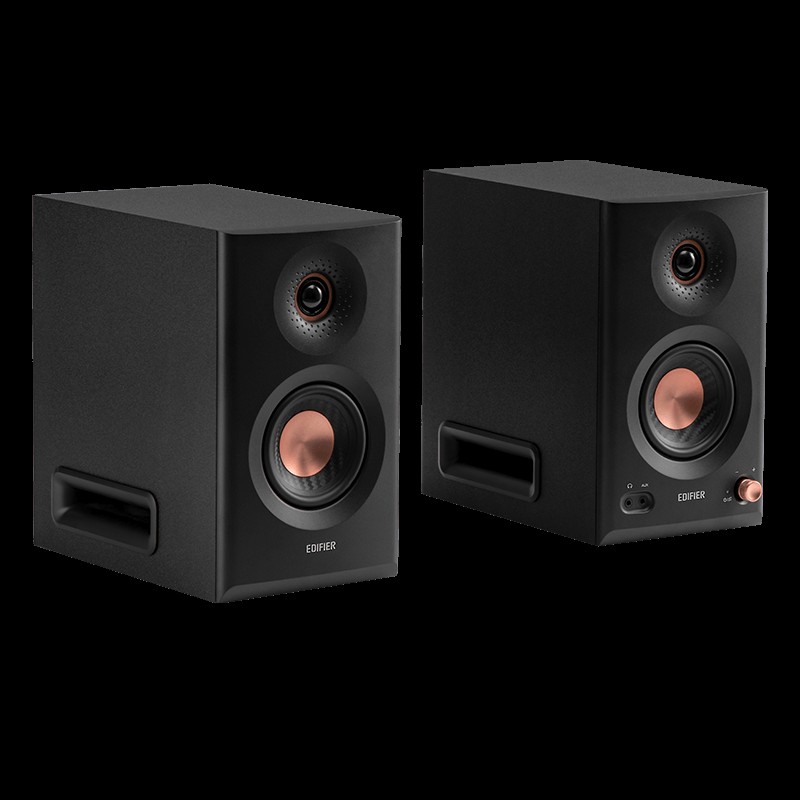
The MR5 looks conventional from the front: a tweeter above a midrange driver, both visible behind copper-accented rings. The 5-inch woofer is hidden inside the cabinet, firing downward and venting through side slits. This is an unconventional layout for a US$350 monitor and it gives the MR5 more low-end authority than its footprint suggests.
Both cabinets use MDF construction rather than plastic, which is a step up from cheaper Edifier models. The active speaker houses all electronics, inputs, and rear controls. The passive speaker connects via a 2.5-metre proprietary DIN cable. The included rubber feet keep both speakers planted without wandering.
Placement is the critical constraint. The rear-firing oval port sits directly behind the tweeter, and the side vents align with the hidden woofer. Both need breathing room. On a cramped desk pushed against a wall, the bass will thicken and the tonal balance will shift. The MR5 rewards a desk with at least 30-40cm of rear clearance and unobstructed sides.
The front panel hosts a multi-function volume knob that also controls power, sound-mode switching, and Bluetooth pairing. A headphone plug mutes the speakers. The rear panel adds two tuning knobs for High and Low frequency shelving, each with a centre detent at neutral.
Connectivity: five inputs, no USB
The MR5 covers the professional and consumer input spectrum well. Balanced XLR and TRS accept audio interface and mixer outputs. RCA and 3.5mm AUX handle consumer sources. Bluetooth 6.0 with LDAC supports high-resolution wireless streaming up to 24-bit/96kHz at 990kbps from compatible Android devices.
The conspicuous omission is USB audio. At this price, a USB-C input would have eliminated the need for a separate DAC or interface on a desktop. Its absence is not a dealbreaker for studio users who already own an interface, but it narrows the MR5's appeal for anyone who wanted a single-cable desktop solution.
There is no subwoofer output, no optical input, and no HDMI. The headphone output on the front is uncharacterized: its power, impedance, and tonal behavior are not published. Treat it as a convenience, not a dedicated amplifier replacement.
All inputs including Bluetooth can operate in parallel. The EDIFIER ConneX app unlocks the full feature set, including a 9-band custom EQ, acoustic room compensation presets, channel assignment, and firmware updates.
What the measurements mean
Independent near-field scanner testing found the on-axis and listening window responses reasonably smooth through the midrange, with more visible variability than some similarly sized competitors. The midrange is the MR5's strongest band. The dedicated 3.75-inch mid driver, freed from bass reproduction by the three-way crossover, contributes to clear vocal and instrument separation.
The measured F3 of approximately 51Hz is respectable for a cabinet this size. Usable output begins around 70-80Hz, and output below approximately 70Hz is level-limited. The bass is adequate for nearfield monitoring and most music genres, but deep electronic sub-bass and film effects need a subwoofer. Since there is no sub out, adding one requires external routing.
A noticeable upper-midrange and treble structure sits around 4kHz. Multiple professional evaluations independently identified this region. In the default Monitor mode, it reads as a slightly forward or energetic presentation rather than a hard flaw, but it is the one deviation from an otherwise steady response. The MR5 reacts well to EQ: a 3dB reduction around 2-4kHz through the app or an external mixer noticeably improves naturalness.
Off-axis response diverges above approximately 2-3kHz. Horizontal dispersion narrows through the upper midrange and treble, and vertical directivity is tight. Toe-in matters: aimed directly at the listening position, the tonal balance is more consistent. Off-axis listening introduces midrange coloration. This is a nearfield monitor, not a room-filling speaker.
Distortion is controlled at 86dB at 1 metre, with expected increases in the bass. At higher drive levels, compression becomes measurable and audible, particularly through the midbass. The MR5 is designed for moderate SPLs in nearfield or small-room use. Push it toward its 101dB peak claim and the protection circuitry limits deep bass output, shifting the perceived balance brighter.
Sound character: clear mids, energetic treble, size-relative bass
The MR5 follows a mildly U-shaped tuning in its default Monitor mode: neutral from the low mids through approximately 2.5kHz, then a rising upper-mid presence culminating in the 4kHz region. Switching to Music mode increases bass and upper treble for a more consumer-friendly V-shape. A Custom mode unlocks the 9-band EQ for user tuning.
Clarity is the strongest consensus across professional evaluations. The dedicated midrange driver separates vocals and instruments from bass duties, and the result is readable mids at sensible volumes. Guitar riffs and vocal lines stay distinct in busy mixes. Stereo imaging is a genuine strength at nearfield distance, with well-defined phantom sources.
Bass is tight and controlled for the cabinet size, reaching approximately 50Hz with reasonable authority. Tracks with substantial sub-bass content reveal the low-frequency limit: the lowest notes disappear rather than merely losing weight. At higher volumes, compression shifts the balance toward the mids and treble.
Treble is the disputed region. The 4kHz emphasis adds energy and detail retrieval, contributing to a lively character. Under normal nearfield listening, it rarely crosses into harshness. Pushing the MR5 hard with dense, complex material can introduce fatigue. At typical desktop levels, extended sessions remain comfortable.
From a distance, the balance shifts toward mids and treble. The forward-firing tweeter and mid driver work against the down-firing woofer, and the off-axis narrowing means the MR5 is not designed for far-field or off-axis listening. This is a desk monitor, not a living-room speaker.
Comparisons: MR5, MR4, and connected monitors
The Edifier MR4 is the obvious family comparison. At roughly half the price, the MR4 is a two-way design with a 4-inch woofer and simpler connectivity. The MR5's three-way architecture, deeper bass, balanced XLR, LDAC, and app-based room compensation justify the price jump for buyers who need the extra connectivity and low-end authority. Choose the MR4 for a tight desk where placement clearance is impossible, and the MR5 for a setup with room to breathe.
The ADAM Audio D3V is the measurement-grade alternative at the same US$349.99 price. It offers USB-C playback, a D-ART AMT tweeter, included tilt stands, and tighter measured response linearity. The D3V measures better and includes USB, but the MR5 counters with XLR inputs, LDAC Bluetooth, app-based EQ, a 9-band custom EQ, and a dedicated midrange driver. Choose ADAM for measurement accuracy and USB convenience, and Edifier for connectivity flexibility and tuning depth.
The Edifier M60 is the compact desktop alternative at roughly US$170. It is smaller, simpler, and excellent value, but it is a two-way design with USB-C, Bluetooth, and no balanced inputs. The MR5 is the step up for buyers who need professional connectivity, deeper bass, and three-way driver separation.
Value and verdict
The Edifier MR5 was available for US$349.99 on Amazon US and in stock on Amazon Canada on September 26, 2026. The Amazon US pool showed 368 ratings at 4.5/5, with 75% 5-star reviews and strong praise for sound quality, value, and Bluetooth connectivity.
At this price, the MR5 packs a tri-amped three-way design, MDF cabinets, balanced XLR and TRS inputs, LDAC Bluetooth 6.0, app-based room compensation with a 9-band EQ, three sound modes, and a dedicated midrange driver into a compact pair. The missing USB audio, subwoofer output, and optical input are boundaries around a focused product rather than evidence of confused design.
The measurement data places the MR5 squarely in nearfield territory. It is not a measurement benchmark, and the 4kHz emphasis, placement-sensitive directivity, and compression at elevated levels are real limitations. But the midrange clarity, bass extension to 51Hz, and unusually deep feature set for the price make it a strong value proposition for budget-conscious creators and desktop listeners who work at moderate volumes.
The Edifier MR5 earns 82/100 and a Highly Recommended rating. It is a genuinely ambitious three-way monitor that delivers more connectivity and tuning flexibility than anything else at US$350, as long as you give it room to breathe and keep the volume reasonable. The MR5 hides its biggest advantage inside the cabinet and its biggest limitation inside the port.
MyHiFi weights Technical Performance at 30%, Value at 30%, Build Quality at 25% and Versatility at 15%. The weighted composite is 82.4, rounded to 82/100, in the Highly Recommended band.
Methodology
This assessment uses one independent full acoustic measurement suite (CTA-2034 near-field scanner), six professional editorial evaluations, retailer aggregate ratings (368 US, 363 Canadian) with AI-generated dimension summaries, manufacturer documentation, and live September 2026 pricing. The measured pair was manufacturer-loaned; sample provenance for most editorial reviews was manufacturer-supplied. Individual firsthand owner review bodies were not accessible (retailer sign-in gating); the owner corpus is retailer-aggregated only. Confidence is Moderate for frequency response, directivity, price, and connectivity, and Moderate for tonal consensus and output interpretation. MyHiFi did not perform hands-on testing.
Affiliate disclosure: MyHiFi may earn a commission from purchases made through affiliate links. This does not influence our editorial decisions or source selection.