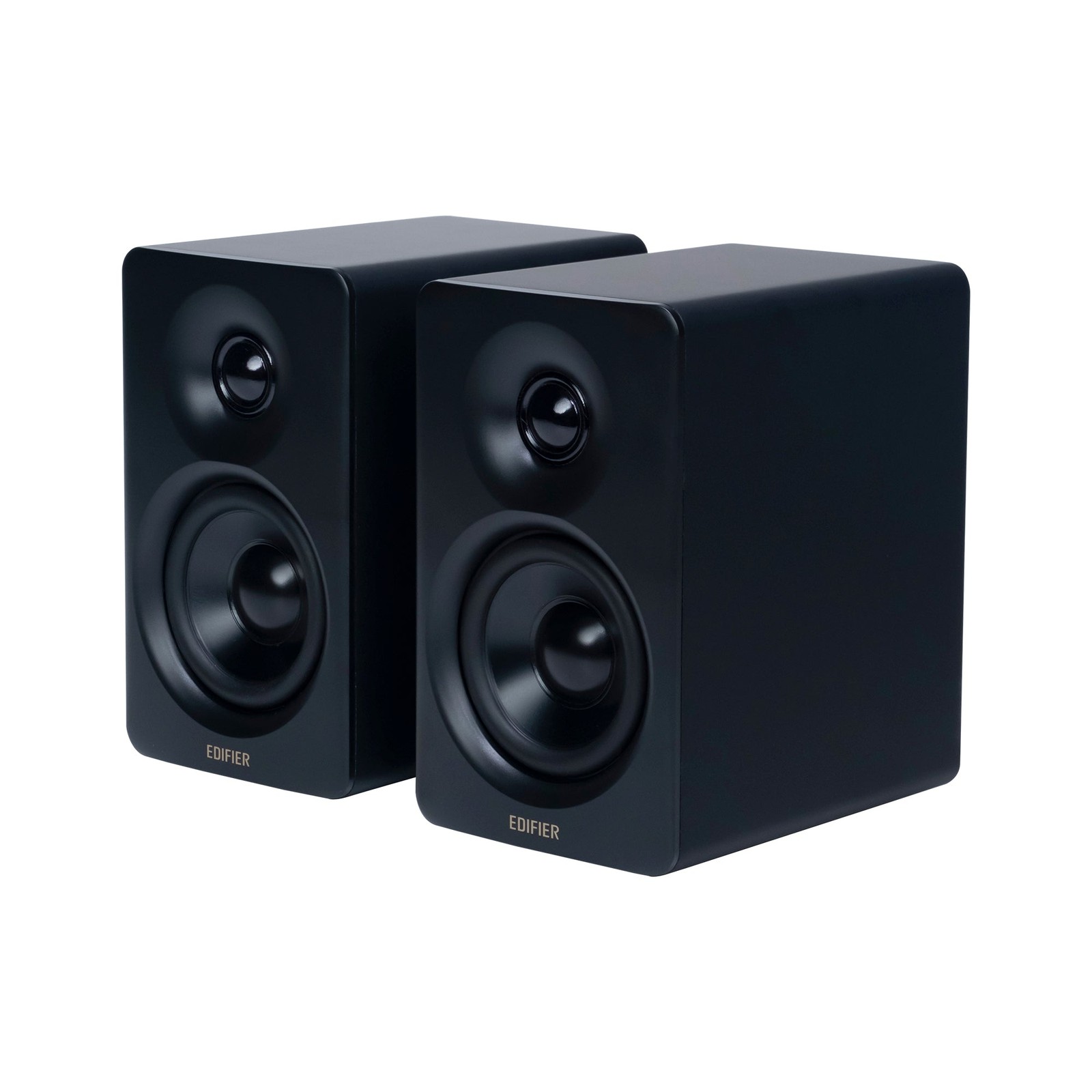
The Edifier M60 is built around a sensible promise: make a real stereo pair small enough for a crowded desk, then give it the inputs modern computers and phones actually use. Each enclosure is only 100mm wide, yet the pair includes USB-C, Bluetooth 5.3 with LDAC, a 3.5mm analog input, app control and angled aluminum stands.
That convenience does not suspend acoustics. Independent measurements show useful small-signal bass extension to approximately 67–70Hz, reasonably controlled horizontal radiation and significant compression when the three-inch drivers are pushed toward 96dB at one metre. The M60 can sound balanced, spacious and surprisingly substantial at arm's length. It is not a miniature party speaker or a substitute for a larger monitor and subwoofer.
At US$169.99 on sale or approximately C$199.99, that trade is compelling. At Edifier's regular US$199.99/C$249.99 pricing, the M60 remains competitive, though the missing subwoofer output becomes more consequential.
Scorecard
Broadly controlled nearfield response and smooth horizontal behavior; limited deep bass, vertical sensitivity and substantial high-level compression
Excellent footprint, solid cabinets and useful stands; exposed drivers, touch controls and a proprietary inter-speaker cable require compromises
Exceptional around US$170/C$200 and still persuasive at regular price given the input set and measured performance
USB-C, analog and LDAC Bluetooth cover most desks; no optical, AirPlay or subwoofer output
Who it is for: computer users who want genuine stereo separation without surrendering much desk space; apartment and home-office listeners who stay near the speakers; buyers who value USB-C and Bluetooth more than optical input or deep-bass expansion.
Who should skip it: listeners trying to fill a larger room; bass-heavy film and music fans; anyone who expects a subwoofer output, physical volume knob or long inter-speaker cable; users who need optical input from a television or console.
Verified specifications
| Specification | Published or independently measured value |
|---|---|
| System | Powered two-way desktop speaker pair |
| Drivers | 3-inch aluminum mid-low driver + 1-inch silk-dome tweeter per speaker |
| Amplifier output | 66W RMS total per pair: 15W × 2 tweeters + 18W × 2 mid-low drivers |
| Published response | 58Hz–40kHz without stated tolerance |
| Measured bass extension | Approximately 67–70Hz F3, depending on normalization |
| Inputs | USB-C, 3.5mm AUX, Bluetooth 5.3 |
| Bluetooth codecs | SBC and LDAC |
| Dimensions | 100 × 168 × 147mm per speaker |
| Stands | Included aluminum stands, 15-degree angle |
| App | Edifier ConneX |
Design and setup: made for the space beside a monitor
The M60's physical proportions are its clearest advantage. A pair occupies less horizontal space than many single powered monitors, and the 147mm cabinet depth is friendly to shallow desks. Black, white and classic-oak finishes are readily available. The clean front omits grilles, leaving the silk dome and aluminum mid-low driver exposed to fingers and dust.
Included aluminum stands tilt each cabinet upward by 15 degrees. That matters because the measured vertical response is less forgiving than the horizontal response. Aiming the tweeters toward ear height reduces the chance that a low desk will place the listener in an uneven vertical region. The stands also create useful breathing room beneath the speakers without requiring separate desktop mounts.
Power amplification is integrated into the system, and a keyed cable links the two enclosures. The cable is about 1.8 metres long. That is enough for a laptop or normal monitor, but several users with ultrawide displays found it restrictive. Because the connectors are proprietary, buying an ordinary longer speaker cable is not a simple fix.
The top panel uses proximity-lit capacitive controls for power, source and volume. It looks tidy and responded reliably in most reports, but it cannot provide the tactile certainty of a knob. Volume behavior also depends on the input: analog and USB speaker level may not track the source device in the same way Bluetooth volume does.
Connectivity and app behavior
USB-C is the most natural desktop connection. It avoids a computer's analog-output variability and provides a direct digital path without occupying the Bluetooth radio. The 3.5mm input supports turntables with an existing phono stage, monitors, controllers and older computers. Bluetooth 5.3 adds SBC and LDAC for phones and tablets.
LDAC may need to be enabled through the ConneX app rather than appearing automatically. The app also handles input selection, volume, sound profiles, custom EQ, backlight behavior, prompt tones, manuals and firmware updates. It is useful rather than essential once the system is configured.
Important omissions are optical input and subwoofer output. Optical would simplify TV and console use. The missing sub output is more limiting because the M60's own bass headroom is finite, yet there is no straightforward managed path to extend it. A sub can still be integrated upstream with the right interface or controller, but the speaker does not make that easy.
Measurements: controlled nearfield, constrained output
The independent standardized measurement package shows a generally coherent small speaker rather than an artificially impressive desktop toy. Midrange and treble remain within a reasonably compact envelope, with moderate response structure around approximately 1kHz and 3kHz and elevated upper treble on the reference axis. Horizontal radiation is comparatively smooth through the midrange before narrowing above roughly 5–6kHz.
That horizontal behavior supports a stable stereo image across a normal seated position. The vertical pattern is more restricted and asymmetric, which makes stand angle and ear height important. The M60 is not unusually fragile to small horizontal movements, but placing it flat below the listener wastes one of the included system's practical strengths.
Small-signal bass reaches an F3 around 67–70Hz. That is useful extension for a cabinet this narrow, but practical output begins closer to 80–90Hz when headroom is considered. The official 58Hz endpoint has no published tolerance and should not be interpreted as flat or high-output response to 58Hz.
At 86dB SPL and one metre, compression remains modest through most of the band, with the largest stress appearing near the bass limit. At 96dB, the picture changes: compression reaches several decibels across bass and much of the midrange, while distortion climbs sharply below roughly 70Hz. A 102dB trace is listed in the test legend but does not demonstrate usable full-band output.
The result is straightforward. At arm's length and ordinary-to-lively volume, the M60 works within its design. Ask it to create deep bass or maintain party levels at room distance and its processing and drivers begin protecting themselves.
Sound character at a desk
The tonal evidence supports clear mids, lively treble and bass that feels fuller than the enclosure dimensions suggest at normal nearfield levels. Voices and instruments remain separated rather than being buried under a broad mid-bass boost. The two physical cabinets create a more convincing stereo field than a soundbar or single Bluetooth speaker, with useful directional cues for games.
Bass descriptions appear contradictory until level and extension are separated. Several owners and reviewers heard satisfying punch and weight. A dissenting specialist found bass quantity inadequate for effects-heavy games and music. Measurements explain both experiences: the M60 can deliver useful upper-bass impact close to the listener, but deep bass and high-level low-frequency output are limited. Desk and wall reinforcement will also change subjective fullness.
Treble is clear and energetic without a recurring fatigue pattern in the available reports. Because horizontal dispersion narrows at higher frequencies and vertical position matters, the brightest reference-axis result will not describe every desk. Stand use and modest toe-in are better tools than assuming one placement is universally correct.
Stereo separation is one of the M60's strongest everyday upgrades. It will not project the depth or effortless scale of larger monitors, but it places voices and effects distinctly enough to improve music, video editing and positional gaming.
Comparisons
The Edifier R1280DB is larger, warmer and more traditionally equipped for bookshelf use. It includes optical connectivity and fills more physical space, while the M60 provides a much smaller footprint, USB-C, newer Bluetooth and cleaner desktop ergonomics. Choose the R1280DB for flexible room sources; choose the M60 for a computer desk.
The ADAM Audio D3V is the technically more ambitious monitor. Its measured response, controlled dispersion and approximately 50Hz extension are stronger, and its USB-C implementation targets accurate nearfield work. The M60 is substantially less expensive and smaller, but it reaches its distortion/compression ceiling earlier.
The Kali Audio LP-UNF offers greater output, fuller bandwidth and more credible mixing-monitor behavior. It also occupies considerably more desk space. The M60 wins when compactness and simple consumer connectivity matter more than maximum acoustic headroom.
The ELAC Debut ConneX DCB41 supplies HDMI, optical, phono and subwoofer connectivity in a larger powered bookshelf package. It is the better system hub; the M60 is the more focused and affordable computer companion.
Value and verdict
On July 16, 2026, Edifier listed the M60 at US$199.99 and C$249.99. Black units were available from Edifier's regional marketplace storefronts at US$169.99 and C$199.99. The visible Canadian pool showed 4.4/5 from 859 colour- and country-pooled ratings, while the US pool showed 4.6/5 from 1,806 colour-pooled ratings. These totals demonstrate demand, not audited owner counts.
Thirteen directly inspected verified-purchase reports were mostly positive on clarity, size, desktop output and value. One Bluetooth pairing complaint and one probable USB-C defect appeared, but no recurring reliability pattern can be established from that limited corpus.
The Edifier M60 earns 86/100 and a Highly Recommended rating. It succeeds by remaining a desktop speaker instead of pretending to be a tiny room system. The M60 uses space and money efficiently, then draws a clear line where deep bass and high output begin.
MyHiFi weights Technical Performance at 30%, Value at 30%, Build Quality at 25% and Versatility at 15%. The weighted composite is 86.05, producing an 86/100 Highly Recommended result.
Methodology
This assessment uses one full exact-model standardized acoustic measurement package, six substantial professional evaluations, 13 inspected verified-purchase reports, separate colour-pooled retailer-rating aggregates, manufacturer documentation and live July 2026 pricing. One measured sample cannot establish production variance, and most editorial samples had undisclosed acquisition terms. Confidence is High for dimensions, connectivity, measured bass extension, directivity and high-level compression; Moderate for ordinary nearfield tonal character, controls and value; Low-to-Moderate for long-term reliability, latency, idle noise and input-path differences. MyHiFi did not perform hands-on testing.
Affiliate disclosure: MyHiFi may earn a commission from purchases made through affiliate links. This does not influence our editorial decisions or source selection.